
No more rule of thumb: precision without borders
Crossing borders, shaping materials – personal insights into a German–Dutch research partnership
A tiny defect can determine whether a device performs or fails. Researchers from Twente and Jülich show how precision, and cross-border collaboration, are powering the technologies of tomorrow. With precision, heart and a touch of humour.
Rough and ready or highly precise – how exact should we really be in life? In everyday situations, we often allow ourselves some leeway: an extra slice of cake, or turning up a few minutes late. A touch of leniency usually carries little consequence. But in materials science, precision makes all the difference. Here, a tiny defect in the crystal lattice can determine whether a energy device lasts longer or a chip runs faster.
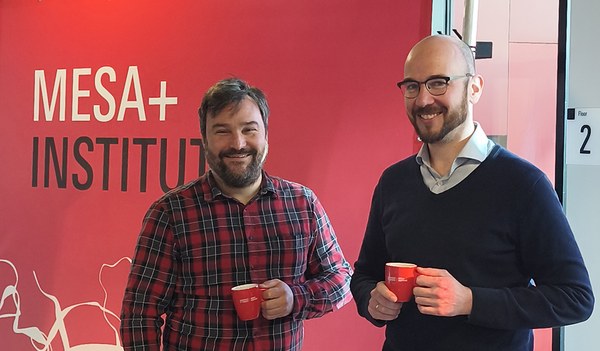
In such a high-precision field, only the brightest minds and the best expertise will do. That is why the University of Twente and Forschungszentrum Jülich have joined forces: to develop and understand materials so precisely that they can unlock the technologies of tomorrow. Although based at different home institutions, Felix Gunkel at Forschungszentrum Jülich (PGI-7) and Chris Baeumer at the University of Twente (MESA+/IMS), both researchers are affiliated with both institutions and work closely together to drive this collaboration forward.
Close Neighbours, Closer Collaboration
Although Jülich lies only a stone’s throw from the Dutch border, geographical proximity is no substitute for actively nurturing collaboration. For more than a decade, the University of Twente and Forschungszentrum Jülich have been working together across national borders. For Felix Gunkel, this partnership began with a very personal moment: “I gave my very first scientific presentation at the University of Twente,” he recalls. “That made a real impression on me.” Since then, the cooperation has flourished, marked by joint projects, co-supervised PhDs, and regular visits to each other’s laboratories.
Together, scientists from both institutions focus on thin, functional material layers known as oxide films. These inconspicuous structures underpin future technologies – from powerful batteries and efficient energy storage to cutting-edge microchips.
“With its deep expertise and state-of-the-art facilities for studying materials on the atomic scale, research in Jülich forms the perfect complement to the work in Twente on defects in ferroelectric semiconductors, superconductors, and functional oxides.” – Chris Baeumer
Science without Borders
Chris Baeumer sums up the collaboration as a genuine intertwining of expertise: “Research in Jülich is distinguished by its deep knowledge and state-of-the-art facilities for probing materials at the atomic scale,” he explains. This perfectly complements the work in Twente “on the role of defects in ferroelectric semiconductors, superconductors and functional oxides.”
Felix Gunkel adds: “Together we can design materials so precisely that we can almost eliminate imperfections. That is crucial, because the success of a technology often depends on exactly these tiniest details.”
A Strengthened Partnership
This long-standing collaboration has been further consolidated this year with a renewed agreement, reaffirming both institutions’ commitment to deepen their ties: more jointly supervised Master’s and PhD students, regular researcher exchanges, and new initiatives in fields such as energy, electronics and climate research.
“We are not just building materials for the future. We are creating a shared research culture across national borders.” – Felix Gunkel
A Culture of Openness
One visible sign of this partnership is the Joint Jülich–Twente Summit which will take place for the fourth time next springNext year, the University of Twente will host the conference, which alternates between Jülich and Twente, organized by a team of young researchers led my Marie Alix Pizzoccaro-Zilamy, Assistant Professor at Twente University and BMBF-group leader at IMD-2 in Jülich. “It’s wonderful,” says Marie, “the summit brings together researchers, students and partners across various research fields e.” When they gather in Enschede next July, the focus will be on energy, information, simulation and climate research – sparking new ideas, fostering collaborations and strengthening the role of joint research in shaping Europe’s future.
The summit is not the only example: the daily collaboration between Jülich and Twente also thrives on a special culture of openness. As Felix puts it: “There is an open, curious atmosphere. Students are engaged, researchers are approachable, and collaboration is really valued.” With a smile, he adds: “And of course, you never forget the one-cent coffee at the department.”
The partnership between Twente and Jülich shows clearly that science knows no borders. It thrives on openness, mutual trust – and, occasionally, on a good cup of coffee. Or, in Felix Gunkel’s words: “Great opportunities often begin with small conversations.”
The full interview with Felix Gunkel and Chris Baeumer is available on the University of Twente website: https://www.utwente.nl/en/tnw/news/2025/5/307422/smart-materials-without-borders-how-twente-and-julich-are-building-the-technology-of-the-future
Further information: https://www.utwente.nl/en/juelichtwente-summit/