
Solid Oxide Cell Stacks for Power-to-X Value Chain Demonstration and Transfer
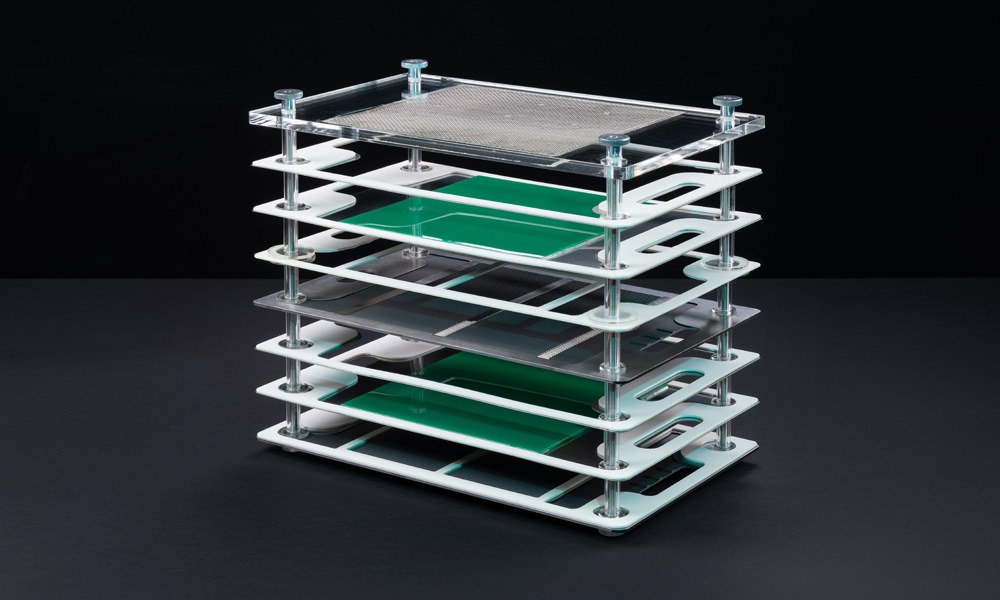
High-temperature electrolysis and fuel cells based on solid oxide cells (SOC) are key technologies for sector coupling thanks to their high efficiency and integration potential with industrial processes. The performance of Jülich H20 stacks has been widely proven in lab demonstrators. Currently, three Power-to-X value chain demonstrators are being built in Jülich based on this technology. Furthermore, Jülich researchers are building an SOC stack production network together with regional companies to drive structural transformation in the Rhenish Mining Area.
High-temperature electrolysis and fuel cells offer a key technology for the global energy transformation, driving sector coupling and circular carbon economies. In the Rhenish mining area, they hold the potential to accelerate the structural transition from lignite to a sustainable, climate-neutral industry. Funded by the Federal Ministry of Research, Development and Space, the PHOENIX – Launch Space Power-to-X project advances this shift by developing three Power-to-X value chain demonstrators based on solid oxide cell (SOC) technology to pioneer scalable sustainable solutions (www.phoenix-p2x.de).
These three targeted SOC application areas include:
- the “Future fuels value chain” for the defossilization of the fuel sector through biogas utilization,
- the “Circular base chemicals value chain” to produce basic chemicals from point sources of CO₂ and industrial wastewater, and
- the value chain for the “Decarbonization of regional heat and electricity supply” using reversible SOC technology.
As an outcome of the intensive involvement of Forschungszentrum Jülich in SOC research for more than three decades, the Jülich H20 stack design, dedicated to stationary applications, has shown robust thermomechanical behavior, high production repeatability, and superior system efficiency in both fuel cell and electrolysis modes in mini-plant level experiments at relevant scales up to 50 kW electrolysis power input. Each PHOENIX demonstrator utilizes four H20 stacks, using a total of 320 cells from Elcogen.
In parallel with the rising interest in solid oxide cell technology globally, the demand for H20 stacks has also strongly increased. Therefore, the production of H20 stacks is currently being transferred to a production network (www.soc-stack-production.de) together with regional companies. The partners of the “SOC production Alliance Jülich” are Schiffer Metall- & Vakuumtechnik GmbH for manufacturing, stack assembly, and coordination, EUROMAT GmbH for the coating of functional ceramic layers, WZR ceramic solutions GmbH for powder production, joining materials, and screen printing of sealant green foils, and AIXcellSYS GmbH in the Herzogenrath Technology Park for stack joining and end-of-line testing. Forschungszentrum Jülich is also part of this network, enabling technology transfer and providing scientific support.
Contact

Dr. Dominik Schäfer
Teamleiter Elektrochemische Messtechnik
- Institute of Energy Technologies (IET)
- Fundamental Electrochemistry (IET-1)
Room 24b

Dr. Steffen Dirkes
Acting Group Lead System Research
- Institute of Energy Technologies (IET)
- Fundamental Electrochemistry (IET-1)
Room 28

Dr. Remzi Can Samsun
Department Head Electrochemical Process and System Technology
- Institute of Energy Technologies (IET)
- Fundamental Electrochemistry (IET-1)
Room 3009

- Institute of Technology and Engineering (ITE)
Room 4014