
Instance Segmentation of Dislocations in TEM Images
Dislocations are line defects in crystal structures that influence how materials deform, strengthen, and eventually fail. Understanding their presence, distribution, and orientation is essential for linking microstructure to mechanical behavior. While advanced imaging techniques like Electron Channeling Contrast Imaging (ECCI) allow dislocations to be observed non-destructively in bulk samples, extracting quantitative information from these images remains a major challenge.
Traditionally, ECCI image analysis has relied on manual tracing, which is time-consuming, subjective, and difficult to scale. To overcome this, we developed a fully automated approach that combines deep learning-based segmentation with crystallographic analysis to detect, classify, and quantify dislocations from ECCI micrographs.
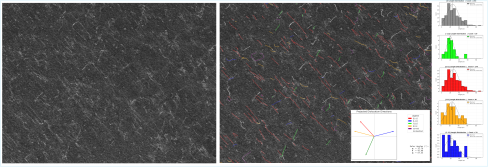
We use a YOLO-based instance segmentation model, initially trained on contrast-inverted Transmission Electron Microscopy (TEM) dislocation images and later fine-tuned on annotated ECCI micrographs. The model segments individual dislocation traces across large image areas. To ensure consistent performance across varying contrast and noise conditions, the inference is performed on overlapping image tiles. Following segmentation, we apply a postprocessing pipeline that includes skeletonization and bridging of fragmented segments to improve the continuity and completeness of the detected dislocation lines.
Once dislocations are identified, we use the sample's crystallographic orientation (Euler angles) to determine how standard face-centered cubic (FCC) slip directions—[111], [-111], [1-11], and [11-1]—project into the 2D image plane. Each detected dislocation is automatically assigned to one of these slip directions based on its measured orientation. Structures that do not match any slip direction or exhibit excessive curvature are labeled accordingly as “curved” or “unclassified.”
The result is a fully labeled image showing the distribution of dislocations by type. Beyond visualization, the system produces statistical outputs such as the total dislocation count, average lengths, and length distributions for each class. This makes it possible to quantitatively compare different microstructures or processing conditions without manual effort.
This work is carried out in collaboration with the Karlsruhe Institute of Technology (KIT) and aims to accelerate dislocation analysis in microstructural studies. The ability to rapidly extract consistent, reproducible statistics from complex images opens the door to more data-driven approaches in alloy design, deformation analysis, and mechanical characterization.
Related Publications:
- K. Ruzaeva, K. Govind, M. Legros, S. Sandfeld, "Instance Segmentation of Dislocations in TEM Images", 2023 IEEE 23rd International Conference on Nanotechnology (NANO), Jeju City, Korea, Republic of, 2023, pp. 1-6, doi: 10.1109/NANO58406.2023.10231169.
Contact:
Dr.-Ing. Bashir Kazimi
Tel.: +49 241/927803-38
E-mail: b.kazimi@fz-juelich.de