
Semantic Segmentation of Nanoparticles in HRTEM Images
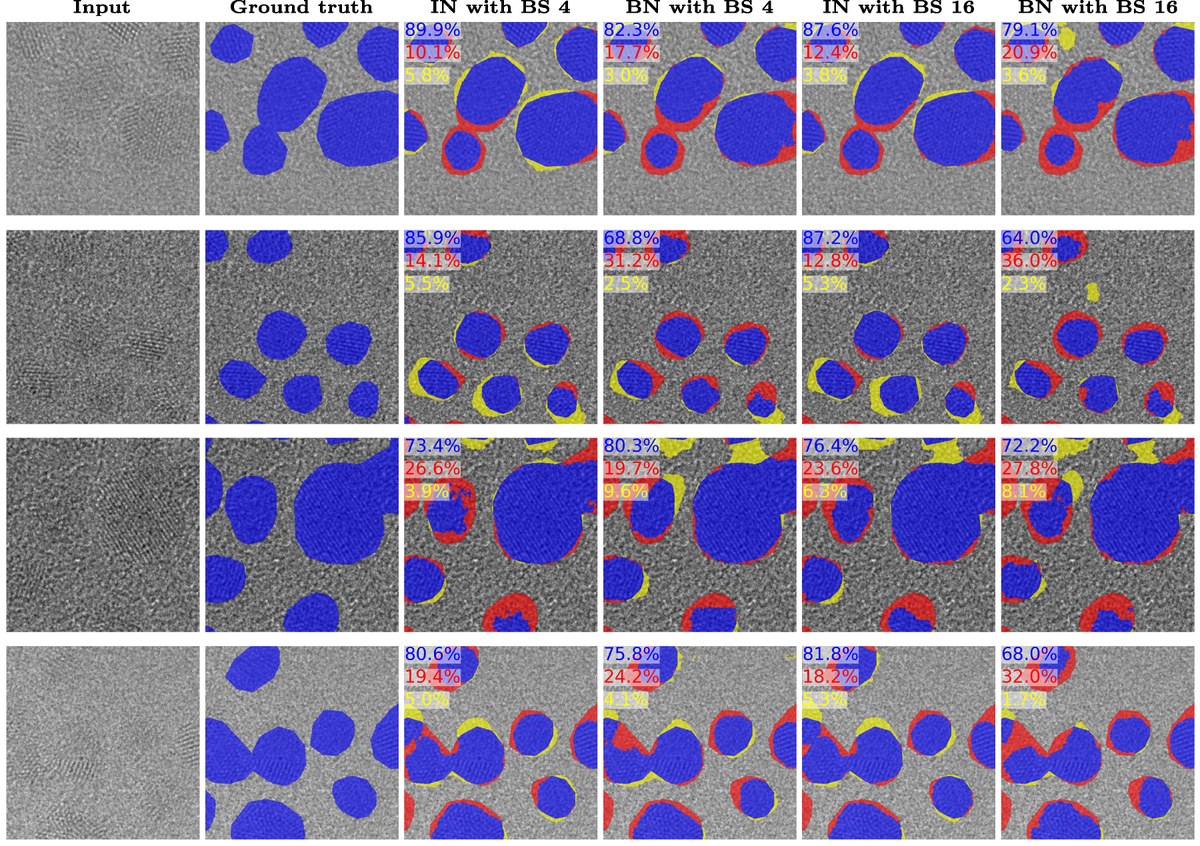
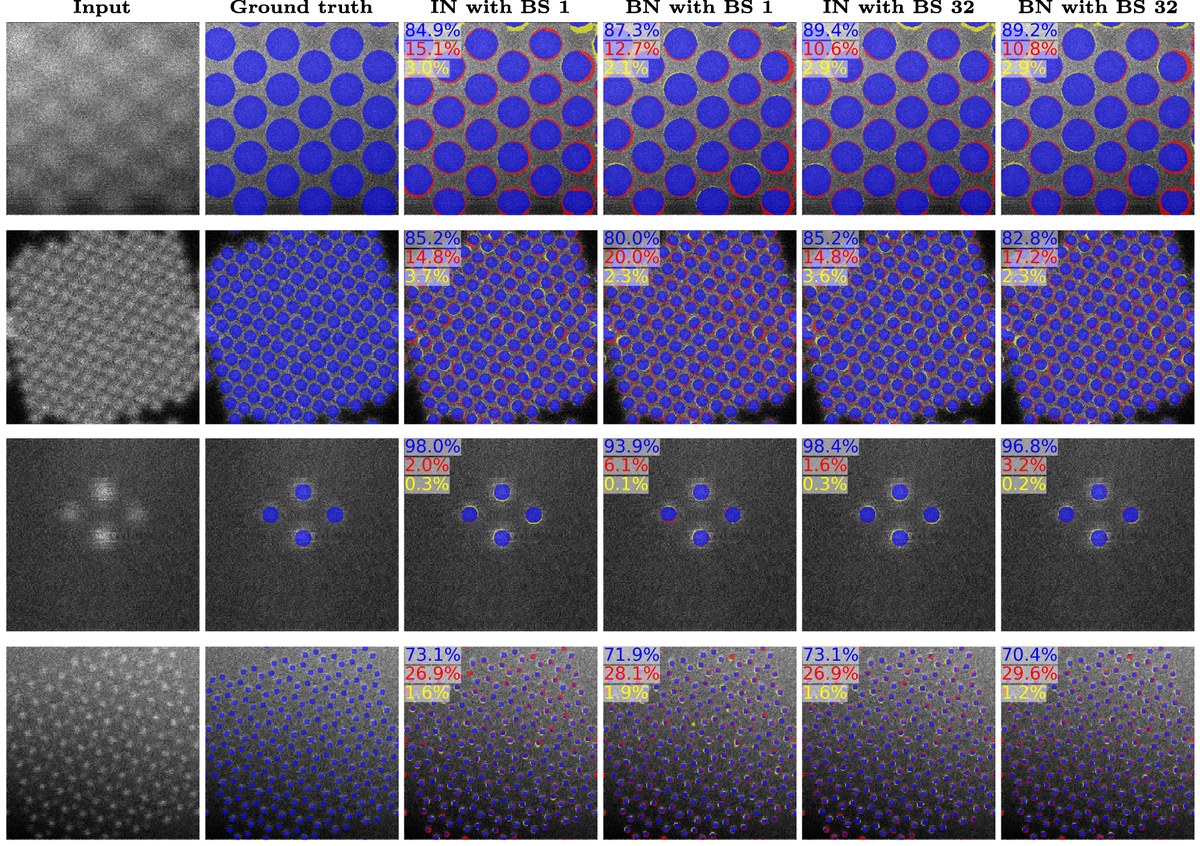
This research focuses on improving semantic segmentation in high-resolution transmission electron microscopy (HRTEM) images, a crucial step toward automated quantitative analysis of nanostructures. The project investigates how normalization techniques, e.g., Batch Normalization (BN) and Instance Normalization (IN), influence the performance of deep learning models such as U-Net and ResNet in accurately identifying and segmenting nanoparticles. Using large-scale datasets including HRTEM Au nanoparticles (Sytwu et al., 2022) and TEMImageNet (Lin et al., 2021), the study systematically compares the two normalization strategies under varying batch sizes to assess their effect on segmentation accuracy and stability.
Our findings reveal that Instance Normalization consistently outperforms Batch Normalization, achieving higher Dice and Intersection-over-Union (IoU) scores across architectures and datasets. IN’s instance-specific feature scaling enables models to better handle the variability inherent in TEM images, arising from noise, contrast fluctuations, and differing acquisition conditions, leading to more robust and generalizable performance even with small batch sizes. By contrast, BN exhibits greater sensitivity to batch statistics, requiring larger batches for stable convergence.
This work highlights the critical role of architectural design choices in optimizing deep learning workflows for electron microscopy. By demonstrating that Instance Normalization enhances segmentation accuracy, stability, and efficiency, the project contributes to building more reliable AI pipelines for automated nanoparticle analysis, microstructural quantification, and data-driven materials characterization in TEM.
Related Publications:
- Bashir Kazimi, Stefan Sandfeld, "Enhancing Semantic Segmentation in High-Resolution TEM Images: A Comparative Study of Batch Normalization and Instance Normalization", Microscopy and Microanalysis, Volume 31, Issue 1, February 2025, ozae093, https://doi.org/10.1093/mam/ozae093
Contact:
Dr.-Ing. Bashir Kazimi
Tel.: +49 241/927803-38
E-mail: b.kazimi@fz-juelich.de