
Two Coexisting Pathways to Volatility in Valence-Change Memory Devices
First published: 24 August 2026
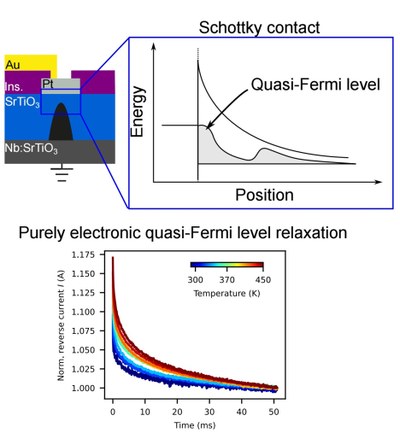
Volatile VCM-type memristive devices exhibit current relaxation after resistive switching, but its microscopic origin remains debated. Using pulsed measurements and a new Tunnel-DLTS approach on Pt/SrTiO₃/Nb:SrTiO₃ devices, we show that post-SET volatility is predominantly ionic, while electronic contributions — arising from quasi-Fermi-level relaxation at oxygen-vacancy–related defects — emerge selectively under reverse bias and within specific temperature ranges.
Journal: Advanced Functional Materials e77515 (early view)
Authors: Johannes Hellwig, Clemens Wittberg, Dimitrios Spithouris, Regina Dittmann
DOI: https://doi.org/10.1002/adfm.77515
Funding:
European Union's Horizon 2020 Marie Skłodowska-Curie Innovative Training Network MANIC (grant No. 861153)
DFG Project MemTDE, project number 441959088, as part of the DFG Priority Program SPP 2262 MemrisTec, project number 422738993
DFG Collaborative Research Center TRR 404 (grant no. 528378584)
Gobierno de Aragón (grant no. E13_23R)
Contacts

Dimitrios Spithouris
Doctoral researcher
- Peter Grünberg Institut (PGI)
- Elektronische Materialien (PGI-7)
Gebäude 04.6 /
Raum 47
Raum 47
+49 2461/61-6302
E-Mail

Prof. Dr. Regina Dittmann
Director Electronic Materials (PGI-7)
- Peter Grünberg Institut (PGI)
- Elektronische Materialien (PGI-7)
Gebäude 04.6 /
Raum 49b
Raum 49b
+49 2461/61-4760
E-Mail
Letzte Änderung: 04.09.2026