
Denoising, Background Removal and Super-Resolution in TEM Images
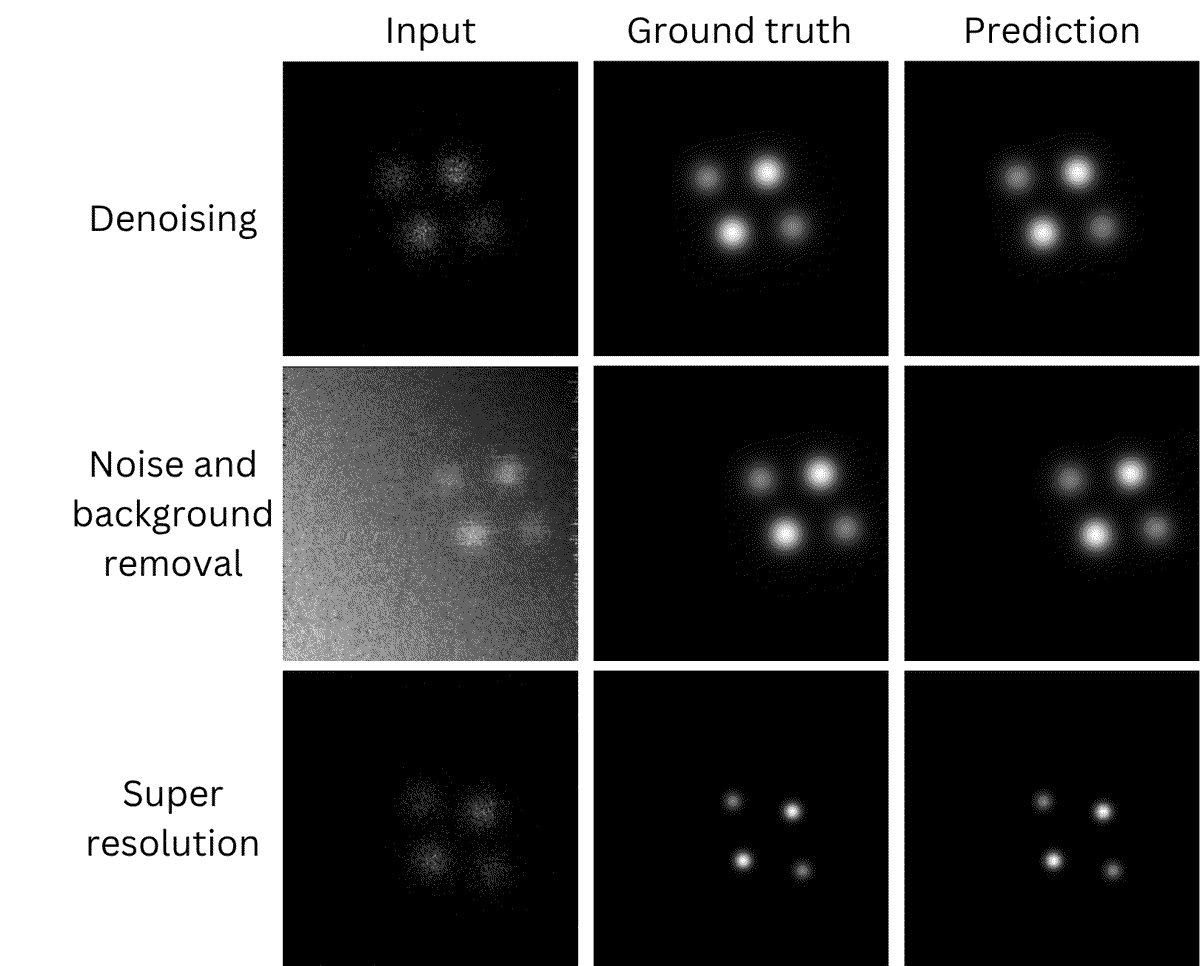
This project investigates how deep neural networks can enhance the quality of transmission electron microscopy (TEM) images through denoising, background removal, and super-resolution. Using convolutional architectures such as U-Net, and HRNet, we first trained models from random weight initializations to learn direct mappings between noisy and clean images, or low- and high-resolution pairs. These experiments form the foundation for understanding how networks capture structural information and texture fidelity in electron microscopy without prior pretraining.
Our results demonstrate that even randomly initialized models can significantly suppress shot noise, remove carbon-film background artifacts, and enhance fine-grained structural details in TEM images. Using the TEMImageNet dataset (Lin et al., 2021), the models achieved substantial improvements in both visual quality and quantitative metrics. However, while these models perform well on in-domain data, their generalization across different microscopes and materials is limited, highlighting the need for pretraining strategies to learn more transferable representations.
These findings established a baseline for our work on GAN-based self-supervised pretraining, where pretrained generators learned structure-preserving features from unlabeled TEM data. The transition from random initialization to self-supervised pretraining significantly enhanced performance and generalization across denoising, background removal, and super-resolution tasks, paving the way toward robust, automated image enhancement pipelines for materials characterization.
Contact:
Dr.-Ing. Bashir Kazimi
Tel.: +49 241/927803-38
E-mail: b.kazimi@fz-juelich.de