Secondary Phases
About
Deep geological repositories for high-level radioactive waste are inherently complex, multiphase systems, consisting of the three main components (1) waste form, (2) engineered barrier system and (3) host rock. Geochemical gradients are likely to develop, particularly at the interfaces between the various components of the engineered barrier system (EBS) and between EBS and host rock. Depending on the host rock and repository design, the EBS may include components such as the waste package, backfill materials, and a concrete liner. When exposed to water, the geochemical conditions are largely influenced by the corrosion of metal components and the groundwater chemistry of the host rock. The corrosion and alteration of the waste form and the EBS result in the formation of new, secondary phases.
For future safety assessments of deep geological repositories, it is important to consider these secondary phases in order to create more realistic scenarios and avoid overly conservative assumptions regarding radionuclide mobility. Radionuclide retention can occur through various mechanisms, including adsorption, structural incorporation, the formation of solid solutions, or the precipitation of pure radionuclide phases.
Research Topics
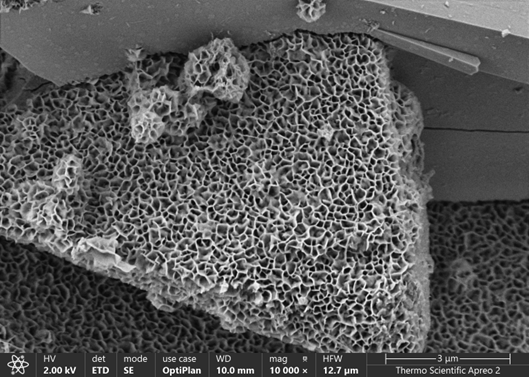
Our research focuses on both experimental and theoretical studies of the different mechanisms of radionuclide retention by secondary phase formation, e.g. via solid solution-aqueous solution systems or as a result of waste form corrosion and re-precipitation processes. We investigate the mechanisms of radionuclide uptake using high-resolution electron microscopy in collaboration with Ernst-Ruska-Centre for electron microscopy (ER-C), as well as theoretical atomistic and thermodynamic modeling at the Jülich supercomputing facilities