The Reactor Safety Division develops scientific methods to address safety issues related to nuclear power plants currently in operation or under planning in Europe. In addition to examining currently operating plants (water-cooled pressurized water reactors), the focus is increasingly shifting to so-called small modular reactors (SMRs), which have been gaining global significance in recent years and are being planned for various new construction projects in neighboring European countries. The expansion of our scientific expertise in accident phenomenology, as well as the development and application of simulation tools, is carried out in close interaction with experimental research and model development and is integrated into international networks and collaborations.
Our work focuses on processes and phenomena within the containment that are critical to the consequences of a reactor accident. In the Thermal-Fluid Dynamics and System Analysis team, we develop computational methods that enable us to simulate the progression of a severe accident. This allows us, for example, to assess whether the safety measures in place are sufficient. To validate the submodels used in this process, the Hydrogen and Aerosol Behavior team conducts experiments that enable the validation of the developed models. Specifically, the experimental facilities—some of which are large-scale—are used to investigate the behavior of aerosols, wall condensation phenomena, and the operational behavior of catalytic recombiners under boundary conditions that have not yet been considered.
The work is divided among two teams, each with a different focus:
Hydrogen and Aerosol Behavior
In the In the Hydrogen and Aerosol Behavior team, we investigate processes within the containment vessel that play a critical role in the progression of postulated severe accidents in light-water reactors. For example, while accident-induced hydrogen release can cause explosions and thereby jeopardize the integrity of the containment vessel, the aerosols generated during an accident serve as the primary carriers of radioactivity. Therefore, experiments on hydrogen recombination and aerosol behavior are the focus of our large-scale test facilities. Using the experimental data, we expand our fundamental understanding of the processes occurring during accidents and develop numerical models for accident simulations.
Thermal-Fluid Dynamics and System Analysis
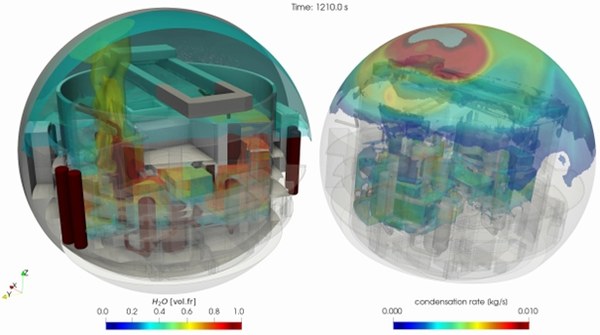
The Thermal-Fluid Dynamics and System Analysis team focuses on the simulation of three-dimensional flow and transport processes. In the field of nuclear engineering, the team specifically investigates thermohydraulics and hydrogen distribution within the containment vessel, as well as the effectiveness of passive safety systems, with the aim of making more reliable assessments of the progression and consequences of an accident. Model development focuses on the physical phenomena of “buoyancy flows” and “wall condensation,” as well as the modeling of the operational behavior of catalytic recombiners. The simulation models are available as an open-source add-on to OpenFOAM®.
- Institute of Fusion Energy and Nuclear Waste Management (IFN)
- Nuclear Waste Management (IFN-2)