
EU Project Greenspeed Successfully Completed
More sustainable battery cell production advanced
03 March 2026 – The European research project greenSPEED, in which Helmholtz Institute Münster (HI MS) at Forschungszentrum Jülich was also involved, has been successfully completed. The aim of the project was to develop more sustainable manufacturing processes for lithium-ion battery cells, reduce energy consumption in production, and completely eliminate emissions of environmentally critical solvents. The project ran from July 2022 to December 2025 as part of Horizon Europe and had a total budget of around 5.3 million euros.
Focus on Sustainable Production
The manufacture of today's battery cells remains energy-intensive and often uses organic solvents that can release volatile organic compounds (VOCs). greenSPEED addressed this issue by developing new electrode and cell manufacturing processes with significantly reduced energy requirements, a lower carbon footprint, and VOC-free production.
The key results include:
Dry electrode manufacturing: New dry coating processes enable electrode production without conventional slurry processes and energy-intensive drying steps. Initial scalable roll-to-roll demonstrations on a pilot scale have been successfully implemented.
- New material concepts: Ni-rich cathodes have been optimised for dry manufacturing processes. Progress has also been made in silicon-rich anodes and in processes for the direct deposition of silicon on current collectors.
- Electrochemical pre-lithiation: Pre-lithiation of the anode can significantly shorten the energy- and time-intensive formation step after cell production, which reduces production costs.
- Digitalisation: Digital twins, artificial intelligence and simulation-based methods helped to optimise production parameters more quickly and shorten development cycles.
- Sustainability assessment: Model calculations show significant savings in energy consumption, CO₂ emissions and production costs compared to conventional processes.
Contribution of Helmholtz Institute Münster
Helmholtz Institute Münster was the core scientific partner in the consortium and led the work package on anode processing. The team coordinated the work of the partners within the work package, organised consultations and reported progress directly to the EU project sponsor.
At the same time, the institute conducted its own experimental research, particularly into the electrochemical pre-lithiation of silicon-based anodes. This involved the use of a pre-lithiation facility in Jülich that is unique in Europe and enables both continuous roll-to-roll processes and flexible test campaigns.
Through this work, the institute made a significant contribution to achieving the scientific and technological goals of anode development and further developing the results towards industrial application.
European Cooperation Along the Value Chain
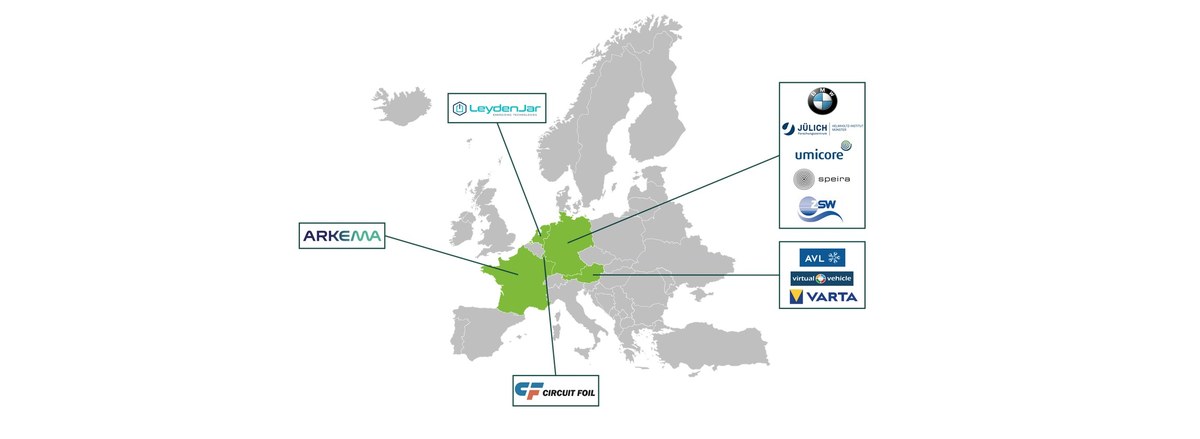
The greenSPEED consortium brought together small to large industrial companies and research institutions from five European countries, including BMW, Umicore, Arkema, AVL List, VARTA, LeydenJar Technologies and the Center for Solar Energy and Hydrogen Research Baden-Württemberg (ZSW). The project was coordinated by Virtual Vehicle Research GmbH.
Close cooperation along the entire research and development chain – from material development and process design to cell validation – enabled system-oriented research and rapid feedback loops. greenSPEED is thus making an important contribution to strengthening European battery manufacturing and developing climate-friendly production processes for future gigafactories.
Further information on greenSPEED can be found here.

Acknowledgement & Disclaimer:
Funded by the European Union. Views and opinions expressed are however those of the author(s) only and do not necessarily reflect those of the European Union or CINEA. Neither the European Union nor the granting authority can be held responsible for them.