
Safe.SIB – Development of a Safe and Durable Sodium-Ion Battery for Stationary Energy Storage
The Safe.SIB project aims to develop a new generation of safe, durable and cost-effective sodium-ion batteries – an important step towards sustainable energy storage solutions from North Rhine-Westphalia.
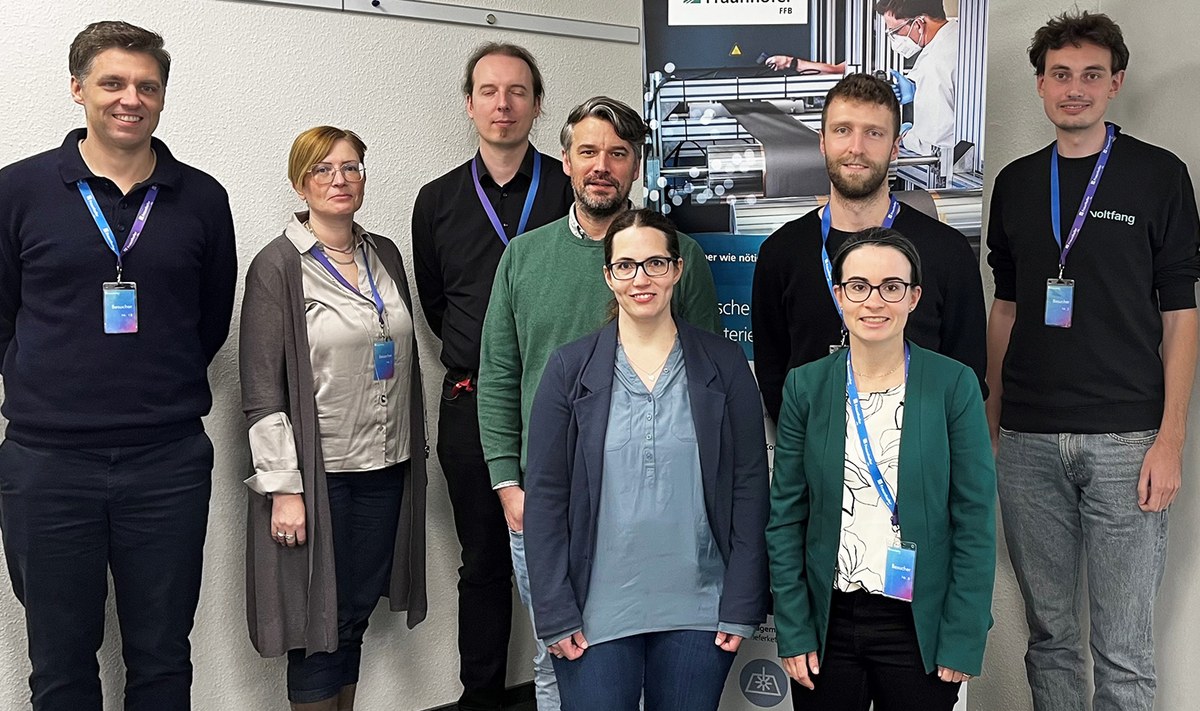
16 December 2025 – As part of the Energie.IN.NRW innovation competition, researchers at Helmholtz Institute Münster (HI MS) at Forschungszentrum Jülich are working with partners from Fraunhofer FFB, Fraunhofer ICT, MANUGY GmbH, and Voltabox AG to develop a safe and durable sodium-ion battery for stationary energy storage applications. The Safe.SIB project, which is scheduled to run to December 2028, aims to establish a sustainable and economically attractive battery technology that actively supports the energy transition in North Rhine-Westphalia while strengthening regional innovation.
Sustainable Battery Technology With a Focus on Safety
Within Safe.SIB, a sodium-ion-based energy storage system is being designed and constructed for private applications. As particularly strict safety requirements apply here, the project focuses on developing safety-optimised cell chemistry – without compromising on cyclic and calendar life. The aim is to create a battery that meets the high demands of efficiency and stability as well as fire protection and operational safety.
Sodium-ion batteries are considered a forward-looking addition to lithium-ion systems. They are based on abundantly available raw materials, avoid critical materials such as cobalt or nickel, and thus enable cost-efficient and environmentally friendly energy storage solutions.
Electrolyte Development at Helmholtz Institute Münster
As part of Safe.SIB, Helmholtz Institute Münster is developing a non-flammable, non-aqueous liquid electrolyte formulation that is optimally compatible with the anode and cathode materials defined in the project.
To this end, the researchers are specifically varying the concentration of the conductive salt, the composition of the solvent mixture (binary or ternary) and the proportion of the individual components. In addition, suitable film-forming additives are used to stabilise the SEI (solid electrolyte interphase) and CEI (cathode electrolyte interphase), supplemented by flame-retardant functional additives to increase system safety.
The aim is to develop an electrolyte formulation with high ionic conductivity and a broad electrochemical stability window that is also non-flammable. To verify suitability for further use in SIB cells, material-specific analyses and compatibility tests are being carried out at Helmholtz Institute Münster. The identified optimal electrolyte formulations are then made available to the project partners for characterisation and validation in small and large-format pouch cells.
From Material Design to Demonstrator
As the project progresses, Fraunhofer FFB and MANUGY GmbH will take over the scaling of electrode production and the development of adapted cell production. Fraunhofer ICT will carry out comprehensive safety and stress tests on the manufactured cells, while Voltabox AG will be responsible for integrating the large-format cells into a functional energy storage demonstrator.
This close collaboration between research institutions, industry partners and technology start-ups creates a continuous development chain in Safe.SIB, from basic research and cell production to system integration.
Cooperation for Sustainable Energy Storage From North Rhine-Westphalia
With a total volume of €2.18 million and planned funding of €1.88 million, Safe.SIB exemplifies North Rhine-Westphalia's innovative strength in the field of sustainable energy storage technologies. The project combines scientific excellence and industrial implementation expertise to develop safe, durable and environmentally friendly battery technology – an important contribution to the energy future from North Rhine-Westphalia.
Coordination

Dr. Isidora Cekic-Laskovic
Research Group Leader "Interfaces and Interphases"
- Institute of Energy Materials and Devices (IMD)
- Helmholtz Institute Münster: Ionics in Energy Storage (IMD-4 / HI MS)
Room E.100.066.1