
High throughput microscopy
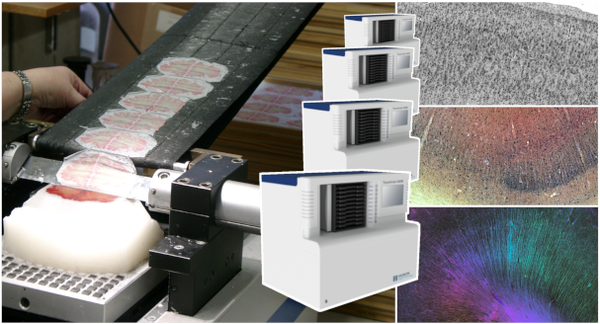
We develop data management solutions for large image datasets generated by high-throughput microscopy to enable efficient and reproducible digitization of the human brain. Such data form the basis for high-resolution 3D models of brain structure at the cellular level and represent key resources for modern neuroinformatics.
Modern whole-slide scanners enable the high-resolution digitization of complete histological tissue sections at very high throughput. As a result, our institute generates several terabytes of image data daily from various microscopy systems. To efficiently process this continuous data stream, we develop distributed data management workflows that:
- enable reliable and automated transfer of image data from the laboratory to the storage systems of the Jülich Supercomputing Centre,
- perform automated quality control and image analyses on parallel high-performance computers,
- and provide web-based remote monitoring and visualization of the processing steps for scientists.
A central focus of our work is on sustainable research data management. This includes provenance tracking, the standardization and harmonization of metadata, comprehensive data curation, and development of efficient methods for data indexing and search. At the same time, we develop user-friendly visualization technologies that enable the interactive exploration and scientific analysis of extremely large image datasets.
Our developments are guided by established international standards for image and neurodata, including Brain Imaging Data Structure (BIDS) and Open Microscopy Environment (OME). Furthermore, we collaborate closely with the developers of DataLad to support reproducible and versioned data and analysis workflows.
Another key focus is actively shaping international data infrastructures and standards. Among other initiatives, we participate in the German consortium NFDI4BIOIMAGE, which develops solutions within the National Research Data Infrastructure for the management, standardization, and reusability of bioimaging data. The goal of this initiative is to make image data available according to the FAIR principles—findable, accessible, interoperable, and reusable—thereby strengthening scientific collaboration and reproducibility.
In the long term, we aim to establish a publicly accessible data repository that provides the international research community with structured access to our large-scale image data. Our work combines state-of-the-art high-performance computing infrastructures with proven best practices in research data management. In doing so, we make an important contribution to open, reproducible, and standardized neuroscience.