
Building your own career path: How non-linear choices led to the UN
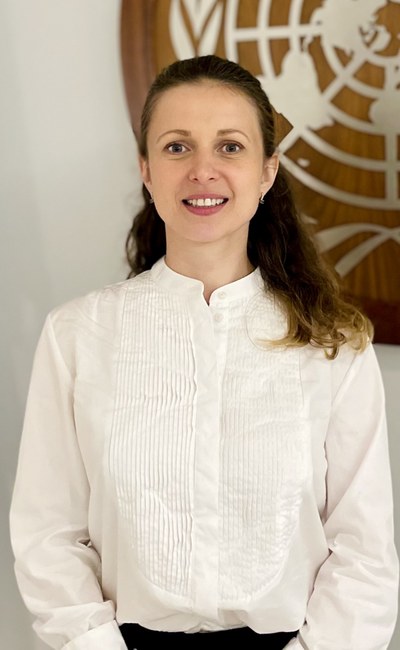
Her career path was anything but predictable: Liubov Poshyvailo-Strube studied physics in Ukraine, completed her doctorate and postdoctoral research at the Jülich Research Centre – and now works at the United Nations. She reveals in this interview how her path led her to the UN and what work she does there.
Ms. Poshyvailo-Strube, what led you from Ukraine to the Jülich Research Centre?
As a master’s student at a Ukrainian university, I participated in the 18th Laboratory Course on Neutron Scattering at the Jülich Research Centre – where I learned that students can write their theses at the Research Centre while enrolled in their home university, and even get paid for that. After several attempts to pass the interview, I finally secured a six-month stay in Jülich and completed my master’s thesis at the Institute of Bio- and Geosciences: Biotechnology (IBG-1). Soon after, I continued my research in Jülich, at the Institute of Energy and Climate: Stratosphere (former IEK-7, now ICE-4), and received a doctorate from the University of Wuppertal. For several more years, I worked as a postdoctoral researcher at the Institute of Bio- and Geosciences: Agrosphere (IBG-3), where I studied the impact of groundwater on simulated heat waves in Europe. In particular, I conducted simulations on a supercomputer for climate projections up to the year 2100. So, in short: I got to know the Jülich Research Centre quite well!
How did you get from there to the UN?
I remember writing my first article on the topic of my doctoral research — an enormous amount of work! But when I asked my supervisor, “Who would read it?”, the answer disappointed me: at best, 70-100 people. That felt like a very small number in comparison to the effort and time invested! Like so many young academics, I wanted to be heard and make a difference. Driven mainly by curiosity and sense of purpose in my work, I became more and more interested in working on global challenges – that’s why I switched to studying heat waves. The Career Centre, located on campus, was incredibly helpful, supporting me in finding my optimal career path: it turned out that my skills, values, and expectations were best suited to an intergovernmental organisation. But it wasn't that simple: a former UN human resources personnel member revealed at one of the Career Centre’s workshops that it can take up to five years or more to transition from academia to the UN. For me it was relatively quick from start to finish, nearly three years and only ten job applications!
You've been working at the UN for over a year, what is your role there?
I work at the UN Global Geodetic Centre of Excellence (abbreviated as UN-GGCE), it’s under the Department of Economic and Social Affairs. Based in Bonn with approximately 25 other UN organisations, UN-GGCE is mandated to advance the implementation of the UN General Assembly resolution 69/266 “A Global Geodetic Reference Frame for Sustainable Development”. We work closely with various research institutions as well as with public and private sectors, assisting Member States in securing continuous support for geodesy on national and international levels. A key focus of my work is assessing the lifecycle of geodetic data products, that is to say the global geodesy supply chain – from data acquisition by observatories to geodetic product dissemination to end-users, and everything in between. The ultimate goal is to provide recommendations to Member States on how to reduce identified weaknesses in the global geodesy supply chain. While many are unaware of the significance of geodesy, it actually forms the basis for multiple socio-economic sectors that rely on accurate positioning, navigation, and timing. For example, environmental monitoring and resource management, Earth observations, telecommunications, vehicle automation, and even interplanetary travel.
Are there skills or expertise gained at the Jülich Research Centre that proved useful at the UN?
Absolutely! Only after joining the UN, I realised how much I had learned at the Research Centre – both hard and soft skills. My current role as an Associate Geospatial Information Officer overlaps in many ways with my previous work in Jülich. For example, we collaborate with the PLATO (stands for Performance Simulations and Architectural Trade-Offs) research community, which simulates ground networks of geodetic stations to plan future infrastructure. Interpreting these simulations correctly requires technical expertise to assess their socio-economic implications, and my experience with numerical modelling and simulations at the Research Centre has equipped me well with that knowledge. At the UN, I also write reports, present at conferences and meetings, contribute to workshops – tasks familiar to every scientist. Analytical and critical thinking are definitely among the most valuable skills! Jülich also gave me the chance to go beyond my core competencies through the Helmholtz Graduate School for Energy and Climate Research (HITEC) and the Jülich Innovation & Entrepreneurship (JUICE) Certificate Program, where I even learned about business models and supply chains.
Looking back, your career path has been quite non-linear – was that intentional or did it evolve naturally?
I once asked myself: “What should you study at university to do what I do today?” and couldn’t find an answer. My current work is quite unique and highly interdisciplinary, which I really enjoy! It combines physics, math, computer sciences, economics, international relations, diplomacy – all tied to a global purpose. And the non-linear choices I took, each with its own rationale, enabled me to be where I am today. My takeaway? There is no perfect recipe for the career path that suits you best, you build it piece by piece – learning about yourself and gathering insights as you go – while creating something called YOUR career path: unique, sometimes not the simplest, often unclear to others, but truly yours.