
‘Every no brought me one step closer to my goal!’
After completing her postdoctoral studies at Forschungszentrum Jülich, physicist Dr Sonam Maiti looked for a job in industry – and received numerous rejections due to her lack of German language skills. She has now found her place: she works in an international team at Infineon and feels completely at home there.
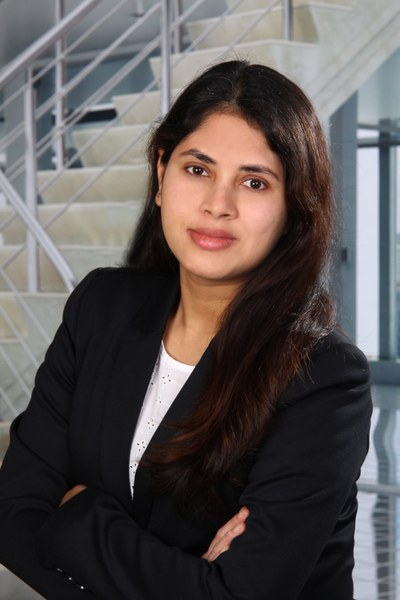
Ms Maiti, how long were you at Forschungszentrum Jülich, and what did you work on there?
After completing my doctorate at the University of Tübingen, I worked as a postdoc at Forschungszentrum Jülich from 2019 to 2022, more specifically at the Peter Grünberg Institute (PGI 7) in Professor Rainer Waser's research group. My work focused on semiconductor technology and materials science, in particular nanocrystals and their potential applications in memory devices.
What prompted your move to Infineon?
During the COVID pandemic, everything was very unstable – but I wanted stability. As my contract was temporary, I wanted to move into industry and began furthering my education in order to find the right job. I applied to various companies, including Infineon: I was very attracted to the work on the various projects there.
Job application phases are usually stressful. How did you find the application process?
It was a difficult time: at first, I was rejected by many companies because I wasn't fluent in German, but good German skills were required. It was very disheartening to receive all those rejections. On the other hand, it was precisely these setbacks that made me the person I am today. My perseverance led me on the right path – it pays off to be focused and to want to achieve something. Every rejection brought me one step closer to my goal. That's why I want to say to all those who are urgently looking for a job and are not getting good feedback: keep at it and don't let setbacks discourage you!
You finally got a job offer from Infineon. What do you do there?
I work as a process integration and product development engineer for semiconductor microchips: we produce microchips that are used in electric vehicles and for numerous applications in the field of power semiconductors. We are accelerating the transition to zero-emission electric vehicles, whether cars, buses, or rail vehicles. This is an area that I believe is very important in today's world, as sustainability is of paramount importance! My responsibilities include development projects, implementations, production support, problem analysis, setup, product launches, and much more in the technology sector—I support several projects and teams. My core team consists of about 15 people: an international team in different locations that manages the same product from different perspectives.
How important is it for you to work in an international team?
Diversity and inclusion are essential for innovation and success. As a foreigner, I also feel very welcome in international teams. Working with a wide variety of teams and cultures has taught me to adapt my communication style: working on complex projects gives me daily practice in dealing with the challenges that come with it.
What are the differences compared to your work at the research center? Is there anything that you particularly appreciate about the research center in retrospect?
At Infineon, we are more organized and the specifications are stricter: after all, we are dealing with a flawless product. We are also very customer-oriented. As a postdoc at the Jülich Research Center, on the other hand, I had the freedom to organize my work independently and tailor it to my own ideas. The opportunities for further training were also great: throughout my time there, I attended German courses for international employees. I also gained valuable insights from the research center's Career Center: they helped me with my applications, supported me in writing my resume, and helped me with my job search. It's really great that I was able to benefit from the services offered by Forschungszentrum Jülich!
At which Infineon location do you work?
I am working at the Villach site in Austria. The nature and Alpine landscape here are a real bonus. When you have a lot to do and are dealing with complex tasks, it's just wonderful to go swimming in the beautiful lakes after work in summer or, now in the colder season, to go for walks in nature and relax in the fresh air.