
ESDE Researchers Showcase AI and Data Workflow Advances at the ESM User Forum 2026
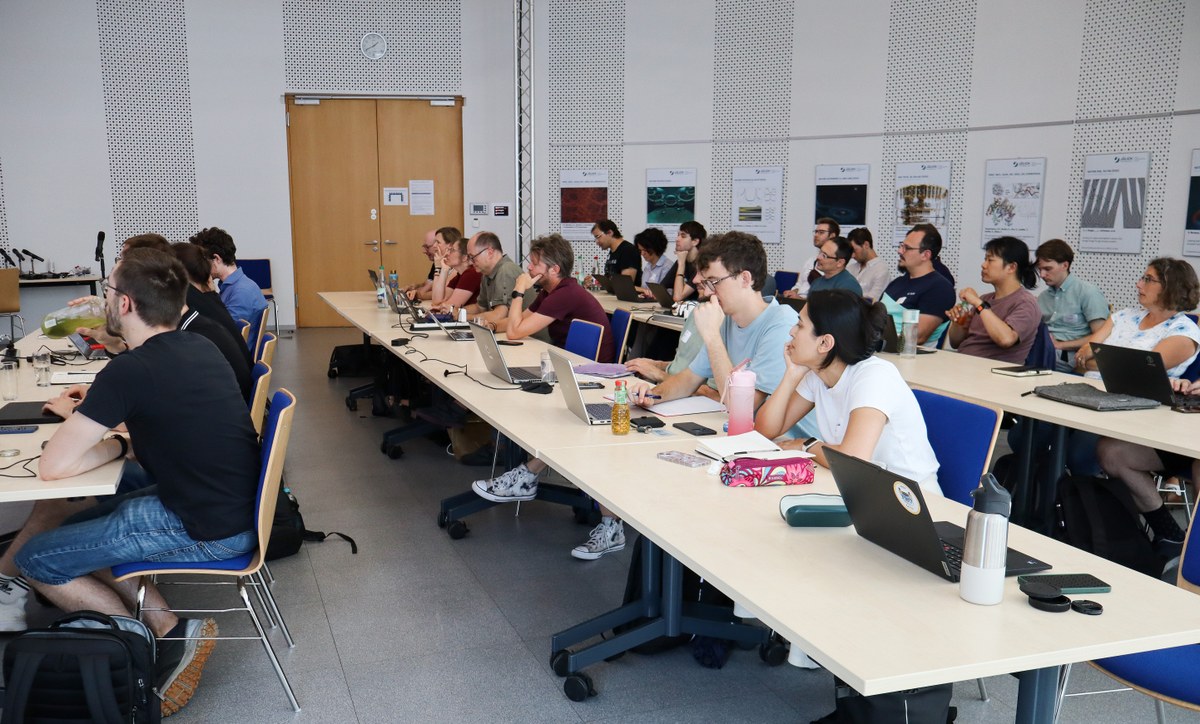
On 29–30 June 2026, the Earth System Modelling (ESM) User Forum brought together researchers from the German Earth system modelling community and users of Jülich's high-performance computing (HPC) systems at the Jülich Supercomputing Centre. The hybrid event provided a platform to exchange experiences on cutting-edge HPC systems, artificial intelligence for Earth system modelling, data management, workflows, and future developments in the field. Participants from the Joint Lab ExaESM, Jülich MeteoCloud, and various research projects discussed current challenges and opportunities for advancing Earth system science on next-generation supercomputers.
Researchers from the ESDE group actively contributed to the scientific programme with presentations highlighting recent developments in AI-driven Earth system modelling and data workflows.
Advancing AI for Weather and Climate
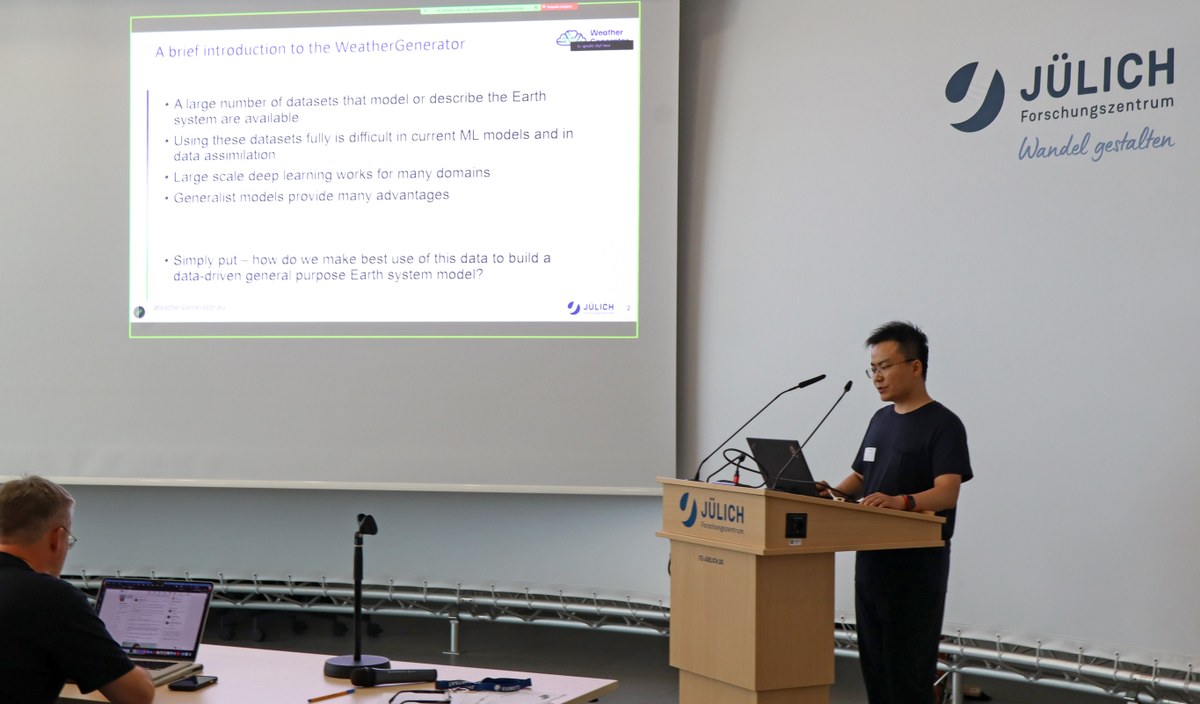
During the AI session, Jifeng Wang presented WeatherGenerator, an AI foundation model designed to integrate heterogeneous Earth-system data—including observations, reanalysis, and numerical simulations—into a unified latent representation. The presentation demonstrated how combining multiple data streams improves short-range weather forecasting by reducing forecast errors and suppressing error spikes between analysis updates. Looking ahead, the project aims to incorporate additional datasets, increase spatial and temporal resolution, and enable probabilistic Earth-system prediction through latent diffusion techniques.
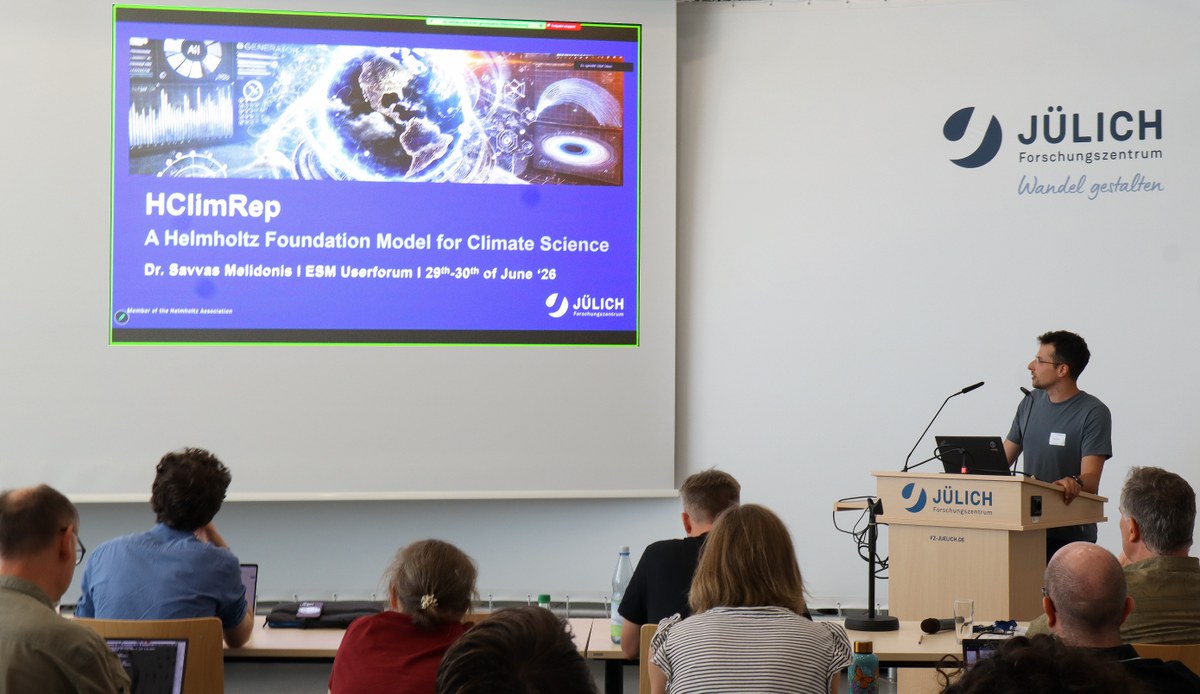
Savvas Melidonis introduced HClimRep, presenting recent progress towards developing a foundation model for climate science. The talk highlighted successful advances across all major model components—including the atmosphere, ocean, stratosphere, and long-term rollout capabilities. While long-range prediction remains a significant challenge for AI-based climate modelling, the project has established a strong basis for future developments and upcoming applications, including atmospheric-oceanic downscaling and the prediction of stratospheric sudden warming events.
Improving Data Workflows for Climate Research
On the second day of the forum, Carsten Hinz presented Warmworld Easier, highlighting the development of tools and workflows for handling Earth system model output. The presentation showcased their application to a high-resolution coupled Earth system simulation (XSPIEs), designed to run on the JUPITER exascale supercomputer, as well as to a measurement campaign conducted by the University of Cologne. Carsten also presented ongoing efforts to improve the accessibility and usability of climate data through continuous developments of community tools such as the Free Evaluation System Framework (FREVA), a platform developed by the German Climate Computing Centre (DKRZ) for accessing and analysing Earth system data, and the Fields DataBase (FDB), a high-performance storage system developed by the European Centre for Medium-Range Weather Forecasts (ECMWF) for operational weather forecasting and climate data.
The strong participation of ESDE researchers reflects the group's continued commitment to developing innovative AI methods, efficient data infrastructures, and user-oriented workflows that support the next generation of Earth system modelling on HPC platforms.