
JUPITER in the Spotlight: ESDE and JSC Experts Discuss Exascale AI on WDR 5
On the 29th of January, host of WDR 5 Das Wirtschaftsmagazin — Helga Hermanns — spoke with Martin Schultz, head of the Earth System Data Exploration (ESDE) research group at the Jülich Supercomputing Centre (JSC), alongside Thomas Lippert, Director of JSC, and Alina Bazarova, researcher in the Simulation and Data Lab (SDL) Applied Machine Learning. The discussion focused on why the new exascale computer JUPITER is particularly suited for AI, what sets it apart from previous supercomputers at Forschungszentrum Jülich, the high level of interest from researchers, and its future role in the global exascale landscape.
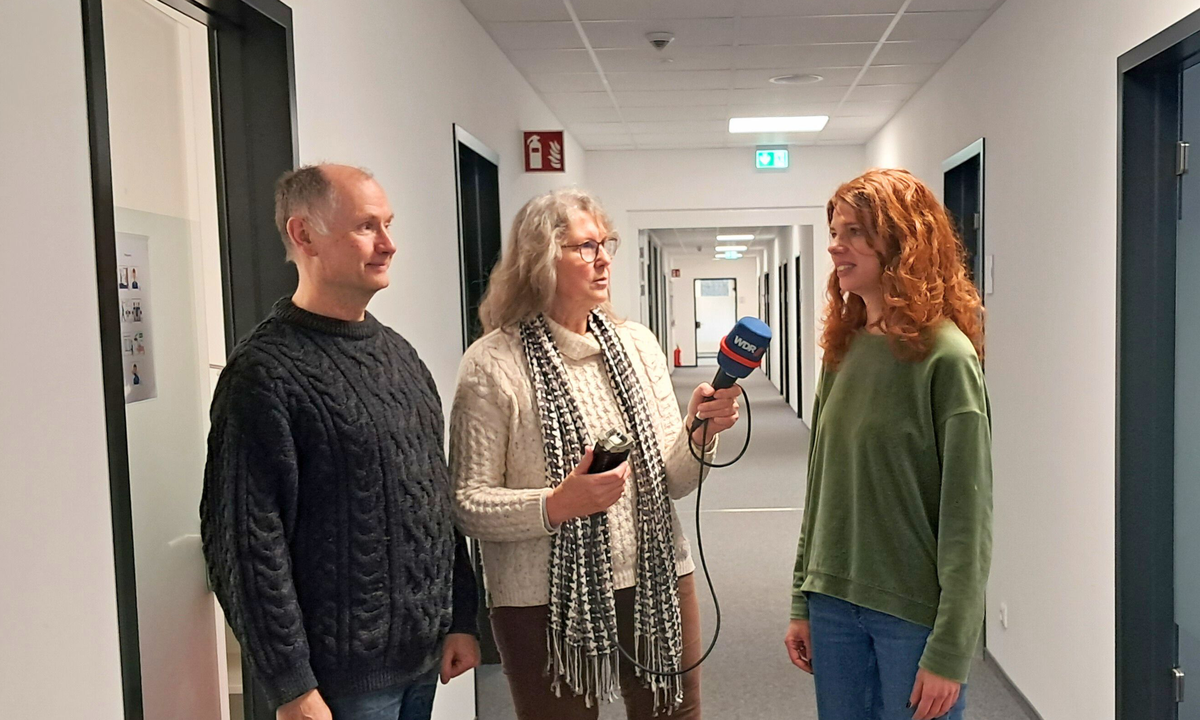
As Hermanns put it, from the outside, JUPITER resembles a village of containers, covering an area roughly half the size of a football field. Inside, however, it represents a major leap forward in computing power. Unlike previous systems, JUPITER is designed not only for highly precise algorithmic simulations but also for training extremely large AI models, where precision is not as critical.
As Thomas Lippert explained during the interview, JUPITER combines classical high-performance computing with AI workloads at unprecedented scale:
In that case [when training AI models], it delivers even higher performance. JUPITER currently has more computing power for AI than all the large computers in Europe combined.
For the ESDE group, this capability opens new possibilities in climate and weather research. Martin Schultz highlighted that AI models running on JUPITER can significantly improve regional weather analyses:
“Where AI models can really make a clear difference is in the regionalisation of these climate issues. That means we can make truly reliable forecasts on small scales – for example, for regions like North Rhine–Westphalia – and gain more reliable insights into how the climate is changing.”
Training AI models that capture the complex interactions of the climate system – such as atmosphere, land, and oceans – requires enormous computational resources. High-resolution predictions for local impact assessments are only feasible with exascale performance. In this context, Schultz emphasised Europe’s strong position in scientific AI:
With regard to the scientific use of AI, and especially in the weather and climate field, I would clearly say that Europe is leading the way. However, this naturally requires exactly this kind of computing capacity in order to train large weather and climate models.
JUPITER is able to provide this capacity, and it also helps to create new opportunities for international collaboration, including key partners such as the European Centre for Medium-Range Weather Forecasts (ECMWF) and the Deutscher Wetterdienst (DWD).
According to Lippert, JUPITER is expected to remain among the world’s leading supercomputers for at least the next eight years and can be expanded with additional modules to further increase performance. With the launch of the JUPITER AI Factory, access to the ‘thinking machine’ will also be opened to companies, strengthening the broader AI ecosystem.
For the ESDE group, JUPITER marks a decisive step toward AI-driven, high-resolution climate and weather modelling – bringing global exascale computing power to regional and local scientific questions, and reinforcing Europe’s role at the forefront of climate and Earth system research.
You can listen to the full interview on the WDR website here (only available in German).