
Machine Learning Brings Greater Consistency to Global Air Quality Station Classification
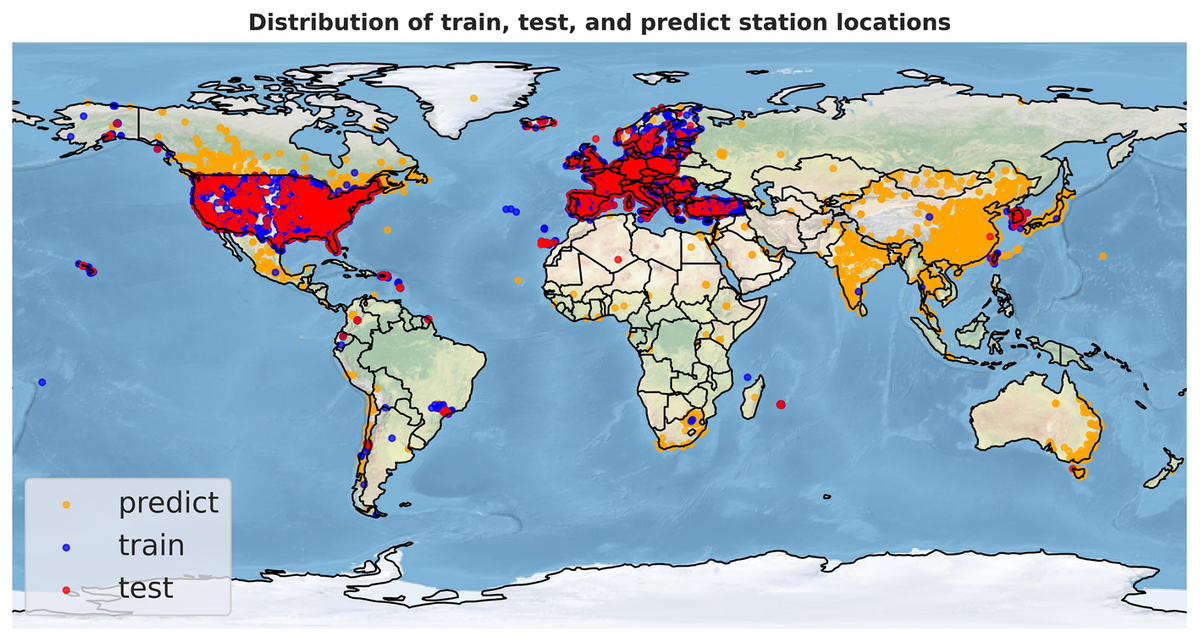
Researchers from the Earth System Data Exploration (ESDE) Group at the Jülich Supercomputing Centre have developed a new machine learning approach for classifying air quality monitoring stations as urban, suburban, or rural. The method, presented in the recent publication TOAR-classifier v2: A data-driven classification tool for global air quality stations by Mache et al. (2025), provides a more objective and transparent way to characterize monitoring sites and supports more consistent global assessments of air pollution.
The work is based on the Tropospheric Ozone Assessment Report (TOAR) database, which brings together measurements from more than 24,000 air quality stations worldwide, including nearly 13,000 ozone monitoring sites. As one of the world's largest collections of air quality observations, TOAR serves as an important resource for studying long-term pollution trends, evaluating atmospheric models, and informing environmental policy.
To make meaningful comparisons across such a diverse global network, it is essential to understand the environment in which each monitoring station is located. Air pollutant concentrations measured in a dense city centre can differ substantially from those observed in suburban neighbourhoods or rural landscapes. Correctly identifying whether a monitoring station represents an urban, suburban, or rural environment is therefore crucial for interpreting observations and assessing regional and global air quality patterns. However, station classifications are often provided by different national monitoring networks using inconsistent criteria or outdated land-use information. Urban expansion and changing infrastructure further complicate the classification of monitoring sites, particularly those located in transitional suburban areas. These inconsistencies can influence scientific analyses by blurring the distinction between different environments.
To address this challenge, the researchers developed a data-driven classification framework that uses station metadata together with modern machine learning techniques. They compared unsupervised clustering methods with several supervised learning algorithms, including Random Forest, LightGBM, and CatBoost, before combining the best-performing models into a voting-based classifier. While unsupervised methods were able to distinguish clearly urban and rural stations, supervised machine learning substantially improved the overall classification performance, especially for the more difficult suburban category.
Rather than forcing every station into a single predefined class, the new approach explicitly considers classification uncertainty. By introducing probability thresholds for suburban stations, the researchers were able to improve classification accuracy while acknowledging that many monitoring sites naturally represent transitional environments between densely populated cities and rural landscapes.
To validate the new classifier, the team compared the predicted station types with independent measurements of nitrogen oxides (NOₓ) and fine particulate matter (PM₂.₅) concentrations, two variables that were not included in the model training. The observed pollution patterns closely matched the expected characteristics of urban, suburban, and rural environments, providing strong evidence that the classifier captures meaningful real-world differences. The researchers also manually inspected, using Google Maps, a selection of stations where the machine learning predictions disagreed with the original database labels. In several cases, the new classifications better reflected the actual surroundings of the monitoring sites than the original station types.
The resulting TOAR-classifier v2 provides a globally consistent and reproducible tool that can be readily integrated into future TOAR assessments and other international air quality studies. Beyond improving station classification, the work demonstrates how machine learning can help make scientific assumptions more transparent and better account for uncertainty in large environmental datasets.
The publication represents another contribution from ESDE to the application of data science and artificial intelligence in Earth system research, supporting more reliable analyses of global air quality observations and strengthening the scientific foundations for future atmospheric assessments.
The TOAR-II database continues to grow as an open community resource for global air quality research and provides the foundation for studies such as this one. For more information about this topic, explore the TOAR-II database here.
To read the full scientific article, go here.