
Making petabyte-scale weather and climate data easier to access: Mathilde Leuridan completes her PhD
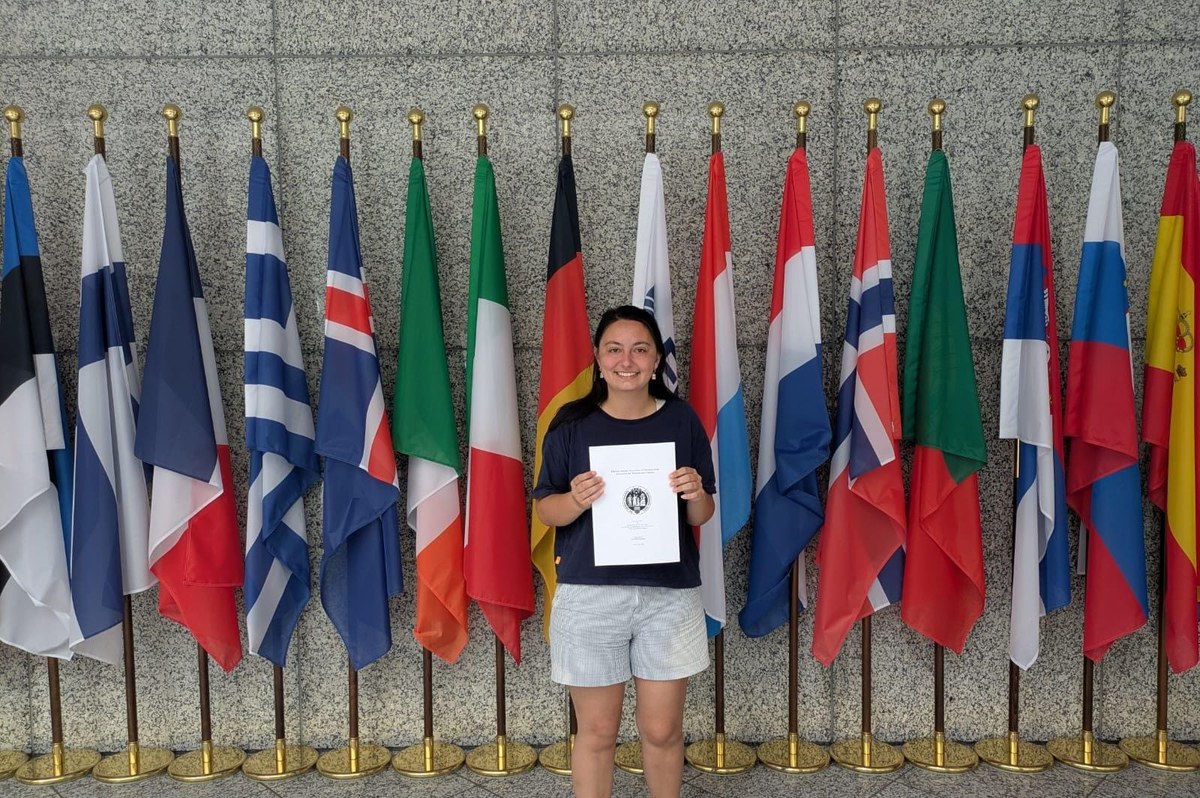
On 4 August 2026, Mathilde Leuridan successfully defended her doctoral dissertation, Efficient Feature Extraction of Petabyte-Scale Datacubes for Weather and Climate, at the University of Cologne, Faculty of Mathematics and Natural Sciences. This work was carried out in collaboration with the European Centre for Medium-Range Weather Forecasts (ECMWF). With her defence, Mathilde completed the requirements for her doctorate. Her dissertation focuses on developing more efficient ways to access the rapidly growing volumes of data used in weather and climate research. The work was supervised by Prof. Dr. Martin Schultz, Head of the Earth System Data Exploration (ESDE) research group at Forschungszentrum Jülich, and Prof. Dr.-Ing. Stefan Wesner, her second official supervisor from the University of Cologne, with Dr. Tiago Quintino and Dr. James Hawkes serving as her supervisors at ECMWF.
Weather and Earth system science are increasingly becoming big-data disciplines. Higher-resolution simulations, more frequent observations, and the emergence of data-driven and machine-learning models are producing datasets that can reach petabyte scale and continue to grow. In numerical weather prediction, for example, the move towards kilometre-scale global forecasts and high-frequency AI-based forecasting is expected to further increase the amount of data generated. While these datasets offer unprecedented opportunities for scientific research, accessing the relevant information efficiently has become a fundamental challenge.
Finding the right data without moving everything
Imagine a researcher wants to extract a particular region, trajectory, or other feature from a very large weather dataset. With conventional approaches, the system may have to retrieve a much larger block of data containing the requested information, even though most of that data will ultimately be discarded. As datasets grow, repeatedly moving unnecessary data between storage and computing systems becomes increasingly expensive and time-consuming.
Mathilde's research tackles this problem by changing how data extraction is performed. Instead of first retrieving a large section of a dataset and filtering it afterwards, her approach determines which data are actually needed for a user's specific request and accesses only those parts. This makes it possible to reduce the amount of data that needs to be read, transferred, and processed, while still allowing users to make flexible, precisely defined queries.
At the heart of her work is Polytope, an algorithm that enables users to request data based on shapes and regions that are not restricted to the usual rectangular boundaries of a datacube. The approach was designed to work directly with the underlying data and identify the relevant data points before they are retrieved. Tests showed that this can reduce the amount of extracted data by up to 99% compared with conventional approaches, while the time needed to determine which data are required remains small compared with the savings in data transfer.
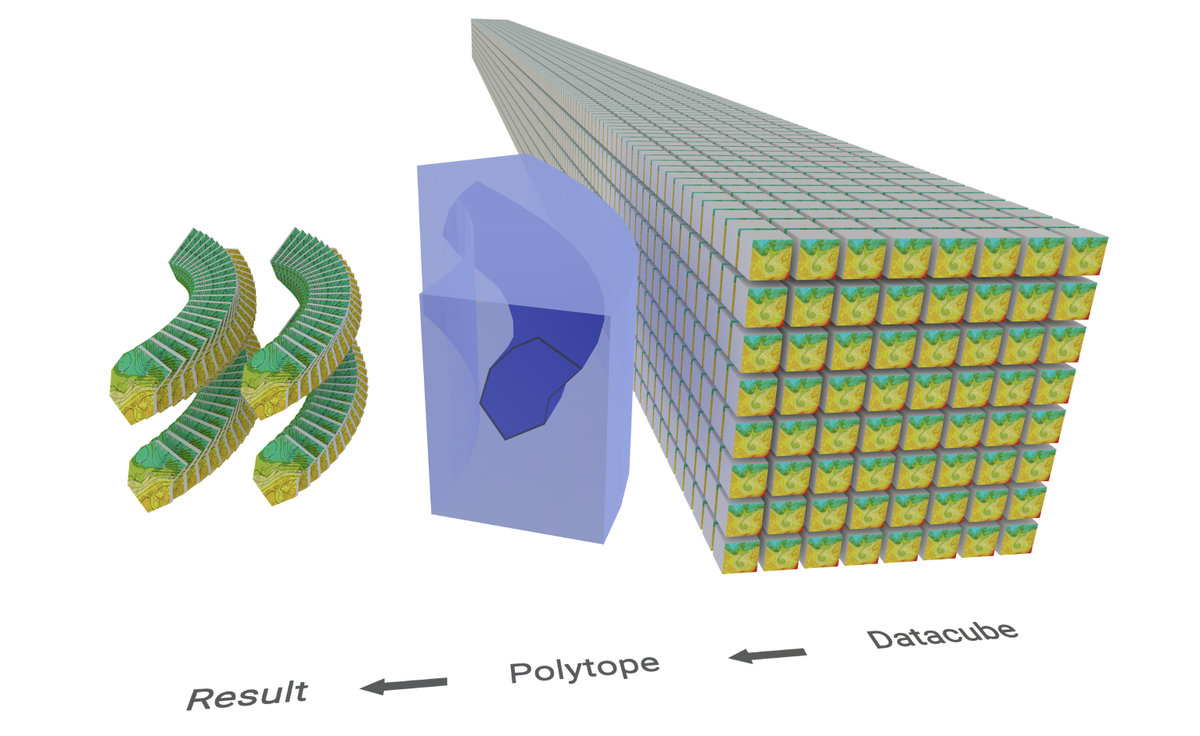
Mathilde also extended the approach to deal with the diversity of datasets used in modern weather and Earth system science. Not all datasets are organised on simple, regular grids, and some contain gaps, irregular structures, or more complex relationships between different dimensions. Her work therefore developed new ways of representing and accessing such datasets, extending the feature-extraction approach beyond regular grids and towards a more flexible framework that can be adapted to different types of scientific data, such as data from remote sensing and Earth observations, medical imaging, astronomy, and other simulation-based sciences.
The study was developed in collaboration with researchers from the Jülich Supercomputing Centre at Forschungszentrum Jülich. The work is particularly relevant to large-scale initiatives such as Destination Earth and Warmworld – two projects where the ESDE group is involved. In these initiatives, the ability to efficiently access and analyse enormous volumes of Earth system data will be essential. By reducing unnecessary data movement and allowing users to retrieve information in a more targeted way, Mathilde's work contributes to making these growing datasets more manageable and accessible for scientific applications.
With her successful defence, Mathilde has completed an important chapter in her career development. Her research demonstrates how new approaches to data access can help address the challenges posed by the next generation of weather and climate datasets. Looking ahead, her work provides a basis for further development towards new scientific applications, AI- and machine learning-driven workflows, and more scalable data infrastructures that can support increasingly complex datasets.
Mathilde's work has already resulted in several publications and conference contributions, including research on the Polytope algorithm, its performance on large-scale meteorological data stores, and its extension to irregular grids. These publications provide further details on the methods and results developed during her doctoral research.
Further reading
Mathilde Leuridan, James Hawkes, Simon Smart, Emanuele Danovaro, Martin Schultz, and Tiago Quintino. "Polytope: an algorithm for efficient feature extraction on hypercubes." Journal of Big Data 12, no. 1 (2025): 1-25. URL: 10.1186/s40537-025-01306-3.
Mathilde Leuridan, Christopher Bradley, James Hawkes, Tiago Quintino, and Martin Schultz. "Performance Analysis of an Efficient Algorithm for Feature Extraction from Large Scale Meteorological Data Stores." In Platform for Advanced Scientific Computing Conference (PASC ’25), pp. 1-9. 2025. URL: 10.1145/3732775.3733573.
Mathilde Leuridan, James Hawkes, Tiago Quintino, and Martin Schultz. “An Algorithm for Feature Extraction from Large Scale Meteorological Data Stores on Irregular Grids.” In Platform for Advanced Scienti!c Computing Conference (PASC ’26), pp. 1-11. 2026. URL: 10.1145/3815572.3815740.