
Using quantum annealing to design lattice proteins
Quantum Computing Category: Optimization
Scientific Domain: Life Sciences / Biophysics
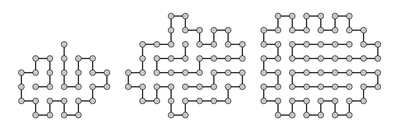
Protein design asks the inverse of the folding problem: instead of predicting the structure adopted by a given sequence, the goal is to identify amino-acid sequences that stabilize a chosen target structure. This project formulates lattice-protein design as an optimization problem for quantum annealing and evaluates both direct QPU and hybrid quantum-classical approaches. The study demonstrates successful sequence design for increasingly large lattice structures and investigates how current hardware limitations and control noise affect solution quality, making it a strong example of quantum optimization applied to a biologically motivated inverse-design problem.
Publication:
Irbäck, A., Knuthson, L., Mohandy, S., Peterson, C. Using quantum annealing to design lattice proteins. Phys. Rev. Research 6, 013162. https://doi.org/10.1103/PhysRevResearch.6.013162