
Solid-state reactions under electric and chemical potential gradients
- Investigation of mixed ionic–electronic solid oxides
- Nanoscopic analysis of local conduction paths and redox reactions
- Clarification of degradation mechanisms in solid oxide electrolysis cells
The analysis of solid-state reactions in transition metal oxides is of fundamental importance for gaining an understanding of degradation processes in solid oxide energy converters (solid oxide cells (SOCs)). In particular, when SOCs are operated in electrolysis mode, the occurrence of gradients of the chemical and electric potential can lead to segregation and phase transitions, which may limit the lifetime of the energy converters. To demonstrate how such phenomena can be prevented, we perform degradation studies using selected model systems. To identify local transport and segregation phenomena in transition metal oxides, we apply spatial-resolution methods such as electron microscopy with energy dispersive X-ray spectroscopy, fluorescence microscopy, or conductive atomic force microscopy. As a model material for the solid electrolyte, we use the oxygen ion conductor Y-stabilized ZrO2 (YSZ), and as a model material for mixed ionic–electronic conducting electrodes, we use SrTiO3 as a conventional dielectric solid oxide with perovskite structure.
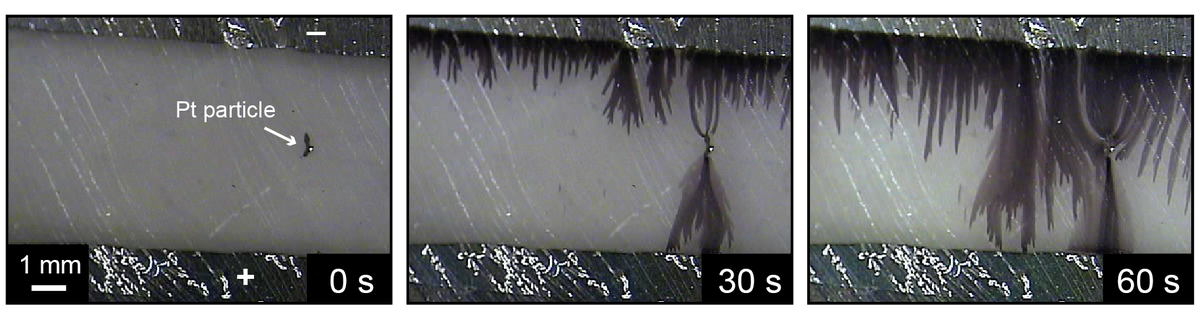
We focus on studies using electroreduction, in which solid oxide samples are electrically polarized under reducing conditions. Fig. 1 depicts an example of such an experiment on a YSZ thin film, where an electric potential gradient causes the formation of a reduction front, which moves from the cathode to the anode following the local field lines. Due to the reduction of the material, the electronic structure changes locally, which affects the optical transparency of the material and thus becomes visible as a “blackening” effect.
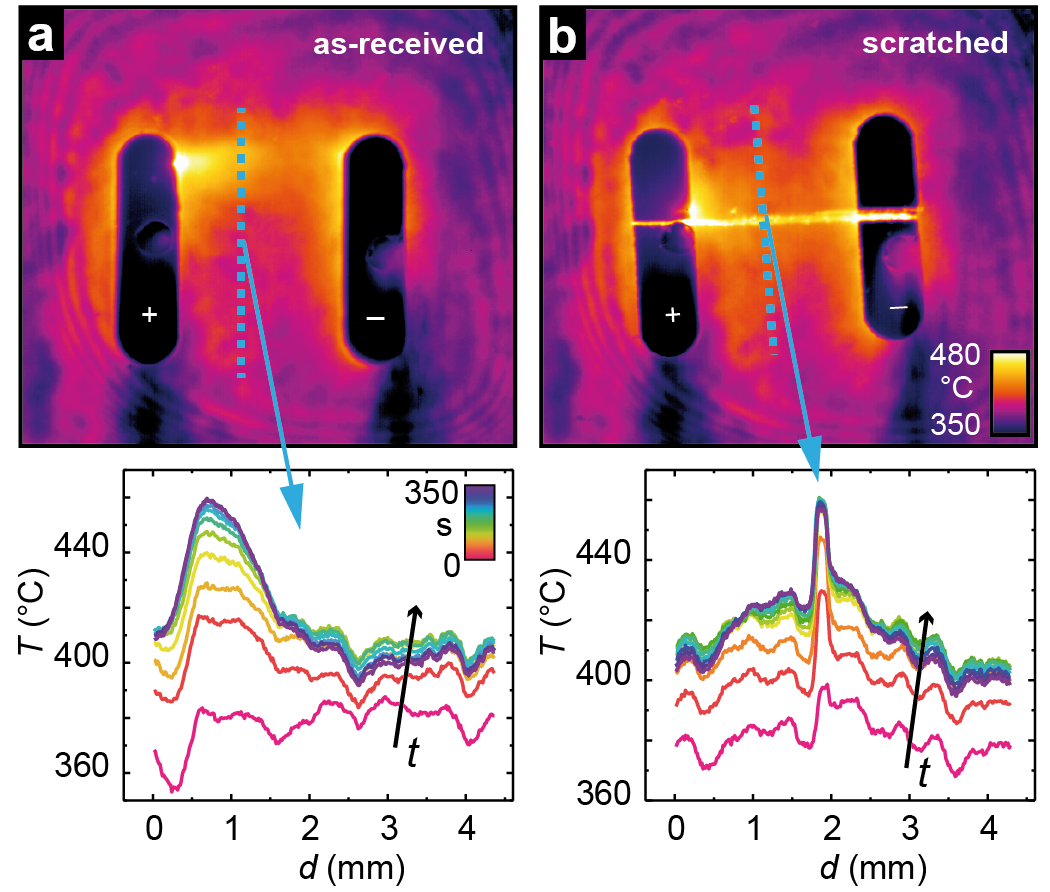
In SrTiO3, however, we demonstrated that extensive defects such as dislocations or grain boundaries have a large influence on electroreduction. Since it is particularly easy to create oxygen vacancies at dislocations, which are locally compensated by electrons, a filamentary canalization of the electric current along the existing dislocation network takes place in the first stage of (electro)reduction. This effect is shown in Fig. 2. Here, the dislocation density was increased in a line between the electrodes through mechanical processing. Compared to the untreated reference sample, the thermal image taken during the onset of electroreduction shows a significant increase in Joule heating and thus a channelling of the current flow along the areas with high dislocation density.
References
[1] Rodenbücher et al. J. Phys. Energy 2020, 2, https://doi.org/10.1088/2515-7655/ab6b39.
[2] Rodenbücher et al. Sci. Rep. 2019, 9:2502, https://doi.org/10.1038/s41598-019-39372-2.