
PLI-Workflow
Background and motivation
Three-dimensional Polarized Light Imaging (3D-PLI) is used to capture high resolution images of thinly sliced sections of post-mortem brains, using a polarizing microscope. These images, if available in adequate quality, can then be stacked to reconstruct the brain in three dimensions. Such a 3D reconstruction enables tracking of individual nerve fibers through the entire brain.
To achieve the high resolution needed for reconstruction, these images are taken tile-wise with up to 108,000 image per brain section. Handling all these images and the different steps needed to calculate fiber orientation becomes increasingly difficult and error-prone as more and more brain sections are measured. Therefore, an automated workflow has been implemented for file handling/transfer and fiber reconstruction.
Our approach
First of all, the number of files needs to be reduced, as the total number can easily exceed millions of files, reaching file system limits and becoming way too difficult to track. To achieve this, the single tiles get placed next to each other on a grid and stored in HDF5 files. This also allows to directly store metadata in these files and read/write these files in parallel (see fig. 1).
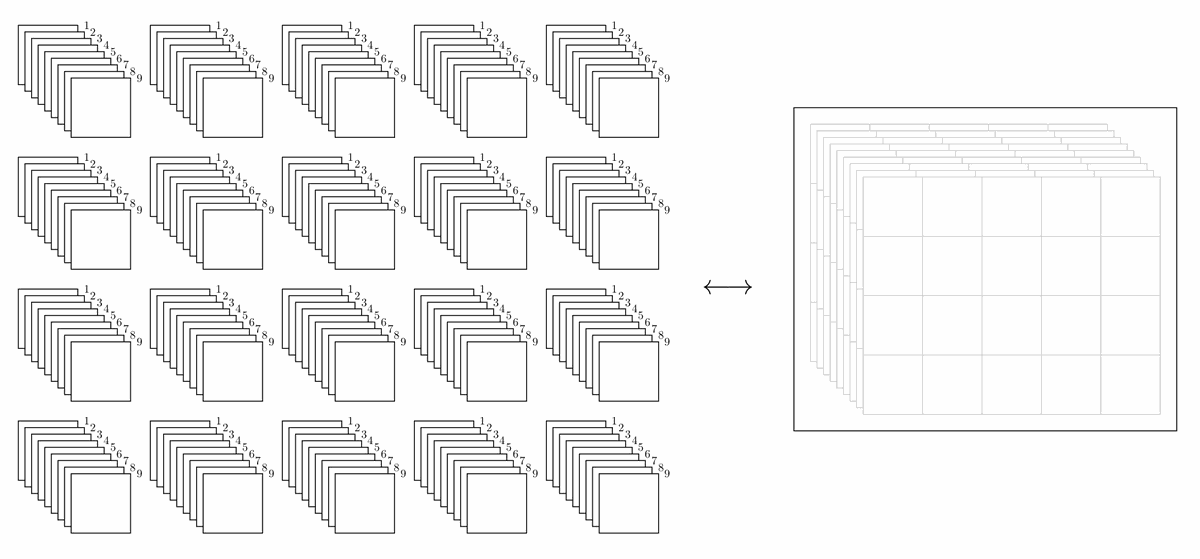
Once all data is available as HDF5 files, it becomes much easier to handle, even for an automated workflow. As soon as they’re converted to HDF5 on a buffer system at INM-1, they’re transferred to JSC, picked up by the data uploader, inserted into a folder structure and added to a database. From there, the reconstruction workflow (depending on the type of data) is started and results are picked up automatically as well. The full workflow is shown in figure 2.
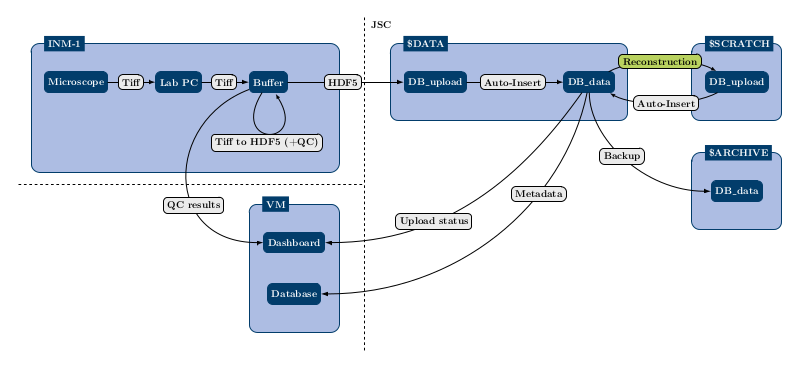
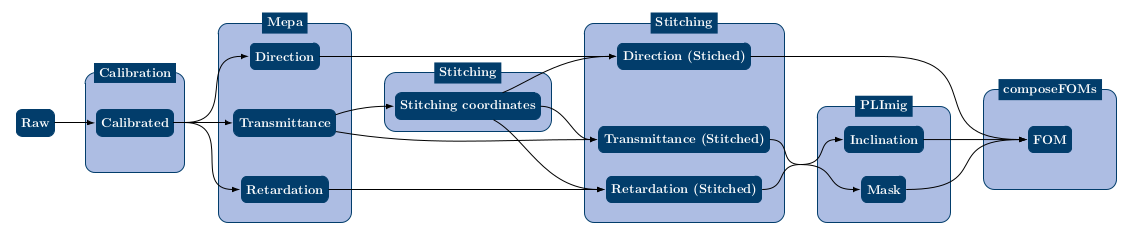
The reconstruction workflow (green box in fig. 2) itself consists of multiple computation steps, running on different partitions of the system, connected via job dependencies. For the most simple measurement (without any tilting), the dependencies are shown in figure 3.
Our collaboration partners
This project is being conducted in collaboration with the Fiber Architecture group of the INM-1.