de en

About JUNIQ
JUNIQ – the Jülich UNIfied Infrastructure for Quantum Computing – is a vendor-neutral, comprehensive research and user platform of the JSC, offering European academic and industrial researchers easy and peer-reviewed access to quantum computers at different maturity levels, as well as software emulators. Seamlessly integrated into JSC’s modular HPC environment, JUNIQ provides secure cloud-based access in the form of a unified platform. JUNIQ’s unique selling points are its large variety of hosted quantum computers and its close interwovenness with JSC’s HPC activities and user communities, resulting in integrated hybrid quantum-classical modular systems for advanced scientific applications. JUNIQ’s phased, vendor-neutral quantum computing provision strategy spans annealing, simulation, and gate-based systems across superconducting, neutral-atom, semiconductor, and trapped-ion qubit technologies. The current portfolio includes five quantum computers and a quantum computer simulator. JUNIQ, a European pioneer, has become the nucleus of quantum computing infrastructures and a strategic catalyst for EuroHPC–QCS, the European Federated Hybrid HPC–Quantum Computing and Simulation Infrastructure. Over the next years, its quantum computer fleet will be enhanced, expanded, and fully integrated into the HPC ecosystem.
A comprehensive overview with potential future pathways was published as part of the NIC Symposium 2022 Proceedings.


Buildings
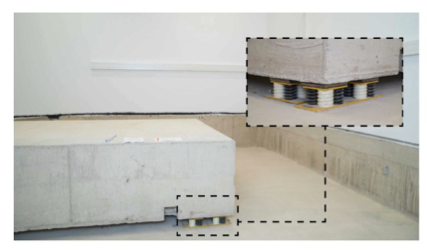
The quantum systems hosted by the JSC are located in two dedicated buildings: Plans for a new quantum computer building started in early 2019 (watch the animated JUNIQ building). The construction of the JUNIQ building officially began on 30 July 2020 with a groundbreaking ceremony (see news flash). The progress of construction could be followed via a webcam, the images of which were edited into a time-lapse video. In summer 2021, the construction of the building was completed. Currently this building hosts the system JUPSI, which requires the special architecture of this building. The quantum computing system is placed on a sprung foundation in order not to exceed the allowable vibration levels, which would adversely affect the performance of the system. The vibration-decoupled support for the quantum computing system consists of a rigid concrete block with dimensions of 2.54m x 3.48m x 0.9m and a total weight of 19.9 tons. This concrete block is mounted on steel spring elements. In the computer rooms a raised floor is installed which is aligned with the top surface of the concrete block.
The system JADE is located in a machine hall of one of the JSC’s main buildings. The digital quantum computers JIQCER, JION and JAQUI are housed in the JSC’s CryoLab which also operates a Leiden Cryogenics cryostat to support student training and prototype testing, with capacities for cryo-electronics, microwave, and cryogenic interconnect experiments.
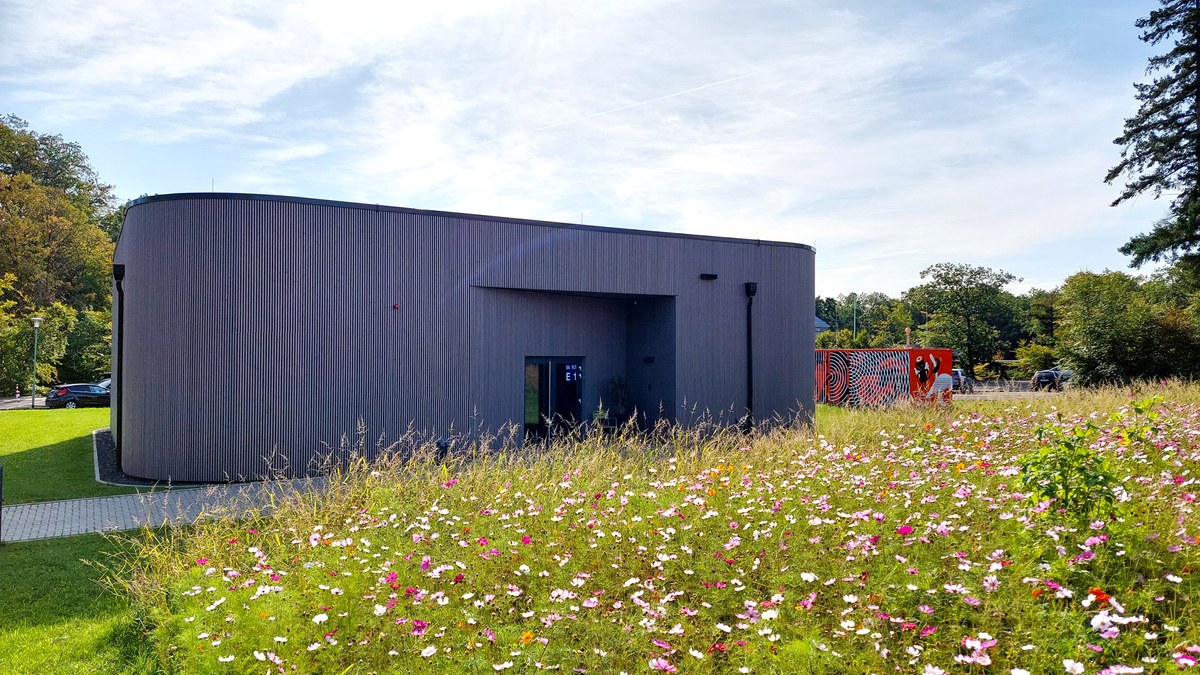
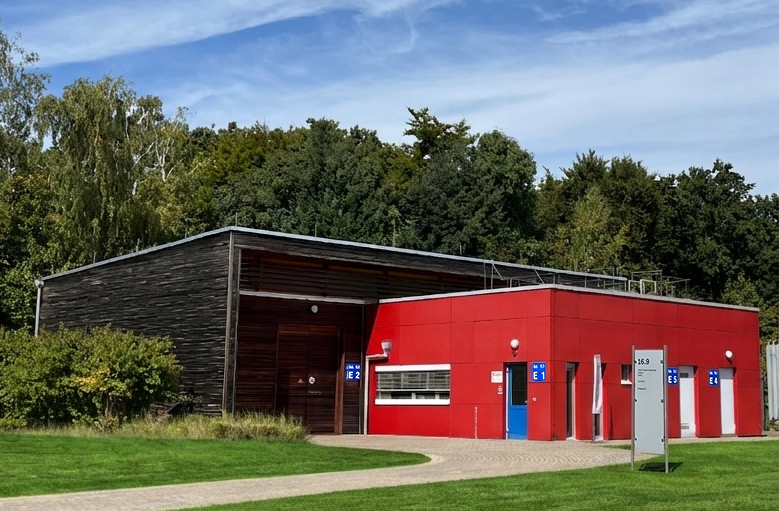
Take a virtual tour through the JUNIQ building and learn more about its architecture, its special infrastructure, and the hosted and planned quantum computing devices.
History
2019 – JUNIQ was founded with an initial funding of 5 million EUR each by BMFTR and MKW NRW. Plans for a dedicated building started.
2020 – Cloud access to a D-Wave 2000Q system was granted. With that, JUNIQ became Europe’s first D-Wave Leap™ cloud site. The construction of the JUNIQ building started with a groundbreaking ceremony.
2021 – The construction of the JUNIQ building was completed.
2022 – The D-Wave AdvantageTM 1 system JUPSI-1 was delivered and placed into the JUNIQ building.
2023 – The EPIQ project, a JSC-eleQtron partnership, launched, which resulted in the delivery of the quantum computer JION.
2024 – The JUNIQ Upgrade was funded with a 25 million EUR Helmholtz Research Infrastructure investment to modernize hardware and expand the fleet of systems. JUPSI-1 was purchased by Forschungszentrum Jülich. The Pasqal Fresnel quantum simulator JADE was installed in the JUNIQ building (and moved into one of the JSC’s machine halls in 2026). The IQM system JIQCER was commissioned.
2025 – JUPSI-1 was upgraded with an Advantage 2 chip and now supports advanced quantum annealing experiments. JADE was inaugurated together with its twin system at GENCI/CEA. The quantum computer JAQUI developed by ARQUE Systems GmbH was installed.
2026 – A second D-Wave AdvantageTM system JUPSI-2 was installed in the JUNIQ building to ensure production-grade access.
Last Modified: 19.08.2026