de en

JUNIQ Systems and Emulators
JUNIQ is a vendor-neutral research and user platform, offering European academic and industrial researchers easy and peer-reviewed access to quantum computers at different maturity levels, as well as software emulators (JUQCS, Qaptiva). The quantum computers can be categorized into analog (JUPSI, JADE) and digital systems (JION, JIQCER, JAQUI). In addition to these systems hosted by the JSC, JUNIQ provides cloud access to additional systems. The emulators and the quantum computers are currently accessible or will be made accessible via the JUNIQ-Cloud platform.
Software Emulators
Quantum computer emulators simulate the operation of quantum computing devices on conventional computers.
JUQCS
The Jülich Universal Quantum Computer Simulator (JUQCS) is a massively parallel emulator of gate-based quantum computers for conventional computers of any type and size with CPUs and GPUs, including the exascale system JUPITER. It provides massively parallel emulation capabilities for validating hardware and benchmarking algorithms. Digital-twin frameworks will emulate hardware-specific noise models, gate fidelities, and connectivity constraints, bridging the gap between theoretical designs and practical implementations. These tools support cross-platform performance validation and accelerate the development of application-relevant quantum computing across Europe. They also provide a critical benchmarking environment for assessing progress toward fault tolerance.
In 2019, JUQCS has set the world record of simulating a universal quantum computer with 48 qubits. In 2025, this record was broken with a simulation of 50 qubits on the supercomputer JUPITER.
Eviden Qaptiva 800
The Qaptiva 800 is a platform for simulating different quantum technologies, being able to emulate up to 40 qubits in either noise- or noiseless situations. Learn more on Eviden's Website.
Analog Quantum Computers
An analog quantum computer solves problems by continuously evolving a physical quantum system under a designed Hamiltonian, allowing the system's natural dynamics to perform the computation.

JUPSI – JUelich Pioneer for Spin Interference
An analog quantum computer of the type quantum annealer.
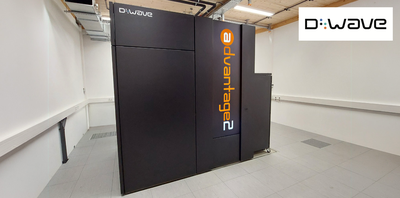
System details
- AdvantageTM system of D-Wave Systems
- More than 4.400 superconducting qubits
- More than 40.000 couplers
- 15-way qubit connectivity
JUNIQ became Europe’s first D-Wave Leap™ cloud site in 2019. Since 2022, it provides peer-reviewed sovereign cloud access to the Advantage 1 system named JUPSI-1. Operated under European legislation as D-Wave’s European node, the system is hosted at JSC in the purpose-built, vibration-free JUNIQ facility. Acquired in 2024 and upgraded in 2025 with an Advantage 2 chip, JUPSI-1 now supports advanced quantum annealing experiments and research into deep integration with JUPITER. A second Advantage™ 2 system (JUPSI-2) was installed in 2026 to ensure production-grade access. Peer-reviewed use of JUPSI-1 has already yielded notable scientific outcomes, including the realization of false vacuum decay (Vodeb et al., 2025) and lattice protein folding on minimal grids (Irbäck et al., 2025).
With quantum annealing, computations are carried out by first bringing a connected system of qubits into a simple and known lowest energy state described in the basis of an initial Hamiltonian. This state turns out to be a uniform superposition state described in the basis of the final Hamiltonian that encodes the problem to solve. The system is then shifted to the lowest energy state of the sought classical problem, the second Hamiltonian, by adiabatically changing the interactions of the qubits. Quantum annealing can especially be used to solve optimization, sampling and machine learning problems.
Latest press releases and news

JADE – Jülich neutral Atom DEvice
An analog quantum computer of the type quantum simulator.
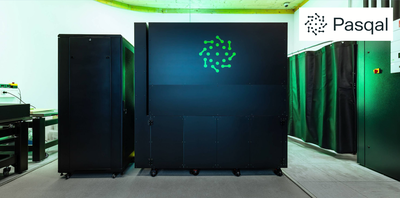
System details
- Fresnel system of Pasqal
- More than 100 neutral rubidium atom qubits
- 1D and 2D atom geometry
JADE was installed in the JUNIQ building in late 2024 as part of the JSC-led EuroHPC JU project HPCQS (High Performance Computing Quantum Simulator hybrid). Operated alongside a twin system at GENCI/CEA, JADE supports hybrid quantum–HPC simulations and is tightly integrated with JSC’s modular HPC environment.
The quantum processing unit (QPU) of the Pasqal quantum simulator is based on a configurable array of single neutral rubidium atoms. The array can be seen as a register, where each single atom plays the role of a qubit. Laser light is used to assemble and read out registers made of more than a hundred of qubits and to perform fully programmable quantum processing. In addition, electronic controls are applied to tune the light properties, apply instructions arising from the quantum software stack and extract information through atomic detection.
Latest press releases and news
Digital Quantum Computers
A digital quantum computer performs computations by applying a sequence of discrete quantum logic gates to qubits, analogous to how classical digital computers execute algorithms through logical operations.

JION – Jülich trapped-ION quantum computer
A digital trapped-ion quantum computer
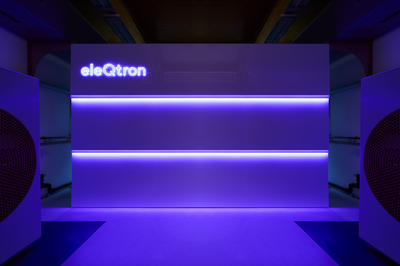
System details
- Trapped-ion quantum computing system developed by eleQtron
- Gradual scaling to 10 qubits by mid-2027
- This will be followed by JION+, a new chip-based system generation targeting 40 qubits by mid-2028
- MAGIC (Magnetic Gradient Induced Coupling) for controlling and coupling qubits using microwaves and magnetic field gradients
As part of the EPIQ project, launched in 2023, the Jülich Supercomputing Centre (JSC) and eleQtron are jointly developing JION (Jülich trapped ION quantum computer), a trapped-ion quantum computer developed and built in North Rhine-Westphalia. The project is funded by the Ministry of Culture and Science of the State of North Rhine-Westphalia (MKW NRW).
JION is operational and will now be further developed and qualified step by step and made accessible through Jülich’s quantum computing infrastructure JUNIQ. In the first expansion stage, the system is planned to scale to 10 qubits by mid-2027. This will be followed by JION+, a new chip-based system generation targeting 40 qubits by mid-2028.
As part of EPIQ, JION will also be integrated into Jülich’s computing infrastructure and coupled with the JURECA-DC supercomputer. The goal is to develop hybrid quantum/HPC workflows in which classical high-performance computers and quantum computers each handle the tasks best suited to them.
Latest press releases and news

JIQCER-5 – Jülich IQM Quantum Computing ExpeRience
A superconducting digital quantum computer.
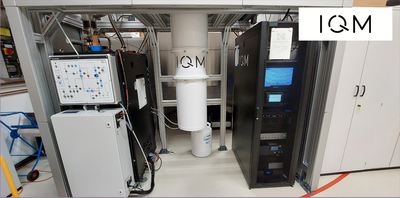
System details
- IQM SparkTM system by IQM Quantum Computers
- 5 superconducting qubits
- 4 couplers
- Square lattice topology
As part of JUNIQ Upgrade, the first commercial gate-based superconducting quantum computer, a five-qubit IQM Spark system, named JIQCER-5 (Jülich IQM Quantum Computing ExpeRience), was commissioned in late 2024.
Latest press releases and news

JAQUI-5 – Jülich ArQUe semIconductor quantum computer
A semiconductor digital quantum computer.
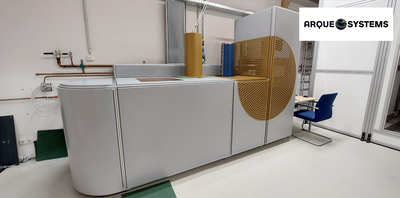
System details
- Semiconductor-based quantum computing system of ARQUE Systems
- 5 electron spin qubits in silicon
- Qubit connectivity: electron shuttle to move electrons across the chip
JAQUI-5, financed by FZJ, was installed in 2025 and commissioned early 2026. This pilot system is intended to be replaced by a scalable semiconductor-based quantum computer with up to 200 qubits, which will also be integrated into the JSC’s HPC infrastructure.
Latest press releases and news
User documentation will be available soon.
Cloud access & future systems
QSolid Quantum Computer (in development)
QSolid is a consortium of 25 German research institutes and companies focused on improving the error rate of qubits over the 5-year period. The starting goal is to produce a quantum computer with 10 high-quality qubits, with plans of reaching up to 30 qubits by the end of its run. The ecosystem developed by the project will be fully integrated into JUNIQ's supercomputing environment and made accessible to external users.
OpenSuperQplus Quantum Computer (in development)
In the Quantum Flagship project OpenSuperQplus, a gate-based quantum computer with superconducting qubits is currently being developed.
Last Modified: 09.09.2026