

PeroInk
AI-assisted perovskite ink analysis for quality control of novel solar cells
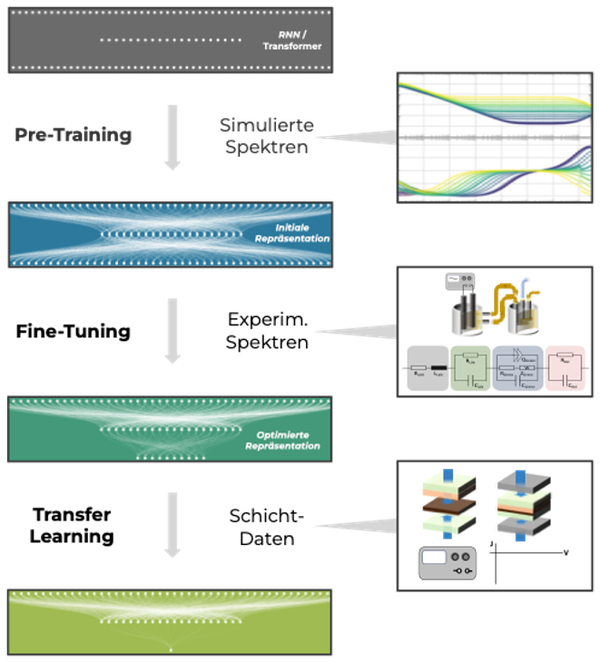
Printable, ultra-thin and lightweight perovskite solar cells are regarded as a promising next-generation photovoltaic technology. They have rapidly closed the technological gap with silicon solar cells and are on the verge of commercialisation. A major bottleneck in the industrial scaling of this technology currently lies in the reliable and sustainable synthesis of the starting materials. Until now, the suitability of the starting materials could only be assessed after the entire production cycle of the solar cell, which incurs high costs, particularly when developing new synthesis and recycling processes. The reason for this is the causal relationship between the starting material used and the final crystalline layer, which is not yet fully understood. Consequently, there is currently a lack of effective quality controls in the early stages of the production cycle.
The PeroInk project develops an electrochemical analysis method that can be used at an early stage of perovskite ink production. Using AI, quality indicators are identified from readily available but difficult-to-interpret measurement data, enabling conclusions to be drawn about the efficiency of the resulting solar cells. The aim is to progressively map various process factors into the resulting AI model in order to shorten the feedback loop and make the model usable for optimising synthesis, recycling and purification processes.

Prof. Dr. Thomas Kirchartz
Direktor
- Institute of Energy Materials and Devices (IMD)
- Photovoltaics (IMD-3)
Room 4006
Projektpartner:
Coordinator: Bergische Universität Wuppertal,
Industry partner: Perolink GmbH, Köln
Funding reference: EFRE-20400228, 01.12.2025 to 30.11.2028,
progres.nrw, ENERGIE.IN.NRW (Energie und innovatives Bauen)