"From Physicist to RSE - My Journey to USRSE'25 in Philadelphia"

As a physicist who mostly works with simulations, I’ve always been surrounded by scientific research software: be it Mathematica for numerically solving field equations in my bachelor’s, or Monte Carlo codes for radiation transport simulations in my master’s and beyond. I worked with other people’s code, extended existing research software, and somehow ended up in a PhD project that requires me to write research software from scratch. While I would still consider myself a physicist, the existence of the Jülich Research Software Engineering initiative (JuRSE) made me start rethinking my role…
Thanks to the JuRSE mailing list, I became aware of the travel grants for Research Software Engineering (RSE) conferences in Germany, the UK, and the US, and I swiftly decided to apply for the next possible conference. I was very excited to receive a positive response and support for travel to the USRSE’25 conference in Philadelphia, which took place from October 6 to 8.

The conference was organized by the US Research Software Engineering Association and was the third of its kind in the US. Roughly 200–300 participants were following interesting keynote talks or were spread over three to four parallel sessions, including talks, discussions, or hands-on workshops. My concerns that people would not know the research center with the German tongue twister as a name proved to be unfounded, as not only Jülich’s new supercomputer JUPITER was commonly known, but the research center was also referenced multiple times as a collaborator in the very first talk of the conference — a keynote delivered by Maxwell Reed, professor at the High Meadows Environmental Institute at Princeton University.
During the conference, I had the opportunity to learn more about best RSE practices (e.g., Jupyter Notebook–based tutorials, metamorphic testing, etc.), useful tools (e.g., for linting, code coverage analysis, etc.), and good code examples (e.g., the Hubverse). It allowed me to develop an idea of an entirely new (to me) professional development track – research software engineers (RSEs) – spanning beyond specific research areas. The conference facilitated new personal contacts with researchers and software engineers based in the US but also in Europe and supported the exchange of professional experiences, especially for students and early-career scientists. It clearly pointed out the benefits research institutions can gain from employing a professionalized research software workforce.
Hearing personal stories of other participants’ winding paths to research software engineering and their awakening moments (“Oh, wow 🤯 I’m basically an RSE.”) was fascinating, relatable, and encouraging.
In practical terms, the conference provided me with the chance to present my project in the form of a poster to a research software–focused community that chose a very different angle to look at my work, in contrast to non-proliferation and safeguards researchers or nuclear physicists, whom I’m more used to. I got support for my work and valuable feedback that I would not want to miss in my further work.
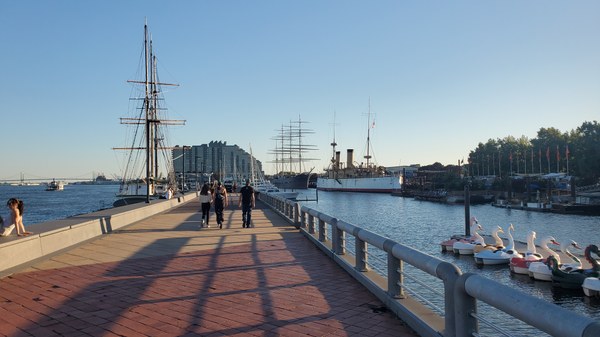
Additional highlights were Philadelphia’s Old City right at the conference hotel’s doorstep and a conference dinner on the world’s oldest and largest four-masted tall ship, the Moshulu.
Author: Manuel Kreutle, IFN-2, FZJ