
Agrosoil
AGROSOIL - Agrogeophysics for Sustainable Soil Management under Climate Extremes
Project overview
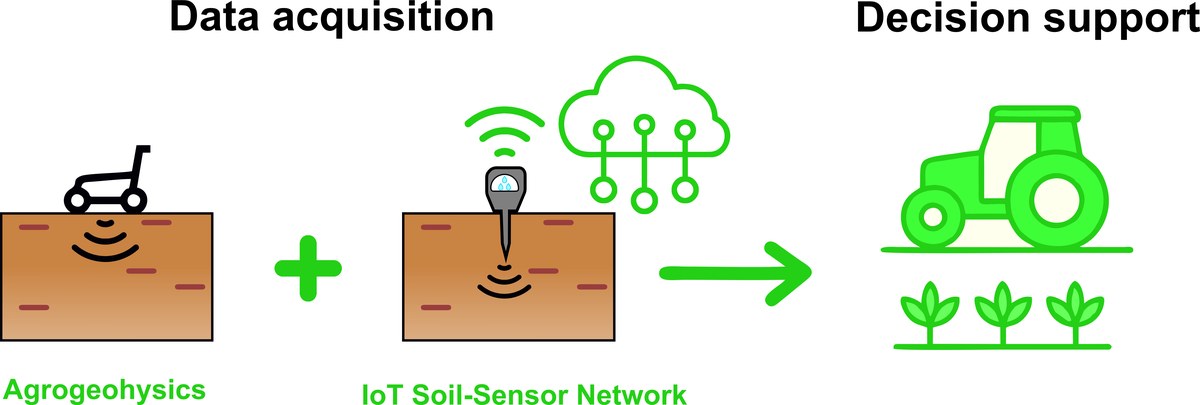
The project aims to develop minimal-invasive investigation techniques to assist the development of climate-resilient crops and improve agricultural practices in the face of climate change. The focus is on understanding the impact of various agricultural practices, such as fertilizer applications and irrigation, on cereal crops like maize and wheat. To achieve this, the project proposes to use a combination of geophysical methods (electromagnetic induction, electrical resistivity tomography, and ground-penetrating radar) and soil sensors networks to characterize the soil and its interaction with crops. Experiments will be conducted across different scales and countries (Germany, Ireland, and Uruguay) to investigate the response to different extreme climate conditions and soil types. The goal is to develop a workflow that can help improve the resilience of agricultural plants to climate extremes, optimize water and fertilizer usage, and support sustainable field management.
Project objectives:
Enhance the non-destructive soil-root continuum characterizations and link process such as solute transport and root distributions in the soil.
Provide recommendations on soil sensor location derived from a geophysical soil map.
Map and monitor soil conditions related to different treatments to reduce waste and resources.
Analyze response of crops to different climates and extreme weather conditions
Provide proxies for agricultural practices
Guideline to use agrogeophysics sensors to monitor processes to establish links to precision and sustainable agriculture.

Main project activities
Synchronized field managed field trials in all three partner countries
Geophysical mapping and IoT soil sensor network for multiple growing seasons under varyingwater regimes, soil erosion, extreme weather and water stress conditions
Development of an autonomous monitoring sensors
Development ofguidelines and workflows
Partners & Funding Institutions:
Instituto Nacional de Investigación Agropecuaria, Uruguay/ National Institute of Agricultural Research, Uruguay
University College Dublin, Ireland/ Department of Agriculture, Forestry and Marine (DAFM), Ireland
Forschungszentrum Jülich GmbH, Germany/ Bundesministerium für Forschung, Technologie und Raumfahrt, Germany
Field Sites

UCD Lyons Farm
UCD Lyons Farm is the teaching and research facility operated by University College Dublin outside Newcastle, Co Kildare, about 30 kilometers west of the main UCD Campus at Belfield. UCD Lyons Research Farm, which is part of the original Lyons Estate, was purchased by UCD in 1963. The farm consists of approximately 250 hectares.
Lyons Farm manages approximately 50 hectares of crop production on a rotational basis, including short-term leys for silage and long-term minimum tillage areas. A new teaching and research area launched in 2024, focuses on sustainable food production and industrial crops.
Campus Klein-Altendorf
The Klein-Altendorf campus is an experimental site of the University of Bonn. Cultivated plants, their agricultural and horticultural growth conditions and their interactions with the environment can be researched there under natural conditions and used as important illustrative objects in teaching. The main part is arable land with sugar beet, wheat and barley. However, rapeseed, potatoes, vegetables, renewable raw materials (miscanthus, silphia, paulownia...) and medicinal plants are also cultivated, depending on the experimental questions. Total agricultural area: 181 ha
INIA La Estanzuela
INIA La Estanzuela is a prominent agricultural research station operated by Uruguay’s National Institute of Agricultural Research (INIA), located in Colonia province. It was established over 100 years ago and is named after Dr. Alberto Boerger, a pioneer in plant breeding and agronomy in South America. The station conducts advanced research in crops, livestock (including cattle grazing and beef production), and sustainable agriculture practices, supporting both scientific innovation and technology transfer to local producers.
Researchers at La Estanzuela focus on breeding improved crop varieties, efficient pasture management, dairy and beef cattle nutrition, and environmental sustainability, using state-of-the-art facilities and experimental fields. The site serves as a hub for collaboration between scientists, universities, and farmers, with an international reputation for its contributions to agricultural progress in Uruguay and neighboring countries.
Institution & Expertise
People:

Anja Klotzsche:
Professor in Hydrogeophysics at University of Cologne.& Head of research group "Multiscale Geophysics of soil-plant systems" at Forschungszentrum Jülich
Role: Coordinator & Scientific researcher
Expertise: Hydrogeophysics, GPR, GPR Full-waveform Inversion, Geophysical Modeling, Imaging and Inversion techniques
Email address: a.klotzsche@fz-juelich.de
Lena Lärm
PostDoc in Agrogeophysics at Forschungszentrum Jülich
Role: Scientific researcher and coordinator
Expertise: GPR, Hydraulic modeling, sequential inversion
Email address: l.laerm@fz-juelich.de
Tilman Hiller
PhD student in Agrogeophysics at Forschungszentrum Jülich
Role: Scientific researcher
Expertise: GPR, EMI
Email address: t.hiller@fz-juelich.de
Juan Andrés Quincke
Principal investigator at National Institute of Agricultural Research
Role: Research Lead & Scientific researcher
Expertise: soil fertility and management, soil quality
Email address: aquincke@inia.org.uy
Julián Andrés Ramos
Researcher University of the Republic Uruguay
Role: Scientific researcher
Expertise:
Email address: jramos@unorte.edu.y
María Cristina Capurro
Principal investigator at National Institute of Agricultural Research, Uruguay
Role: Scientific researcher
Expertise:
Email address: mcapurro@inia.org.uy
Nestor Bonomo
Researcher at National Institute of Agricultural Research, Uruguay
Role: Scientific researcher
Expertise:
Email address: bonomo@df.uba.ar
Declan Delaney
Assistant Professor at the School of Electrical and Electronic Engineering, UCD.
Role: Research Lead
Expertise:
Email address: declan.delaney@ucd.ie
Gary Gillespie
Assistant Professor at University College Dublin, School of Agriculture and Food Science
Role: Field rial coordinator and robotics expert
Expertise:
Email address: gary.gillespie@ucd.ie