
Gene regulatory networks
Microorganisms are living in a complex and dynamic environments. Therefore, they must be able to adapt to changing conditions, such as nutrient availability, physical stresses or the presence of friends or foes. The micronutrient iron is essential for almost all organisms and is often a growth-limiting factor in aerobic and microaerobic environments due to the extremely low solubility of Fe3+. Consequently, organisms have evolved sophisticated regulatory networks tightly controlling uptake and storage, while avoiding the accumulation of toxic intracellular levels.
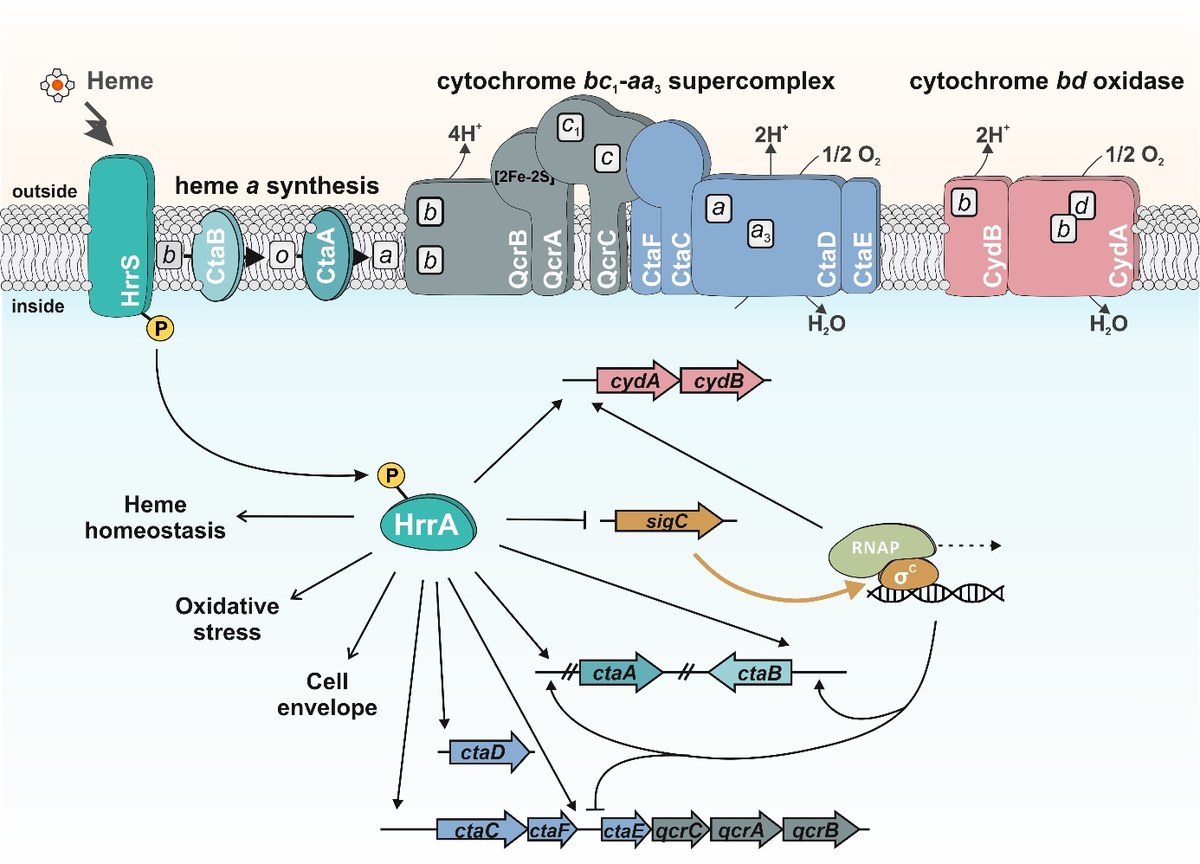
We are studying gene regulatory networks and signal transduction cascades controlling iron and heme homeostasis in the Gram-positive soil bacterium Corynebacterium glutamicum (Figure 3). We establish defined microbial communities to decipher the impact of heme- and siderophore-mediated networking on community dynamics. To achieve these goals, we are combining classical molecular microbiology methods with state-of-the art genome-wide profiling of DNA-binding proteins (ChIP-Seq), omics techniques (RNA-Seq) and mathematical modelling.
Selected publications
Krüger A, Keppel M, Sharma V, Frunzke J (2022) The diversity of heme sensor systems - heme-responsive transcriptional regulation mediated by transient heme protein interactions. FEMS Microbiol. Rev. 10.1093/femsre/fuac002.
Keppel M, Hünnefeld M, Filipchyk A, Viets U, Davoudi C-F, Krüger A, Mack C, Pfeifer E, Polen T, Baumgart M, Bott M, and Frunzke J (2020) HrrSA orchestrates a systemic response to heme and determines prioritization of terminal cytochrome oxidase expression. Nucleic Acids Res, doi: 10.1093/nar/gkaa415
Hünnefeld M, Persicke M, Kalinowski J, and Frunzke J (2019) The MarR-Type Regulator MalR Is Involved in Stress-Responsive Cell Envelope Remodeling in Corynebacterium glutamicum. Front Microbiol, doi: 10.3389/fmicb.2019.01039
Keppel M, Piepenbreier H, Gätgens C, Fritz G, and Frunzke J (2019) Toxic but tasty - Temporal dynamics and network architecture of heme-responsive two-component signalling in Corynebacterium glutamicum. Mol Microbiol, doi: 10.1111/mmi.14226
Keppel M, Davoudi E, Gätgens C, and Frunzke J (2018) Membrane Topology and Heme Binding of the Histidine Kinases HrrS and ChrS in Corynebacterium glutamicum. Front Microbiol, doi: 10.3389/fmicb.2018.00183.
Funding
