
Interaction engineering

Synthetic microbial communities
Microbial metabolism, signalling, and gene regulation evolved through interactions between microbes. Using synthetic microbial communities, we study how microbes exchange metabolites, communicate, and compete or coexist, revealing principles that govern community dynamics and resilience. A central focus is the microbial “race for iron,” in which bacteria deploy chemically diverse siderophores, uptake systems, and regulatory strategies. In communities combining prokaryotic and eukaryotic model organisms, we examine how microbes compete and cooperate for iron. Microfluidic cultivation, optogenetic tools, and in vivo biosensors allow us to resolve these interactions in space and time at single-cell resolution, providing a basis for designing robust and stable microbial consortia.

Utilization of third-generation feedstocks
Algae are considered as highly promising third-generation feedstock for microbial fermentation because they grow rapidly, require no arable land, and can be cultivated using CO2 and wastewater. Their high productivity, flexible biochemical composition, and simple processing make them a sustainable, efficient alternative to traditional feedstocks. Our work on alternative feedstocks focuses on the extremophilic microalgae Galdieria javensis and Cyanidioschyzon merolae, which convert carbon dioxide, sunlight and water into organic compounds (Figure X). After extraction of high-value metabolites such as phycocyanin and chlorophyll, the residual carbohydrate-rich algal biomass serves as 3rd generation feedstock for microbial fermentation. Using established biotechnolical platform organisms like Corynebacterium glutamicum or the fungus Ustilago maydis, we transform this biomass into amino acids, proteins, biosurfactants and organic acids through metabolic engineering and adaptive evolution. In the long term, integrated photo- and heterotrophic co-cultures will provide robust blueprints for circular, carbon-neutral bioprocesses.
Transcription factor-based biosensors & evolutionary engineering
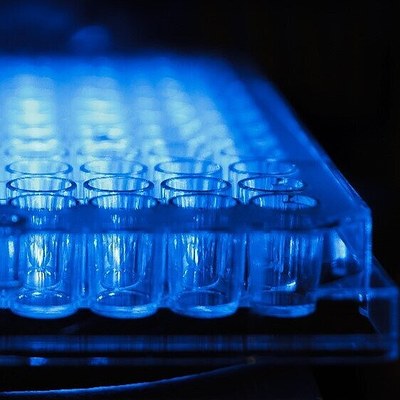
Transcription factor (TF)-based biosensors developed by our institute translate cellular signals into measurable outputs, enabling precise control and monitoring of the microbial metabolism. These biosensors exploit natural sensing systems for small molecules, ions, and physical parameters, allowing us to link growth to product formation and apply evolutionary engineering to enhance strain performance. By integrating next-generation sequencing, automation, and high-throughput evolution strategies, we streamline microbial hosts such as Corynebacterium glutamicum for industrial biotechnology. Our approach focuses on designing circuits that couple metabolic productivity to growth, providing a powerful strategy to improve small molecule production while deepening understanding of biological systems.
Selected publications
- de Witt J, Luthe T, Wiechert J, Jensen K, Polen T, Wirtz A, Thies S, Frunzke J, Wynands B, Wierckx N (2025) Upcycling of polyamides through chemical hydrolysis and engineered Pseudomonas putida. Nat Microbiol. 10(3):667-680. doi: 10.1038/s41564-025-01929-5.
- Mostafa F, Krüger A, Nies T, Frunzke J, Schipper K, Matuszyńska A. (2024) Microbial markets: socio-economic perspective in studying microbial communities. Microlife. 28;5:uqae016. doi: 10.1093/femsml/uqae016.
- Krüger A, Göddecke J, Osthege M, Navratil L, Weber U, Oldiges M, Frunzke J. (2024) Biosensor-based growth-coupling as an evolutionary strategy to improve heme export in Corynebacterium glutamicum. Microb Cell Fact. 14;23(1):276. doi: 10.1186/s12934-024-02556-1
- Stella RG, Gertzen CGW, Smits SHJ, Gätgens C, Polen T, Noack S, Frunzke J (2021) Biosensor-based growth-coupling and spatial separation as an evolution strategy to improve small molecule production of Corynebacterium glutamicum. Metab Eng, 68:162-173, doi: 10.1016/j.ymben.2021.10.003
- Tenhaef N, Stella R, Frunzke J, Noack S (2021) Automated Rational Strain Construction Based on High-Throughput Conjugation. ACS Synth Biol10(3):589-599, doi: 10.1021/acssynbio.0c00599.
- Stella RG, Wiechert J, Noack S, and Frunzke J (2019) Evolutionary engineering of Corynebacterium glutamicum. Biotechnol J, doi: 10.1002/biot.201800444
- Mahr R, Gätgens C, Gätgens J, Polen T, Kalinowski J, and Frunzke J (2015) Biosensor-driven adaptive laboratory evolution of l-valine production in Corynebacterium glutamicum. Metab Eng, doi: 10.1016/j.ymben.2015.09.017
- Mustafi N, Grünberger A, Kohlheyer D, Bott M, and Frunzke J (2012) The development and application of a single-cell biosensor for the detection of l-methionine and branched-chain amino acids. Metab Eng, doi: 10.1016/j.ymben.2012.02.002.
Funding:


