
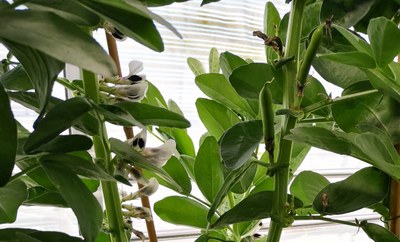
FABALOUS - Faba Bean Biotic and Abiotic Stress Tolerance for Improved Yield Stability
Faba bean is a legume producing seeds with high protein content and quality. At the same time, it is an important phytosanitary crop with positive impact on pollinators and soil fertility. It leaves a significant N surplus in the soil and therefore plays an important role in sustainable crop rotations, predominantly in organic agriculture.
Duration
May 2025 to May 2029
Contact

Björn Usadel
Building 06.5 / Room 2002
+49 2461/61-9503
E-MailThe „protein plant strategy“ of the Federal Government of Germany aims to increase the cropped area for legumes such by 2030 from below 3 % to 10%. However, biotic and abiotic stresses reduce both yield and interannual yield stability. Faba bean (Vicia faba) yield stability is particularly harmed by abiotic stress during reproductive stages, which is expected to occur more often under current climate change prospects, which makes faba bean less attractive for farmers despite its huge yield potential. However, faba bean breeding is lagging behind major crops due to different reasons: the large and complex genome, the partial allogamous fertilization system and the low multiplication rate. FABALOUS aims to improve yield stability under combined environmental stresses using a multidisciplinary approach. A combination of state-of-the-art genomics, plant biotechnology and stress physiology with the characterization of new genetic resources and the development of novel phenotyping approaches should reveal a near-complete picture of stress response in faba bean. Based on these findings, we want to develop breeding markers which can be used both immediately using the current breeding materials, but may also assist introgressing exotic material into the elite breeding pool.
Institutes involved
Bioinformatics (IBG-4)
Plant Sciences (IBG-2)
Partners
Justus-Liebig-University Gießen: Prof. Dr. Sarah Schießl-Weidenweber, Prof. Dr. Patrick Schäfer, Dr. Sruthy Maria Augustine, Dr. Lin-Bo Wu, Prof. Dr. Agnieszka Golicz, Prof. Dr. John Clifton-Brown, Prof. Dr. Jakob Santner
Georg-August University Göttingen: Dr. Lisa Brünjes
University of Bayreuth: Prof. Dr. Anna Cornelia Vlot-Schuster, Prof. Dr. Susanne Baldermann
Julius Kühn-Institute: Prof. Dr. Andreas Stahl
Leibniz Institute of Plant Genetics and Crop Plant Research: Prof. Dr. Nils Stein, Dr. Martin Mascher
NPZ Innovation GmbH: Hanna Tietgen
Funding