




Institute of Energy Technologies
Theory and Computation of Energy Materials (IET-3)
The research at IET-3 combines theoretical physics, computer simulations and physical modeling to study how energy materials form, function, fade and fail.
27 April 2026
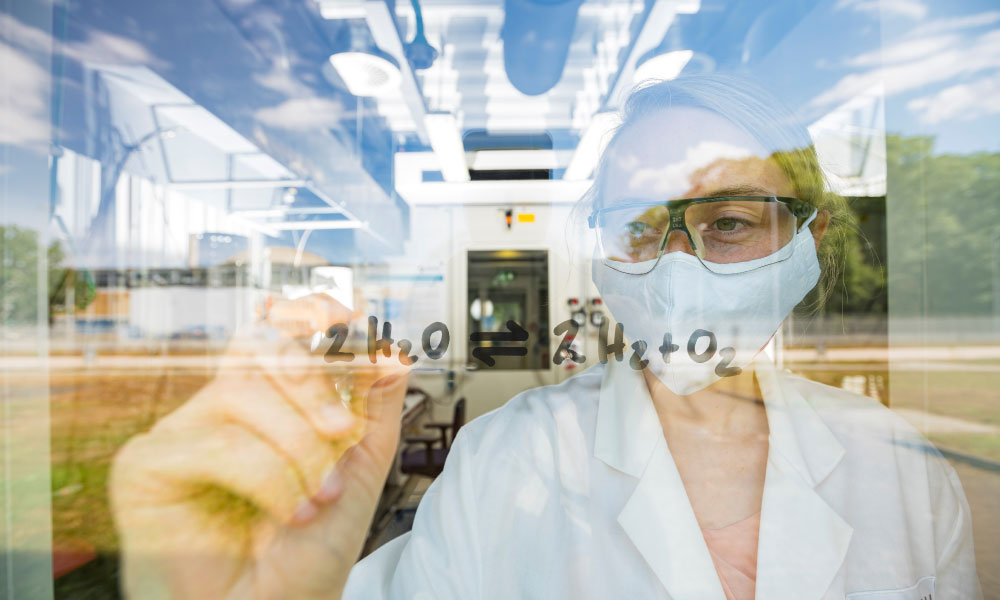
Electrochemical reactions are key to hydrogen production and CO₂ conversion. It has been known for decades that cations such as sodium ions can either speed up or slow down reactions. Researchers from Forschungszentrum Jülich and Leiden University have now found a surprisingly simple explanation.
Electrochemical processes typically take place at electrode–electrolyte interfaces. Cations, mobile charged particles that carry the electric current in the electrolyte do not directly participate in the chemical reaction, yet they strongly influence how easily it proceeds. Scientists have long referred to them as “spectator species”. Yet their dual role has remained unexplained since it was first observed in the 1930s.
In a modelling study published in Nature Communications, the team provides a unified physical picture of how cations control electrocatalytic reactions, using the hydrogen evolution reaction (HER) to probe the effect.
The key insight: Cations near an electrode do not behave as either “good” or “bad”. Both behaviours are possible, depending on the state of cations.
Some cations remain solvated in their liquid shell and accumulate close to the electrode surface. In this state, they enhance the local electric field and promote important reaction steps – for example the splitting of water during hydrogen production.
Other cations, however, partially lose their surrounding solvent molecules and adsorb onto the catalyst surface. In this case, they weaken the electric field and slow down the reaction. Which effect dominates depends on the balance between these two states.

Beyond solving this long-standing puzzle in experimental observations, the study highlights a broader principle: the importance of the local electric environment that exists in the boundary region between electrode and electrolyte.
The findings open up new opportunities for improving electrochemical technologies, such as water electrolysis for green hydrogen production.
By tuning how ions behave at the interface, especially how they interact with water, it may be possible to design electrolytes that enhance performance. In particular, combining different types of cations could offer a way to balance beneficial and detrimental effects, leading to more efficient catalytic systems.
Zhu, X., Binninger, T., Koper, M. T. M. & Eikerling, M.
Disentangling the Janus-faced effects of cations in electrocatalysis
Nat Commun (2026). DOI: 10.1038/s41467-026-71126-3