An international team involving researchers from Forschungszentrum Jülich has, for the first time, generated isolated magnetic hopfions induced by laser pulses. These intricately twisted magnetic structures are considered a promising approach for future information technologies.
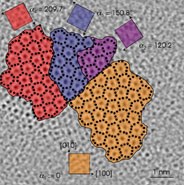
Isolated magnetic hopfionCopyright: Chen, X., Yang, D., Li, Z. et al., Nat. Phys. (2026), https://doi.org/10.1038/s41567-026-03236-0 (CC BY 4.0)
Hopfions are among the most complex magnetic configurations known. Unlike skyrmions—two-dimensional magnetic vortices that have already been studied extensively—hopfions are only just beginning to be explored and extend across all three spatial dimensions. Owing to their topological properties, they can exhibit enhanced stability .
Although hopfions are fundamentally extended structures, they can behave like classical particles: they can move under the influence of external forces and interact with one another. These properties make them promising candidates for applications in spintronics and neuromorphic computing systems.
Controlled generation using laser pulses
A key advance of the present work is that hopfions have now been created for the first time as isolated, independent objects by short laser pulses. Previously, they had only been observed in bound configurations—for example, as hopfion rings linked to skyrmions. This was previously demonstrated by researchers at Jülich, together with international partners, and published in Nature in 2023. An independent study recently published in Nature Materials reports the nucleation of magnetic hopfions by electrical current pulses.
For the experiments now presented in Nature Physics, the researchers used ultrashort laser pulses to briefly drive the material into an excited state. This makes it possible to overcome energy barriers that would normally prevent the formation of such complex structures. In fact, it has been shown that even a single laser pulse can be sufficient to generate hopfions.
The experimental work was carried out at the South China University of Technology and Nankai University in China, where both the laser experiments and high-resolution electron microscopy studies were performed. Researchers from the Peter Grünberg Institute and the Ernst Ruska-Centre made key contributions to the theoretical modelling, the interpretation of the experimental results, and the development of accompanying computer simulations. The work in Jülich was conducted within the framework of the ERC Synergy Grant “3D MAGiC”, which was specifically awarded to explore such three-dimensional topological spin structures.
original publication
Chen, X., Yang, D., Li, Z. et al. Laser-induced nucleation of magnetic hopfions. Nat. Phys. (2026), DOI: 10.1038/s41567-026-03236-0