
Loading
Energy-Efficient Cryogenic Pulse Generator for Advanced Qubit Control in Quantum Processors
TO-218 • PT 1.3179 • As of 07/2025
Peter Grünberg Institute
Integrated Computing Architectures (PGI-4)
Technology
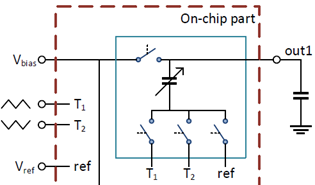
Our novel technology is an adiabatic pulse generator, specifically optimised for use at cryogenic temperatures crucial for quantum computing. This generator produces baseband pulses – signals in the low- to mid-frequency range (from 1 MHz to several hundred MHz) – needed to control, initialise, and read out qubits. Central to the design are two variable voltage inputs, a signal output to a capacitive load, and a signal shaping module made up of a switching unit and variable capacitance. By digitally multiplexing the two input voltages, custom pulse forms are created. The variable capacitance allows precise amplitude adjustment. Importantly, adiabatic charging greatly reduces energy dissipation, a major concern at cryogenic conditions. The design is CMOS-compatible and compact, enabling integration close to the qubits. This localised pulse generation provides highly accurate, low-energy control signals needed for advanced quantum computing in cryogenic setups.
Problem addressed
Traditional methods for controlling qubits in quantum computers face scaling and efficiency challenges. Typically, room-temperature electronics control the quantum processor via numerous coaxial cables, introducing excessive thermal load and space demands in the cryostat. As the number of qubits rises, these issues intensify, restricting system expansion and complicating wiring. Alternatively, integrating all electronics within the cryogenic area in the direct vicinity of the qubits can lead to unacceptable energy dissipation, conflicting with the strict cooling limits of dilution refrigeration. As a result, dense integration near qubits is blocked or significant trade-offs in performance, reliability, or possible qubit count become necessary. Previous strategies either failed to scale efficiently, generated too much heat, or imposed practical limits on quantum processor design and operation.
Solution
Our adiabatic pulse generator solves major limitations in current quantum hardware. Rather than generating all pulse shapes within the , this design receives two straightforward, externally generated voltage signals at higher temperatures and shapes them locally using an efficient switching and capacitance network. Custom pulse forms are created through digital control and adiabatic charging, substantially reducing energy loss in the cryogenic environment. This lets cryostats support more qubits without exceeding their cooling capacity. The system requires fewer low-frequency signal lines, reducing cable complexity, heat influx, and cost versus traditional setups. With adjustable amplitude and offset, digital configuration, and reliable sub-Kelvin operation in a compact CMOS implementation, this solution supports scalable quantum computing and cuts hardware barriers present in earlier technologies.
Benefits and Potential Use
This adiabatic pulse generator is essential for scaling up quantum computers. Its efficient, precise delivery of baseband pulses at cryogenic temperatures eliminates energy and wiring bottlenecks for quantum processor growth. Potential licensees include quantum computer manufacturers, cryogenic electronics integrators, and quantum system control platform developers. The technology enables systems with many more qubits while reducing cable and heat problems. Beyond quantum computing, its low-power, accurate pulse control serves cryogenic detectors, measurement arrays, and research requiring stable pulses at millikelvin temperatures. The CMOS-based, digitally configurable design supports easy adaptation to specific use cases. By adopting this technology, licensees can advance quantum hardware, reduce costs, and realise the broader potential of cryogenic and quantum platforms.
Development Status and Next Steps
Forschungszentrum Jülich (FZJ) has extensive expertise in this field and holds several patents. Our technology described above is continuously being enhanced. Our Peter Grünberg Institute (PGI-4) – Integrated Computing Architectures – already cooperates with numerous national and international companies and scientific partners. Forschungszentrum Jülich focuses on energy and cost-efficient devices suitable for application in various emerging technologies. We are thus constantly seeking cooperation partners and/or licensees in this field and adjacent areas of research and applications.
TRL
3-4
IP
EP 25187850.0
Further patent filing is being pursued.
Keywords
Adiabatic pulse generator, Cryogenic electronics, Quantum computing, Qubit control, Baseband pulses, Energy-efficient pulsing, Capacitive load
Contact us
Loading
More technologies
Loading
Last Modified: 20.05.2026