
Loading
Novel Circuit for Analog Content Addressable Memory (aCAM) with Enhanced Flexibility
TO-142 • PT 1.3042 • As of 01/2024
Peter Grünberg Institute
Neuromorphic Compute Nodes (PGI-14)
Technology
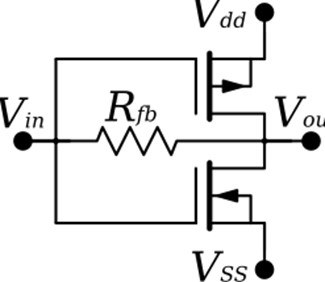
Our approach introduces a memristor based analog Content Addressable Memory (aCAM). Unlike conventional memory types like RAM, which access data based on memory addresses, aCAM allows data access based on content. This means that aCAM can search for specific data without requiring the exact memory address. It is often referred to as an "associative memory." The invented circuit includes a CMOS inverter and an adjustable resistor (Rfb) that electrically connects the input (Vin) and output (Vout) of the CMOS inverter. This innovative design enables each aCAM cell to provide both digital and continuous outputs, which enhances the flexibility in data processing.
Problem addressed
The motivation for the patent stems from the limitations in existing memristor based analog Content Addressable Memory (aCAM) technologies. Current aCAM designs cannot simultaneously achieve a high data capacity (aCAM) and the capability for differentiable operation (dCAM) in a single, compact circuit. This lack of flexibility leads to increased design costs and constraints. The existing dCAM designs have limitations in data capacity and selectivity between match and mismatch, while aCAM designs, due to their digital output characteristics, lack adequate error gradients necessary for example in optimization.
Solution
Our CAM technology offers several advantages over previous approaches. Firstly, it combines the features of analog CAMs (aCAMs) and differentiable CAMs (dCAMs), allowing for both binary and analog output in response to an applied analog input signal. This behaviour is realized by implementing a resistive feedback path between the input and the output of the inverter which allows for adjusting its gain and thus implements a more analog input output relation. Analog values can represent a measure of distance or similarity, providing more nuanced information. Secondly, the circuit design includes an adjustable resistor that allows for gradual changes in the output signal, rather than abrupt transitions. This enhances the flexibility and precision of the CAM. Overall, this technology offers improved performance, expanded capabilities, and greater adaptability to various applications.
Benefits and Potential Use
The patented technology has potential use in the development of novel analog associative memory and processing units, particularly in applications requiring gradient descent learning. Its ability to combine high data capacity and differentiable operation within a single circuit makes it especially suitable for advanced machine learning and artificial intelligence applications. This can lead to more efficient and compact designs for neural networks and other AI systems, enhancing their learning capabilities while reducing design costs and complexity.
Development Status and Next Steps
Forschungszentrum Jülich has extensive expertise in this field and holds several patents. The technology described above is continuously being developed further. The measurement capabilities resulting from the invention have already been demonstrated. The Peter Grünberg Institute (PGI-14) – Neuromorphic Compute Nodes – already cooperates with numerous national and international companies and scientific partners. Forschungszentrum Jülich focuses on energy and cost-efficient devices, suitable for various emerging technologies. We are continuously seeking for cooperation partners and/or licensees in this and adjacent areas of research and applications.
TRL
2
Keywords
Content-Addressable Memory, CAM, aCAM, dCAM, CMOS Inverter, Memristor, Resistive Feedback Path, Neural Network
Contact us
Loading
More technologies
Loading
Last Modified: 19.05.2026