Press Release
JUPITER Sets New Energy Efficiency Standards
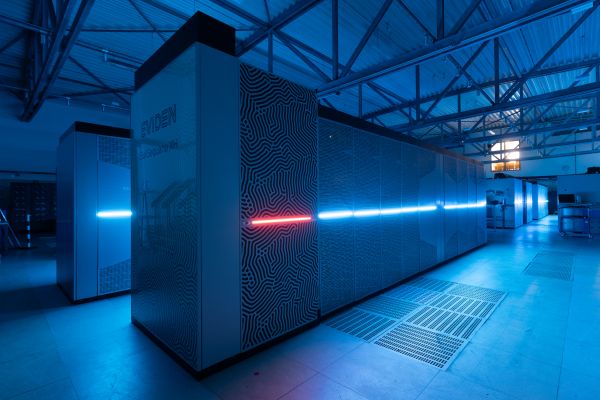
The first module of the European exascale supercomputer JUPITER, named JEDI, has ranked first in the Green500 list of the world’s most energy-efficient supercomputers.

SDG 9 aims to build a resilient infrastructure, promote inclusive and sustainable industrialization, and foster innovation. This involves not only modernizing the existing infrastructure in a sustainable way and improving resource efficiency in industry through environmentally sound technologies and processes, but also promoting scientific research, the technological capabilities of industrial sectors, and innovation.
Overview, targets and indicators of SDG 9
Forschungszentrum Jülich is helping to realize SDG 9 by providing science and industry with sustainable and energy-efficient access to innovative research infrastructure.
When it comes to the use of innovative research infrastructures, sustainability and energy efficiency are not mutually exclusive.
Since 2025, the Jülich Supercomputing Centre (JSC) has been operating JUPITER, Europe’s first exascale supercomputer, and JUNIQ, the first European quantum computing infrastructure. JUPITER is capable of training and applying huge AI models and enables scientific simulations with unprecedented accuracy.
It will provide a significant boost to research into sustainable energy systems, for example through the optimization of power grids and the development of innovative energy storage materials and hydrogen technologies. The system will also help to predict natural disasters and climate changes with greater accuracy, develop new drugs to treat diseases that are still poorly understood, and improve our understanding of the human brain.
JUPITER runs entirely on green electricity and is equipped with highly energy-efficient processors. According to the TOP500 list (as of June 2025), it is the most energy-efficient of the world’s five fastest computers. Thanks to its highly efficient warm water cooling system, the waste heat generated during operation can be used to heat buildings. This will help cover a large proportion of Forschungszentrum Jülich’s heating requirements in future.
JUPITER is housed in an innovative modular data centre with around 50 container modules. This offers numerous advantages, such as:

Energy consumption – in this case, green electricity – and potential heat recovery options were important considerations for JUPITER during the procurement phase. JUPITER’s hardware offers diverse opportunities for energy optimization
Learn more about JUPITER’s technical design and find out why the system will play a significant role in advancing research in the future.