
Loading
Enhanced ATR-FTIR Cell Setup for Electrochemical Analysis of Electrode and Electrolyte Processes
TO-178 • PT 1.3113 • As of 07/2024
Institute of Energy Materials and Devices
Ionics in Energy Storage (IMD-4 / HI MS)
Technology
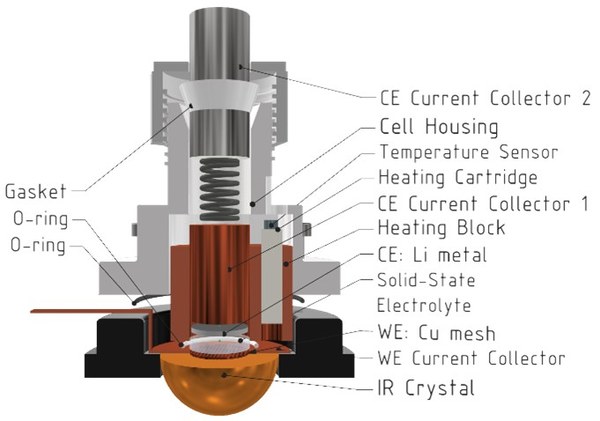
Our novel technology is an innovative design for a spectroscopic cell. This airtight cell is designed for the ATR-FTIR spectroscopic examination of electrochemical electrode and electrolyte processes. The cell has a specific structure that includes a heating sleeve with an electric heating element. This allows for a simple and consistent temperature control of the electrode and electrolyte assembly under examination. The cell itself does not contain any structures for carrying out FTIR measurements. It is however designed so that it can be placed on an ATR crystal of an FTIR spectrometer and provides a sample compartment that can easily be fitted with different electrode and electrolyte configurations.
Problem addressed
Batteries, crucial for mobile applications, have seen significant improvements in performance and longevity over the years. However, challenges persist in enhancing battery power and reducing costs. The reversible charging and discharging of batteries, influenced by electrochemical processes at the electrodes and in the electrolyte, is a key functionality. Analysing these processes requires tailored solutions and a variety of electrode and electrolyte materials. The investigation of solid electrolytes or polymer electrolytes, whose properties are suitable for battery applications only at temperatures above 50°C, is particularly important. Current spectroelectrochemical cells must be airtight and capable of controlling additional environmental and operational parameters. However, existing infrared spectroscopic devices have limitations in their design and functionality. Therefore, there is a need for innovative approaches that address these issues and offer a more efficient and cost-effective solution for battery analysis.
Solution
The innovative cell design described above allows for cost-effective, reliable, and highly accurate cell and electrode temperature control, significantly expanding the cell's range of applications. It enables the tracking of electrode and electrolyte reactions under different temperature conditions and the study of the influence of cyclic temperature changes on the electrode and electrolyte processes of different electrode materials. This design is advantageous compared to existing cell designs, which lack the ability to precisely control the temperature. The cell can be easily adapted and is significantly cheaper as it may also be 3D printed. Moreover, it allows for the examination of liquid, solid, and hybrid electrolytes.
Benefits and Potential Use
The cell is suitable for the ATR-FTIR spectroscopic investigation of electrochemical electrode and electrolyte processes. It is designed so that it can be placed on an ATR crystal of an FTIR spectrometer. The cell offers a sample chamber that can be filled with different electrode and electrolyte assemblies. This enables the investigation of electrochemical processes at different electrodes and in different electrolytes. The infrared light used for the investigation is emitted into the cell from below through the ATR crystal. The cell contains a current collector for the working and counter electrode, but also a reference electrode can be implemented.
Development Status and Next Steps
Our technology is continuously being enhanced. Our Institute of Energy Materials and Devices – Ionics in Energy Storage (IMD-4 / HI MS) already cooperates with numerous national and international companies and scientific partners. Forschungszentrum Jülich focuses on energy and cost-efficient devices suitable for application in various emerging technologies. We are thus constantly seeking cooperation partners and/or licensees in this field and adjacent areas of research and applications.
TRL
4
Keywords
ATR-FTIR Spectroscopy, Spectroelectrochemical cell, Attenuated total reflectance, Electrolyte Analysis, Electrochemical Cells, Electrolyte Assemblies, 3D printing
Contact us
Loading
More technologies
Loading
Last Modified: 02.06.2025