
Loading
Dynamical Microstructures through Microfold
TO-203 • PT 1.2894 • As of 01/2025
Institute for Advances Simulation (IAS)
Theoretical Physics of Living Matter (IAS-2)
Technology
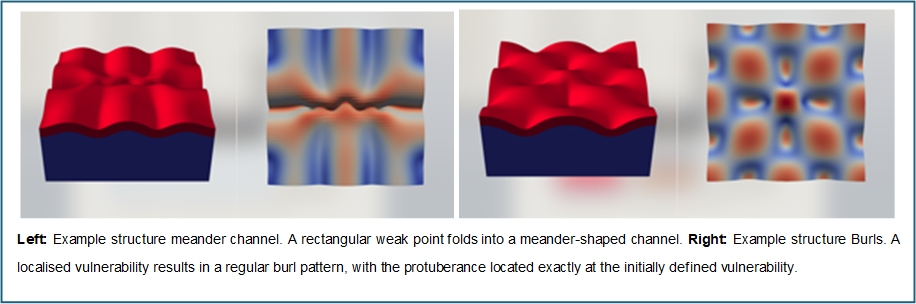
The properties of surfaces play a decisive role in countless products and manufacturing processes. The aim of surface technologies is to change and functionalise surface properties, which is achieved, for example, by creating geometrically and topographically structured surfaces. They play an important role in almost all manufacturing processes, from the metalworking industry to the semiconductor industry all the way up to biomedicine. Inspired by a scientific project on brain folding, we developed the idea of structuring surfaces of elastomers by controlling wrinkling patterns using masks. With our in-house HPC simulations, we are able to predict the structures resulting from particular masks. In this way, we can structure surfaces in a targeted manner and, for example, produce microfluidic chips or structured cell culture dishes. In addition to accelerated development cycles and lower costs due to less complex processes, our technology in particular enables novel functionalised and dynamic surfaces.
Problem addressed
The key problem of current surface structuring methods is, that the resulting structures are static. This is more problematic than might be seen at first glance. For example, the static structures are in the way when coating the surface: A deposited functional layer like fibronectin for cellular adhesion will always face problems with inhomogeneities correlated with the structure. Dynamic applications, where the structure changes and adapts, are only conceivable if the underlying structure is also dynamic.
Solution
We offer a dynamic and cost-effective process to create microstructures. An elastomer like a silicone rubber or hydrogel is stretched. Using a mask, a well controlled part of the surface is hardened. Upon release, the elastomer-surface folds into a three dimensional microstructure. Thanks to our HPC-Computer simulations, this structure can be predicted, and thus masks for desired structures designed.
Benefits and Potential Use
Dynamic Microstructures allow improvements of current structured surfaces and completely novel applications: For one, the dynamic microstructures allow for a more homogeneous coating. For example, a homogeneous layer of fibronectin or other proteins can be deposited on the surface, while still flat in the stretched state. Upon release, the surface folds into a three-dimensional structure, with a homogeneous layer ontop. On the other hand, fully dynamic applications are conceivable. For example, chemical compounds can be released upon stretch, or cellular response to sudden structural changes can be measured.
Development Status and Next Steps
The technology described above has already been initially verified through prototypes and is continuously being developed further. We are continuously seeking for cooperation partners and/or licensees in this and adjacent areas of research and applications.
TRL
4
IP
WO2022012825
Keywords
Surfaces, Microfluidics, cell culture
Sectors
- Surface technologies
- Microfluidics
- Cell culture systems
Contact us
Loading
More technologies
Loading
Last Modified: 01.10.2026