

Loading
Reopenable solar modules for easier recycling
TO-236 • PT 1.3184 • As of 02/2026
Institute of Energy Materials and Devices
Photovoltaics (IMD-3)
This technology introduces a reopenable glass edge encapsulation that enables non-destructive end-of-life disassembly via a thermally removable sacrificial interlayer, without compromising reliability, safety, or environmental resistance.
Technology
The technology uses a thermally activatable sacrificial layer integrated between conventional polyisobutylene edge encapsulants. During operation, the module remains fully sealed and weather-resistant, providing long-term stability Only upon targeted heating does the layer release, enabling controlled, non-destructive opening at end of life.
Problem addressed
Photovoltaic modules are designed for maximum operational lifetime, but their permanent encapsulation makes non-destructive disassembly at end of life difficult. Commonly used edge-sealing materials such as polyisobutylene require the application of mechanical forces during separation of glass–glass encapsulated modules, often resulting in substantial material losses, rendering recycling processes technically complex and economically unattractive.
Solution
The integrated sacrificial layer acts as a planned, controllable separation mechanism that is activated only at moderate temperatures of around 80-100 °C, enabling clean separation of the glass panes. In contrast to conventional encapsulation concepts, this approach allows non-destructive disassembly without mechanical force, facilitating the high-purity recovery of valuable module materials.
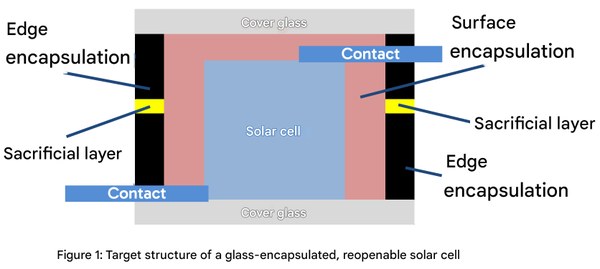
Advantages:
· Significantly reduced recycling costs due to easy, non-destructive separation.
· Low energy requirement for disassembly.
· High compatibility with existing module architectures.
Disadvantages:
· Additional material and processing step required during module manufacturing.
· Industrial long-term validation of the sacrificial layer required.
Benefits and Potential Use
The technology primarily targets photovoltaic module manufacturers seeking to align their products early with upcoming recycling requirements. It is also relevant for PV recycling companies, providers of sustainable energy systems, and circular economy stakeholders who value high material recovery rates.
Development Status and Next Steps
The technology is at TRL 3-4 with core functionality successfully demonstrated under laboratory conditions, while transfer to industrial processes is still pending. Interested industrial partners have several cooperation models available, including technology licensing, joint development projects to adapt to existing production lines, and pilot projects to validate performance under industrial conditions.
TRL
3
Keywords
Photovoltaics, solar cell, recycling
Sectors
- Photovoltais
CONTACT US

- Institute of Energy Materials and Devices (IMD)
- Photovoltaics (IMD-3)
Building HIERN-Immerwahrstr /
Room 08
Room 08
+49 9131-12538337
E-Mail

- Institute of Energy Materials and Devices (IMD)
- Photovoltaics (IMD-3)
Building HIERN-Immerwahrstr /
Room 2.3
Room 2.3
+49 9131-12538303
E-Mail
More technologies
Last Modified: 30.09.2026