
Research Focus
Quantum Technology
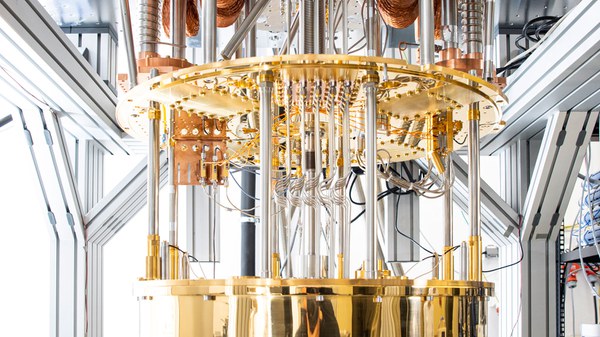
Quantum computers are changing computing in a fascinating way. At Jülich, we are testing systems and prototypes that users from all over Europe can utilize for their development work.
7 August 2026
Manganese bismuth telluride (MnBi₂Te₄) is a promising material in topological quantum research. However, previous measurements have yielded conflicting results. Researchers at Forschungszentrum Jülich and Oak Ridge National Laboratory have now found a possible explanation.

MnBi₂Te₄ combines two rare properties: topological surface states and intrinsic magnetism. What makes it unique is that the magnetic manganese atoms are an integral part of the crystal lattice, rather than being introduced into the material at a later stage.
The crystal consists of stacked blocks. Within each block, the magnetic moments align parallel to each other; in neighbouring blocks, however, they align antiparallel. The number of blocks therefore serves as a control parameter for the electronic properties. Thin samples with an odd number of blocks can form a quantum anomalous Hall state, while an even number of blocks can result in an axion insulator.
In the quantum anomalous Hall state, current ideally flows in only one direction along the edge of the sample with virtually no energy loss. In the long term, this could be of interest for energy-efficient electronics and antiferromagnetic spintronics.
An axion insulator, on the other hand, is electrically insulating, yet exhibits special quantised coupling between electric and magnetic fields. This opens up prospects for magnetoelectric and optical quantum effects. However, this is still basic research: so far, these effects have only occurred under specific conditions and at low temperatures.
The energy gap of the topological surface states plays a central role when the energy gap shrinks. This does not refer to a spatial gap, but rather to an energy range in which no electronic states are available. In experiments, however, this gap has often turned out to be smaller than expected, or has not been detected at all. This can lead to unwanted conduction paths and make the topological properties of the material difficult to control.
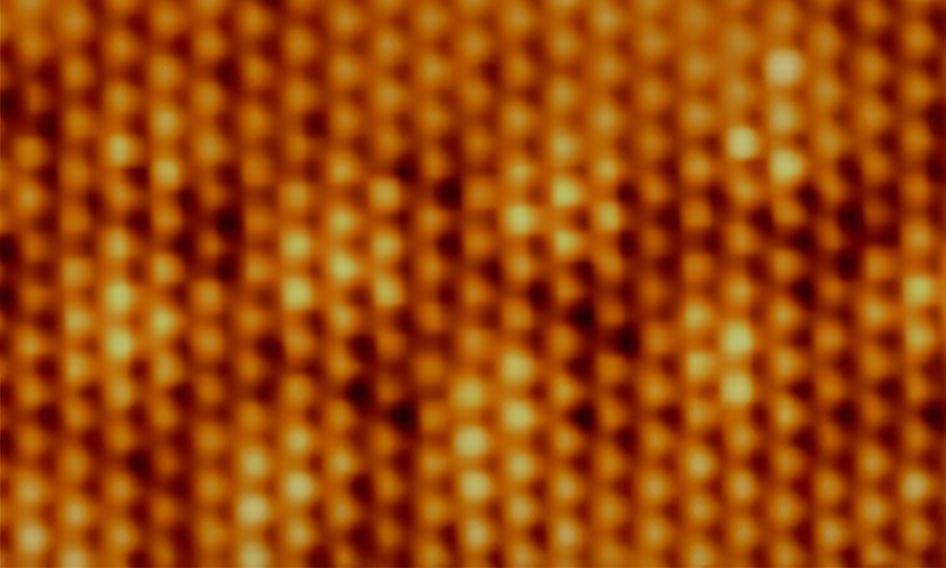
Researchers from the Peter Grünberg Institute (PGI-3) in Jülich and Oak Ridge National Laboratory (USA) have now identified a possible cause of this phenomenon: so-called antisite defects. In these defects, atoms occupy the wrong position in the crystal lattice. While this does not immediately destroy the topological surface state, the state's quantum mechanical wave function shifts from the outermost atomic layer to deeper layers of the material.
Consequently, it becomes virtually invisible to surface-sensitive measurement techniques, though methods with greater penetration depth can still detect it. Using scanning tunnelling microscopy, photoemission spectroscopy and theoretical modelling, the researchers were able to show that the more antisites there are, the deeper the topological surface states are ‘submerged’ beneath the crystal surface.
These results explain why earlier measurements were sometimes contradictory. At the same time, they demonstrate the crucial importance of controlling atomic defects. If antisites can be directly controlled, MnBi₂Te₄ could, in the long term, become a reliable platform for topological and spintronic devices.
Felix Lüpke, Marek Kolmer, Hengxin Tan, Hao Chang, Adam Kaminski, Binghai Yan, Jiaqiang Yan, Wonhee Ko, An-Ping Li
Defect-Induced Displacement of Topological Surface State in Quantum Magnet MnBi2Te4
Phys. Rev. Lett. (2026), DOI: https://doi.org/10.1103/pt1j-996m

Group leader at Peter Grünberg Institute (PGI-3)