World Alzheimer’s Day: What We Can Do to Prevent Dementia
World Alzheimer’s Day: What We Can Do to Prevent Dementia
18 September 2026
September 21 is World Alzheimer's Day. Prof. Svenja Caspers is researching how the human brain ages – and why some people remain mentally fit well into old age, while others develop cognitive impairments much earlier.
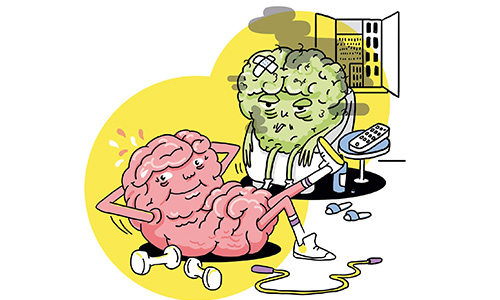
Prevention can help delay the onset of the disease or slow its progression.Copyright: AdobeStock
In this interview, the neuroscientist from Forschungszentrum Jülich and Heinrich Heine University Düsseldorf explains how the risk of developing dementia can be influenced even today and why health data could play a crucial role in more targeted dementia prevention in the future.
Prof. Svenja Caspers Copyright: Forschungszentrum Jülich / Ralf-Uwe Limbach
Professor Caspers, many people consider dementia in old age to be nearly inevitable. Is that true?
No. Of course, not every case of dementia can be prevented. But we now know that a number of modifiable factors contribute to the risk of developing the disease. These include, for example, high blood pressure, lack of physical activity, smoking, high cholesterol levels, and social isolation. Education and mental activity also play a role. Prevention can therefore help delay the onset of the disease or slow its progression. The key point is this: Our brains remain malleable even in old age – and every brain ages differently.
You are committed to "data-driven dementia prevention." What does that mean?
Today, we can generally recommend getting enough exercise, not smoking, or treating risk factors such as high blood pressure. In the future, we’d like to be able to say much more precisely which measures are particularly important for a specific person. To do this, we need to bring together different types of information – such as data from long-term studies, medical examinations, and possibly also digital biomarkers from everyday life. With such data and modern analytical methods, we could develop individualized risk profiles and tailor prevention strategies more precisely. This is precisely where the great potential lies.
What are you working on in this regard at Forschungszentrum Jülich and Heinrich Heine University Düsseldorf?
I am particularly interested in the question of why brains age so differently. We are studying large population groups – for example, in cohort studies involving many thousands of participants – and combining information about the brain’s structure and connectivity with factors such as lifestyle, environment, and genetics. Such large datasets enable us to identify patterns that would not be visible in individual people. Based on these patterns, our long-term goal is to better understand what makes a brain resilient and how this knowledge can be used for more personalized prevention of dementia.