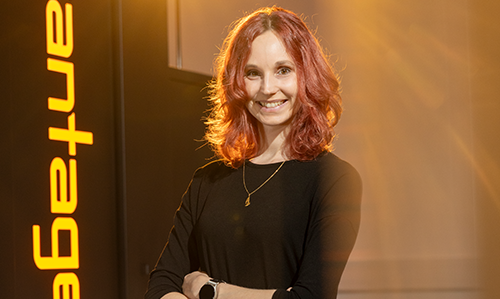
“I actually wanted to become a marine biologist,” admits Dr. Kimberley Lothmann. “I wanted to make the world a better place. But then I ended up in neuroscience, because I think our understanding of the brain could also do with a little improvement. We are still a long way from fully understanding how the most complex human organ works.”
Kimberley Lothmann arbeitet am Julich Brain Atlas, einem Herzensprojekt: „Das Gehirn ist die Schaltzentrale jedes einzelnen – egal wie alt, egal wie reich – der Gehirnatlas verbindet uns alle.“ Copyright: Forschungszentrum Jülich /Sascha Kreklau
The scientist teaches at Heinrich Heine University Düsseldorf and conducts research at Jülich’s Institute of Neuroscience and Medicine (INM-1), where she is helping to map the human brain: “The Julich Brain Atlas is a three-dimensional digital map of the brain – a sort of Google Maps for this complex organ.” It shows how the various cell types are distributed throughout the brain, where the connections between neurons are, and how receptors that bind neurotransmitters are distributed.
Developing AI models to expand EBRAINS’ services: Christian SchifferCopyright: Forschungszentrum Jülich / Sascha Kreklau
The Julich Brain Atlas forms the centrepiece of the European digital research infrastructure EBRAINS, which emerged from the EU’s Human Brain Project. “Through EBRAINS, the brain atlas is made available to the international scientific community and provides the foundation for further research,” says Lothmann. The atlas benefits basic research – for example, work on brain models and simulations of neuronal processes. In future, however, the data could also be of interest for developing new drugs or neuroimplants, for example in the treatment of Parkinson’s disease. They could also drive the development of new AI algorithms and energy-efficient neuromorphic computers inspired by the brain.
EBRAINS brings together 41 institutions involved in brain research and provides around 17,000 users worldwide with access to data and software. The computing power required for this is also provided at Jülich. Forschungszentrum Jülich coordinates the German node of the international project and the platform is currently being further developed. EBRAINS 2.0 aims not only to facilitate research, but also to bring together and interlink the collected data.
Huge volumes of data
Computer scientist Dr. Christian Schiffer (also INM-1) is developing AI algorithms to process the huge amounts of data generated for the Julich Brain Atlas. For the atlas, up to 8,000 thin sections are prepared from donated human brains. The sections are stained so that the nerve cells can be visualized and scanned using high-resolution automated microscopes. “This allows us, for example, to determine the distribution of neurons in the respective brain regions,” explains Schiffer.
Traditionally, this was done by eye, but given the enormous volumes of data that need to be processed, it is extremely time-consuming. “We’re talking about hundreds of terabytes, or even several petabytes. We’re reliant on supercomputers and AI models if we want to digitally model and understand the human brain,” says the researcher. The new exascale supercomputer JUPITER is helping with this.
The models that Schiffer is training on the supercomputers are intended to automatically analyse the digitized brain sections in future, for example to determine cell density or identify brain regions. “However, we are also working on a foundation model for brain research. Instead of numerous specialized models, this would be a large, more powerful model trained on vast amounts of data that can be adapted to many different use cases – comparable to the large language models behind chatbots such as ChatGPT.”
The fact that brain researchers and computer experts work virtually side by side at Jülich is a major advantage for Schiffer: “If challenges arise, I can discuss them directly with my colleagues,” says the computer scientist. These are ideal conditions for further developing the tools and models from the EBRAINS infrastructure for the benefit of as many users as possible across Europe.
How it began: The roots of brain research at Jülich stretch back to its founding years. From the 1990s onwards, research into imaging techniques and the neurosciences grew out of Jülich’s expertise in nuclear chemistry and nuclear medicine. A range of large-scale instruments were acquired, such as for magnetic resonance imaging (MRI). The aim was to gain a better understanding of the brain and to combat diseases such as Alzheimer’s and tumours. Jülich has produced a range of innovations, such as the FET-PET for detecting brain tumours and the BigBrain model. EBRAINS bridges the gap between neuroscience and computing, facilitating new insights and innovative infrastructure.
70 Years of Forschungszentrum Jülich – Our History
For 70 years, the Forschungszentrum Jülich has been tackling the big questions of our time. From energy research and supercomputing to AI and the sustainable circular economy: this journey through time highlights the milestones on the path to becoming one of Europe’s largest interdisciplinary research centres.