
Loading
Innovative Approach for the Detection of Dynamical Changes in Gravitational Fields with Improved Accuracy
TO-130 • PT 1.3025 • As of 10/2023
Peter Grünberg Institute
Quantum Computing Analytics (PGI-12)
Technology
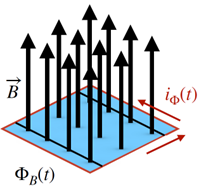
The aim of our novel technology is to measure absolute values or gradients of a gravitational field. We thus offer a completely novel approach to convert local dynamical gravitational fields (e.g., those generated by an oscillating mass or a gravitational wave) into measurable electric currents. Using a predefined magnetic field and an electrical conductor loop surrounding a two-dimensional surface, we can detect electrical signals induced in the conductor loop in response to changes in the magnetic flux due spatiotemporal distortions. In particular, our method considers temporal changes of the gravitational field at a stationary location, or changes caused by the movement of the conductor loop in a spatially varying gravitational field. A simple implementation is that of a static magnetic field, and a conductor loop that can have a rectangular shape with a field-free gap between the boundaries of the surface area and the enclosed part of the magnetic field.
Problem addressed
The current state of the art for detecting gravitational fields and their gradients has significant limitations. Such technologies rely on localised classical machines, large interferometers or ultracold physical systems operating in the quantum regime. Each conventional approach has its drawbacks. Mechanical systems based on mass require precise control over the motion and position of a physical reference object, leading to problems in monitoring and stabilising the system. Interferometer-based technologies are bulky and require a significant number of personnel to operate, with space-based interferometers being prohibitively expensive. Gradiometers designed to operate on moving carriers offer more applications, but suffer from increased sources of noise, such as vibrations. Regardless of the specific type of technology, one of the main sources of noise is related to the issue that the reference physical mass used as the basis for the measurement must be monitored with high accuracy. Stabilisation of the moving component as reference part of the gradiometer, as well as inclusion of torque forces within the overall effect, is thus critical for optimal instrument performance.
Solution
As a main advantage, our new approach eliminates the need for any moving proof masses – such as compact objects or clouds of cold atoms in conventional technologies – within the measuring device, simplifying the overall setup and reducing potential sources of error. The closed loop, e.g., a solenoid immersed in a magnetic field, allows for the direct detection and measurement of electric currents caused by changes in the curvature of spacetime. This direct interface with an electric circuit streamlines the signal-transduction process. Additionally, the adjustable field-free gap, a key parameter of our invention, provides flexibility and control over the magnitude and effects of gravitational field variations.
Benefits and Potential Use
Overall, our technology offers a versatile and efficient approach to the detection and utilisation of dynamic changes in gravitational fields, opening up a wide range of possible applications in different technological fields. Firstly, it enables gradiometry, which involves measuring the gradient of a gravitational field. This can potentially serve commercial applications in geophysics, environmental monitoring, and oil and mineral exploration. Secondly, it allows for the sensing of dynamical gravitational fields, which are gravitational fields that change due to the dynamics of external sources. This can be useful in fields such as astrophysics and space exploration. Thirdly, our technology has implications for fundamental science, providing an innovative tool for studying and understanding gravity.
Development Status and Next Steps
The concept of Forschungszentrum Jülich’s technology described above is continuously being developed further. The Peter Grünberg Institute (PGI-12) – Quantum Computing Analytics – already cooperates with numerous national and international companies and scientific partners. Forschungszentrum Jülich focuses on energy and cost-efficient devices, suitable for various emerging technologies. We are continuously seeking for cooperation partners and/or licensees in this and adjacent areas of research and applications.
TRL
4
IP
EP23158220.6
WO2024/175637
Keywords
Gravitational field detection, gravitational waves, gravity, gradiometer, interferometer, field-free gap, electrodynamics in curved spacetime
Contact us
Loading
More technologies
Loading
Last Modified: 31.03.2026