

Realistischere Zellsubstrate
Transfer Talents
Pioneers – Researchers and Their Innovations
Some people turn research into papers. Others turn it into products. At Forschungszentrum Jülich, a new generation of founders is doing both: spotting problems, building prototypes and pushing science out into the world.
June 2026


Andreas Kuhlmann & Marten Huck
Co-founders of 7EX Technologies
Institute for a sustainable Hydrogen Economy - Catalytic Interfaces (IHE-1)
Lithium is everywhere now: in smartphones, power tools, electric cars and the batteries that store renewable energy. Demand is rising fast. But mining new lithium is hard on the environment, while recycling it has often been more difficult and more expensive than digging up fresh material.
7EX Technologies wants to change that equation. The team is developing a way to recover high-purity lithium from used batteries and industrial wastewater without relying on the aggressive acids common in conventional recycling. Even tiny traces of the alkali metal can be extracted electrochemically from liquid streams and battery residues — powered by renewable electricity.
Huck and Kuhlmann are preparing the spin-off and working toward modular systems that can recover lithium right where battery waste is generated. The goal is simple: turn an expensive disposal problem into a local source of a critical raw material.
»It doesn’t have to be perfect. It has to work.« – Marten
»Small steps matter — they add up.« – Andreas
When did you realize: “This has potential?“
Andreas & Marten: During our electrochemical measurements, we made some interesting observations that led us to formulate several hypotheses. Our professor then said, “We could probably file a patent for that.” As our research progressed, we were able to support these hypotheses using two additional measurement methods, which was very exciting and really set things in motion.
What was the best advice a colleague has ever given you?
Andreas: “Work isn’t everything. You should treat yourself from time to time.”
Marten: “It doesn’t have to be perfect – it just has to work.”
The best innovation of the 21st century?
Andreas: Modern smartphones, considering how useful they are and how dependent we have become on them.
Marten: For me, it’s 3D printing. The ability to create almost anything imaginable quickly and at low cost is remarkable and has a wide range of applications. The technology continues to evolve, enabling the use of more and increasingly complex materials and opening up new fields of application.
Your lifehack for generating new ideas?
Andreas: My best ideas usually come when I’m not actively thinking about work and am doing something completely different—they almost seem to come to me out of nowhere. There is scientific evidence behind that as well. Otherwise, a good night’s sleep always helps me return to work with a fresh perspective.
Marten: Walking and hiking outdoors in beautiful surroundings help me develop new ideas and overcome creative blocks.

Dr. Rachel Maier
Co-founder of Twinetic
In factories, energy losses rarely announce themselves. Electricity, heat and compressed air disappear into daily operations as quietly as they drain budgets. Companies that want to save energy often begin with the least inspiring tool imaginable: spreadsheet after spreadsheet of CO2 and consumption data.
Twinetic replaces that manual slog with a digital twin. Its AI scans industrial sites in real time, showing where electricity is being wasted and where heat escapes unused. Within minutes, it can generate forecasts and optimisation recommendations that would otherwise take specialists hours, sometimes days.
Maier helped build the company while still working on her doctorate at Forschungszentrum Jülich. Today, she leads development at Twinetic and helps industrial customers make their operations leaner, cleaner and more efficient.
»For new ideas, I often need to step away from the laptop.«
When did you realize: “This has potential?“
We experienced that moment as a team when our first strong partnerships integrated our software into a tangible solution offering. This transformed our research into a key component of a comprehensive solution for businesses.
What was the best advice a colleague has ever given you?
One piece of advice that has had a lasting impact on me is: “Kill your darlings.” As difficult as it may be, you need to regularly question your ideas and assumptions and have the courage to let them go, even when you have already invested a great deal of passion and effort in them.
The best innovation of the 21st century?
AI tools that support work processes and significantly increase efficiency.
Your lifehack for generating new ideas?
For new ideas, I often need some distance from my laptop. When I’m on my own, a walk or simply a pen and paper helps me organize my thoughts. As a team, we turn to a whiteboard and discuss ideas there without distractions.

See Yuan Choo
Second place, JUICE Innovation Contest 2025 | H2Cycle
Institute for a sustainable Hydrogen Economy - Process and Plant Engineering (IHE-4)
Factory exhaust is not always just waste. Hidden in some industrial flue gases is valuable hydrogen — a resource that still too often disappears up the chimney. H2Cycle wants to catch it before it is lost.
Choo’s idea is to separate hydrogen directly at the factory exhaust pipe and store it on site using LOHC technology — liquid organic hydrogen carriers, which can absorb hydrogen and hold it in liquid form. The system would then release the hydrogen where the plant needs it and feed it back into the production process.
Her first business model imagines the technology as a compact unit installed directly at industrial sites. It could help companies cut costs, use resources more efficiently and turn an overlooked waste stream into part of a circular hydrogen economy. The concept earned her second place in the JUICE Innovation Contest 2025.
»My filter for every decision is simple: does this step take me closer to the goal?«
When did you realize: “This has potential?“
From day one, I recognized that my research topic had strong potential for impact. It introduces a novel approach to a key building block in the chemical process industry, and if validated, it could enable new applications and open up new possibilities for how waste gases are treated.
What was the best advice a colleague has ever given you?
A piece of advice that has really stayed with me is to consistently return to the objective. It’s shaped the way I work by helping me evaluate decisions and daily tasks through a simple lens: does this action move me closer to the goal? If not, I adjust—so my time and effort stay aligned with the outcome I’m aiming for.
The best innovation of the 21st century?
AI. It significantly speeds up my workflow and improves my overall productivity, especially when it comes to researching information, creating summaries and automating repetitive tasks, so I can focus more of my time on higher-impact work.
Your lifehack for generating new ideas?
I usually talk things through with people from different fields—fresh eyes often help me see my results in a new way. And if I’m really stuck, I take a break and come back to it later; clearing my head often makes the ideas click.
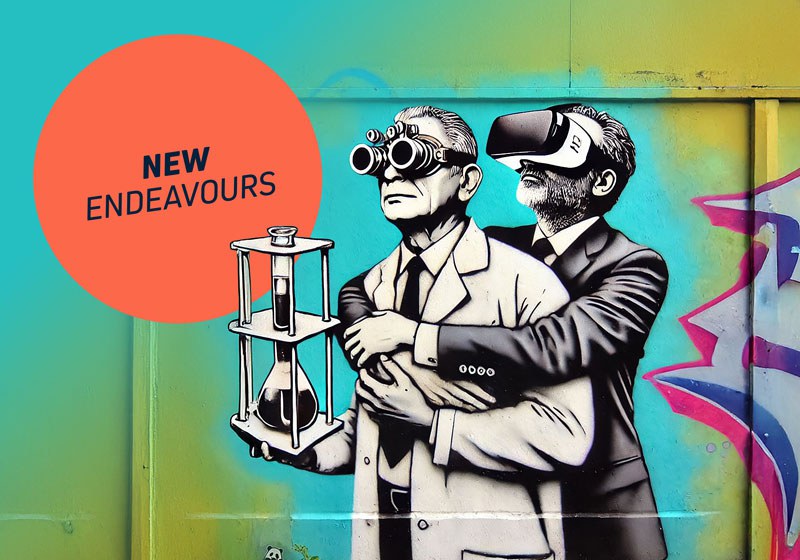
Tiefer Blicken: Die aktuelle Ausgabe
Gemeinsam geht mehr – besonders, wenn Forschung, Industrie und Gesellschaft ihre Perspektiven verbinden. Dann entstehen Lösungen, die größer sind als die Summe ihrer Teile.
Im Endeavours-Magazin zeigen wir, wie Co-Creation gelingt: mit echten Geschichten von Kooperation, Pioniergeist und Transfer. Für eine Zukunft, die wir gemeinsam gestalten können.
Weitere Artikel


Service: Transfer und innovation


Last Modified: 09.07.2026