
The rhythm of swarms
10 December 2025
Researchers from Konstanz and Jülich realize tunable “swarmalators” – particles that both move in space and synchronize in time like living organisms

A collaboration between the University of Konstanz and Forschungszentrum Jülich has achieved the first fully tunable experimental realization of a long predicted “swarmalator” system. The study, published in Nature Communications, shows how tiny, self-propelled particles can simultaneously coordinate their motion and synchronize their internal rhythms – a behaviour reminiscent of flashing fireflies, japanese tree frogs or schooling fish. The results underline how collective dynamics can arise from simple interactions, without overarching leadership or control. Possible applications include autonomous robotic swarms.
Swarmalators – short for swarming oscillators – are systems in which each individual not only moves but also oscillates, with motion and rhythm influencing one another. In nature, this form of coupling is widespread: fireflies, for example, synchronize their flashes with nearby peers to attract mates more effectively, resulting in spectacular collective light displays. Japanese tree frogs coordinate their mating calls in astounding synchronized patterns, while large fish schools are known for the coordinated movement of thousands of individuals, each influencing the other’s pace. Until now, however, such behaviour had never been realized in a controllable physical system.
Collective movement patterns in physical experiments
In the new study, Veit-Lorenz Heuthe and Clemens Bechinger (University of Konstanz) together with Priyanka Iyer and Gerhard Gompper (Forschungszentrum Jülich) created a microscopic swarmalator model from light-driven colloidal particles (colloids = microscopic particles dispersed in a liquid).
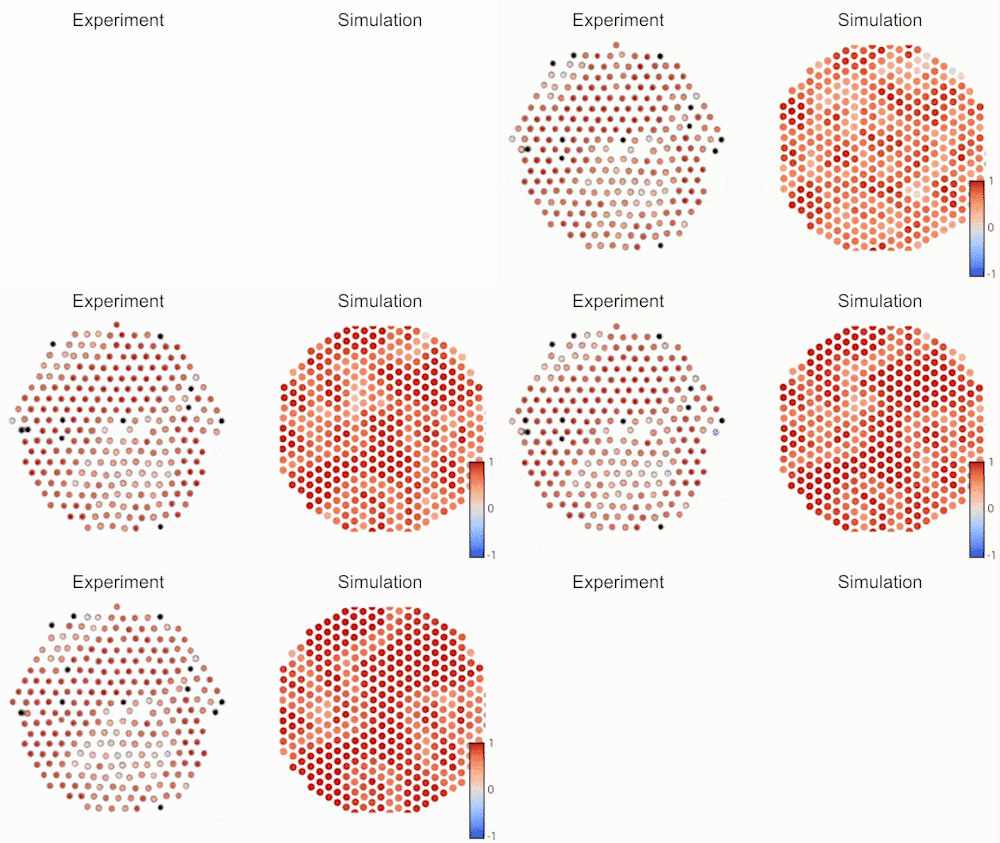
Each particle aims to move towards a reference point guided by a laser-based feedback loop, but with a small time-delay which induces an orbiting, oscillatory motion around the reference point. When many of these oscillators interact through hydrodynamic flows in the liquid, they spontaneously synchronize and self-organize into complex patterns. “By tuning a single parameter, we can switch the system from synchronized clusters to rotating or completely dispersed states,” says Veit-Lorenz Heuthe, who performed the experiments.
A particularly striking new observation is the emergence of a rotating swarmalator state. Here, synchronized particles generate tiny circulating flow fields that combine into a collective torque, causing the entire cluster to rotate — even though none of the particles exerts a torque itself. Instead, this rotation originates from phase-dependent lateral hydrodynamic forces between neighbouring particles and gives rise to collective motion closely resembling the vortical clusters observed in some biological systems, such as groups of starfish embryos or bacterial colonies.
Numerical simulations by the Jülich team reproduced these effects and revealed how hydrodynamic coupling leads to synchronization-dependent attractive, repulsive and lateral forces. “Our simulations uncover how fluidic flow fields create feedback between motion and phase — the essence of swarmalator behaviour,” explains Priyanka Iyer, who led the numerical modeling.
“It’s fascinating that such simple systems can mimic the complex collective dynamics of living organisms," adds Clemens Bechinger.
As the particles’ coupling strength and synchronization can be precisely controlled, the system also provides a model for autonomous robotic swarms, where coordination and task-sharing could emerge spontaneously without centralized control. The study establishes a versatile platform for exploring how complex collective behaviour and memory emerge from simple interaction rules — bridging the worlds of biological collectives and synthetic active matter.
Original publication
Veit-Lorenz Heuthe, Priyanka Iyer, Gerhard Gompper, and Clemens Bechinger
Tunable colloidal swarmalators with hydrodynamic coupling
Nature Communications (2025), DOI: 10.1038/s41467-025-66830-5
Contact

Prof. Dr. Gerhard Gompper
Head of Institute Theoretical Physics of Living Matter (IAS-2)
- Institute for Advanced Simulation (IAS)
- Theoretical Physics of Living Matter (IAS-2)
Room R 2009
Media Contact