QSolid Shows What German Quantum Technology Can Achieve
QSolid Shows What German Quantum Technology Can Achieve
23 Oktober 2026
For nearly five years, 26 research institutions, companies and start-ups have joined forces in QSolid to develop a quantum computer using cutting-edge German technology. Now, Germany’s largest national consortium project of its kind to date, coordinated by Forschungszentrum Jülich, takes stock.
From 27 to 29 October, project participants from different parts of Germany will gather in Jülich for the project's closing event to present their results and discuss insights gained from their collaborative work. The achievements range from tested quantum computer prototypes accessible via the cloud to expertise that has already been translated into concrete products and services.
With a total budget over €75 million, the collaborative project has pooled expertise from across Germany and brought together partners from research and industry. By jointly developing a quantum ecosystem, the consortium has given companies early access to this emerging technology and strengthened their technological capabilities and independence.
Initial Project Goals More Than Achieved
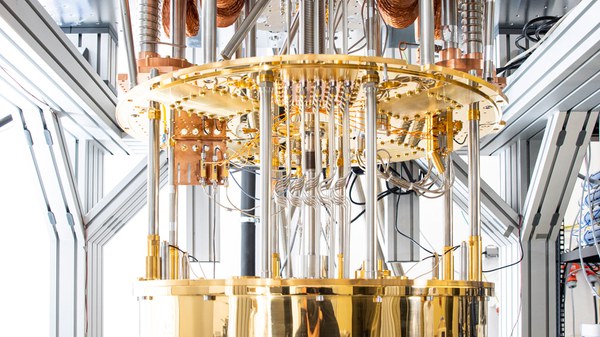
Close-up of quantum computer hardwareCopyright: Forschungszentrum Jülich/Sascha Kreklau
QSolid was launched in early 2022 with the aim of developing a 30-qubit quantum chip with low error rates. With several competitive demonstrators, the project has more than achieved this goal. In addition to a 10-qubit system that has already been tested and made accessible to users, the consortium is currently testing a 30-qubit system, with promising results.
Using demonstration applications, such as the modelling of spin resonance processes employed in chemical analysis and magnetic resonance imaging (MRI), the interaction between hardware and software could be investigated under realistic conditions.
Ultra-Fast Quantum Gate Sets New Benchmarks
One of the project's technological achievements is the development of a particularly fast quantum gate that sets new international benchmarks for switching speed. Quantum gates play a crucial role in quantum computers: they perform computational operations that can change the state of a qubit, thereby forming the basis for information processing in a quantum computer.
"The performance of a quantum computer depends on how many computational steps it can carry out while keeping errors to a minimum. There are two main ways to achieve this: we can either ensure that qubits retain their quantum states for longer or speed up gate operations, allowing more computational steps to be performed in the same amount of time," explains Prof. Frank Wilhelm-Mauch of Forschungszentrum Jülich, who coordinates the large-scale project.
Close-up of a cryostat Copyright: Forschungszentrum Jülich/Sascha Kreklau
"In QSolid, we have made important methodological advances, particularly in gate speed, that extend far beyond the project itself. They demonstrate that we have highly capable components and that the integration of hardware and software has already reached a high level of maturity," says the quantum physicist and Director of the Peter Grünberg Institute for Quantum Computing Analytics (PGI-12).
Successful Collaboration Between Research and Industry
One of QSolid's key achievements has been to bring together expertise previously distributed across numerous locations and partners and channel it into the joint development of a large-scale scientific instrument.
"With QSolid, we have demonstrated that here in Germany we can design, manufacture and operate functional quantum processors from scratch within a short period of time. This is a crucial prerequisite for the further development of the German quantum ecosystem and a major achievement for the highly skilled students, scientists and engineers who made it possible," explains Prof. Rami Barends, Director of the Peter Grünberg Institute for Functional Quantum Systems (PGI-13) at Forschungszentrum Jülich, which was established shortly before the project began.
A professional, collaborative systems engineering approach, building on methods originally developed for the space sector, enabled specialised partners to test their technologies together and successfully combine and further develop them into integrated quantum systems. Alongside Forschungszentrum Jülich, the Leibniz Institute of Photonic Technology (Leibniz-IPHT) in Jena, the CiS Forschungsinstitut für Mikrosensorik in Erfurt, the Karlsruhe Institute of Technology (KIT) and the Physikalisch-Technische Bundesanstalt (PTB) in Braunschweig contributed their expertise.
The software also reflects the close collaboration within the consortium. The software stack of the current demonstrators combines solutions from Zurich Instruments, Qruise, Bull, ParityQC and HQS Quantum Simulations. Innovative hardware components, such as connectors from Rosenberger and cables from Supracon, have also made a significant contribution to improving the performance of the quantum computers.
From the Laboratory to Practical Applications
Dr Marina Walt, Team Lead in Business Development at HQS Quantum Simulations, looks back very positively on the collaboration within QSolid. The company specialises in developing software for the simulation of quantum systems. She emphasises the value of participating in the project for the further development of HQS Quantum Simulations' software portfolio:
"QSolid was a turning point for HQS Quantum Simulations’ work on quantum applications. Our work on nuclear magnetic resonance (NMR) identified a promising route towards demonstrating the value of quantum computing in a real-world application and substantially advanced our understanding of the field. The expertise developed through the project has since led to further innovations, including a product for analysing materials using nuclear magnetic resonance (NMR) that is already delivering value to users. QSolid is a strong example of how application-focused quantum research can translate into concrete industrial impact."
Dr Claudius Riek, Managing Director of Zurich Instruments Germany, sees direct benefits from the project results for the next generation of Zurich Instruments’ quantum control technology:
"QSolid shows what close collaboration between research and industry can achieve. Over five years, we worked side by side with Forschungszentrum Jülich (PGI-13) and our consortium partners to take our quantum control system from the lab into continuous operation on the QSolid demonstrator. The experience we gained in QSolid now feeds directly into the next generation of our control system, built to master the challenge ahead: long-lived logical qubits."
Dr Gregor Oelsner, Head of the Quantum Circuits Research Group at Leibniz-IPHT, also emphasises the potential to make use of the project results beyond its conclusion:
"In QSolid, we researched and developed fabrication processes for superconducting qubit circuits. Our aim was to enable reproducible manufacturing at wafer scale. We are currently characterising the necessary processes and statistically analysing the results. This allows us to demonstrate their reproducibility and yield as well as to complete the process descriptions. With the successful completion of QSolid, we will then be able to incorporate these processes into the FLUXONICS Foundry's service portfolio as planned. Integrating them into the foundry service will ensure that the project results remain available and can be put to practical use in the long term."
QSolid key data
Acronym QSolid
Title Quantum Computer in the Solid State
Project duration January 2022 - December 2026
Partners Forschungszentrum Jülich, Fraunhofer IZM und IPMS, Karlsruhe Institute for Technology, Leibniz IPHT, ParityQC, HQS Quantum Simulations, Rosenberger, Ulm University, Physikalisch-Technische Bundesanstalt, Qruise, University of Stuttgart, Freie Universität Berlin, IQM, University of Konstanz, University of Cologne, Heinrich-Heine University Düsseldorf, Supracon, ParTec, Racyics, AdMOS, LPKF Laser & Electronics, MKS Atotech, Bull / Eviden, Globalfoundries, CiS Forschungsinstitut für Mikrosensorik, Zurich Instruments
BMFTR framework programme: “Quantum technologies – from basic research to market”
The QSolid project is part of the framework programme entitled “Quantum technologies – from basic research to market”. Coordinated by the Federal Ministry of Research Technology and Space (BMFTR), the programme combines the goals of the German Federal Government in relation to the development of quantum technologies:
1. Developing the quantum technology research landscape 2. Creating research networks for new applications 3. Establishing industrial competitiveness through lighthouse projects 4. Ensuring security and technical sovereignty 5. Shaping international collaboration 6. Getting Germany’s population involved