
Quantum Technology
Quantum computers are changing computing in a fascinating way. At Jülich, we are testing systems and prototypes that users from all over Europe can utilize for their development work.
23 October 2026
Researchers from Jülich, Aachen and Cologne have performed a quantum operation on a qubit in just 6.8 nanoseconds – with more than 99.98 percent accuracy. Such operations typically take several tens of nanoseconds in superconducting quantum computers. The paper was published in Nature Communications.
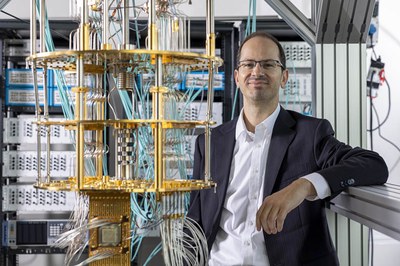
6.8 nanoseconds – that's how long it takes light to travel a distance of around two metres in a vacuum. In this tiny fraction of a second, researchers in the Peter Grünberg Institute for Functional Quantum Systems (PGI-13) and Quantum Control (PGI-8) at Forschungszentrum Jülich have succeeded in performing elementary computing operations on a quantum bit, or qubit for short.

Switching speed is a critical factor in quantum computing. This is because qubits are sensitive and retain their quantum states for only a limited time. The faster individual operations can be performed, the more can fit into this time window. This is important for complex algorithms and for resource-intensive error correction.
However, the shorter the microwave pulses used to switch qubits, the stronger they must be. This increases the risk of unwanted excitation. This is because superconducting qubits possess more than the two energy states used for computation. If they are excited too strongly, they can unintentionally transition to higher energy levels.
To put it simply, you can think of it like a lift in a tall building, meant to carry its load only between the ground floor and the first floor. Raise the load too briskly and it can overshoot. The team found that strong, rapid microwave pulses can not only push information one floor beyond its intended destination but also set it two or three floors higher through so-called multiphoton transitions – an effect that had previously been overlooked. Such multiphoton transitions in qubits are particularly treacherous: They can persist across multiple computational steps and impair quantum error correction.
In close collaboration between the experimental group of Yuan Gao and Prof. Rami Barends (PGI-13) and the theoretical group of José da Costa Jesus, Dr. Francisco Cárdenas-López und Prof. Felix Motzoi (PGI-8) , the team has therefore developed a method that specifically suppresses such transitions. To achieve this, the control pulses are shaped with exceptional precision. Similar to a frequency filter, certain frequency components are suppressed. Consequently, the pulses continue to trigger the desired computational operation while barely exciting any transitions to higher energy states.

The new method, called R2D, builds on the established DRAG method, the correction technique that has been standard practice for more than a decade, for controlling qubits. Compared to the previous standard method, the new method reduces the probability of unwanted multiphoton transitions by a factor of more than 20.
These results were obtained as part of the large-scale collaborative project QSOLID. The method was tested on a single superconducting transmon qubit fabricated at the Helmholtz Nano Facility at Forschungszentrum Jülich.
Two fundamental quantum operations were performed using microwave pulses, each lasting only 6.8 nanoseconds. The respective measured accuracies were 99.981% and 99.989%. The probability of the qubit unintentionally transitioning to a higher energy state remained below 0.002% per operation.
However, so far the method has only been tested on a single, isolated qubit. Further experiments are needed to determine whether it works just as well in larger quantum processors and during operations involving two qubits.
The results not only set a new benchmark for quantum gates but also deepen our understanding and provide valuable insights for further improvements to the quantum system. After all, the work has demonstrated that extremely short switching times and high precision can be achieved simultaneously.
Original paper: https://www.nature.com/articles/s41467-026-78373-4 Gao, Y., Galicia, A., Da Costa Jesus, J.D. et al. Ultrafast single-qubit gates through multi-photon transition removal. Nat Commun 17, 10874 (2026). https://doi.org/10.1038/s41467-026-78373-4