

Go to Online-effzett for the latest topics and background information
Cool prospects for transistors
Computer chips generate a lot of heat and require a lot of energy for cooling. Electronics that operate at very low temperatures could reduce power consumption by up to 80 %. Prof. Qing-Tai Zhao explains how in this interview.
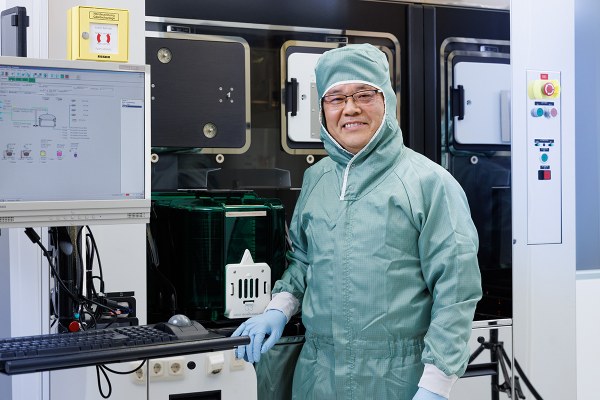
Prof. Zhao, what are the advantages of very low temperatures?
At temperatures of -196 °C or even colder, computer chips could not only run faster but also be much more energy-efficient – if they are properly adapted. Cryogenic computing isn’t just relevant for quantum computers or medical imaging; conventional computer chips could also benefit from intensive cooling.
What does that look like in practice?
A large share of a computer’s power consumption comes from transistors. These tiny switches require a certain voltage to toggle between on and off. This voltage decreases as the temperature drops. Near absolute zero, only a few millivolts would theoretically be needed instead of about 1 volt at room temperature. Less voltage means less energy and heat. Studies show that this could lead to power savings of up to 80 % – including the energy required for liquid nitrogen or helium cooling. However, today’s computer chips can’t simply be run at such low temperatures.
Why not?
This is due to physical phenomena such as band tail effects and source–drain tunnelling. These cause transistors to fail to switch off properly in extreme cold, allowing unwanted current leakage, or they reduce a transistor’s switching efficiency. In the end, the targeted energy efficiency cannot be achieved.
How can this be prevented?
We need different materials – for instance, semiconductors with a smaller bandgap that allow switching at lower voltages. Together with colleagues from Aachen, Switzerland, Taiwan, and Japan, as well as the Taiwanese chip manufacturer TSMC, we have investigated technologies that, when combined, could enable a kind of “super transistor for the cold.” For example, we were able to optimize the surfaces and interfaces within the transistor and achieve particularly precise control and a suitable control voltage.
What is your conclusion?
Cryogenic devices are feasible. Our results show that various approaches should be combined – from high-k dielectrics and wrap-gate architectures to back-gating. However, further research is still needed.
This text is taken from the 2/25 issue of effzett. Interview: Tobias Schlößer
Never miss an issue of effzett again


Last Modified: 05.01.2026