

Download latest issue and all issues in the archive as a PDF
Magnetic resonance imaging

MRI (magnetic resonance imaging) allows us to see inside the body. It is particularly suitable for tissue with a high water content, such as the heart and the brain, and can detect inflammation or tumours in these areas.
How it works ...
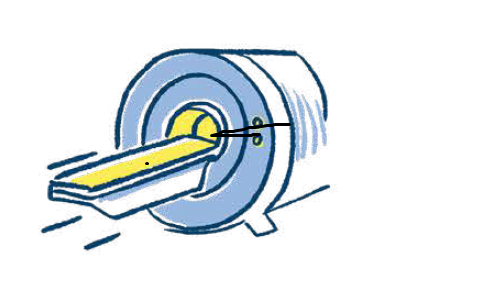
MRI machines are usually large, tube-shaped scanners. Electrical coils in the walls generate one very strong magnetic field and several smaller ones.

The strong magnetic field causes the nuclei of the hydrogen atoms in the body to align in the same direction – similar to compass needles.

Radio waves briefly disrupt this alignment. As the nuclei realign, they emit electromagnetic signals.

From the signals, a computer generates individual cross-sections step by step. These are then assembled to form a three-dimensional image of the body’s interior.

Observing the brain
It is not only structures that can be captured. Functional MRI measures changes in blood flow within brain tissue. This reveals which regions are currently active and to what extent.
Why so noisy?
MRI machines make a lot of noise. The knocking and hammering sounds come from the rapid switching and superimposition of the magnetic fields. This causes coils and plastic parts to vibrate.
What is Jülich doing?
Jülich researchers use MRI primarily to study brain structure and function as well as plants. They also develop new methods and techniques.
This text is published in the effzett issue 2-25. Illustrations: SeitenPlan
Never miss an issue of effzett again

More Knowing it all
Loading
Last Modified: 02.02.2026