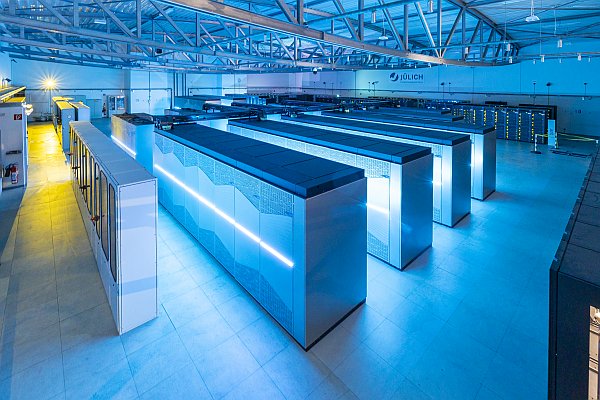


Supercomputer
JUPITER – The New Dimension of Computing
With more than a quintillion floating-point operations per second, Jülich’s latest supercomputer enables groundbreaking insights into the major topics of the future.
24 June 2026
JUPITER at Forschungszentrum Jülich remains one of the world’s most powerful supercomputers. In the latest TOP500 list of the fastest computers JUPITER ranks fifth worldwide. It is also the most energy-efficient computer in the exascale class.

According to the latest TOP500 list, which was published ISC High Performance 2026 in Hamburg, JUPITER requires less energy per computational operation than the new number one on the list, the Chinese supercomputer LineShine.
JUPITER was developed by the Jülich Supercomputing Centre (JSC) together with the EuroHPC Joint Undertaking (EuroHPC JU) and procured by EuroHPC. It enables scientific simulations and AI applications on a scale that has not previously been available in Europe, thereby strengthening Europe’s digital and scientific sovereignty.
Operated by the Jülich Supercomputing Centre (JSC), the supercomputer reached a historic milestone in November last year when it became the first European supercomputer to officially surpass the exascale threshold. With a computing performance of 1 ExaFLOP/s at 64-bit precision, JUPITER can perform one quintillion – a “1” followed by 18 zeros – computing operations per second. For 8-bit calculations with lower precision, such as those used in training large AI models, its theoretical performance even exceeds 40 ExaFLOP/s.
With JUPITER, Europe can for the first time train the largest AI models and carry out scientific simulations in climate, energy, medical, and materials research with unprecedented complexity and level of detail. Thanks to the enormous computing power of the exascale system, it is possible to forecast extreme weather events such as heavy rainfall or heatwaves at significantly higher spatial resolution, advance the development of sustainable energy systems, and better understand complex biological processes – for example in proteins, cells, or the brain – as a basis for new therapies.
More than 120 national and international projects have already applied for computing time for applications on JUPITER. Notable examples include the new record for the simulation of a 50-qubit quantum computer set by researchers at Jülich, climate simulations of the entire Earth system with a resolution of approximately 1 kilometer and the new Jülich foundation model CytoNet for analyzing the microarchitecture of the brain.
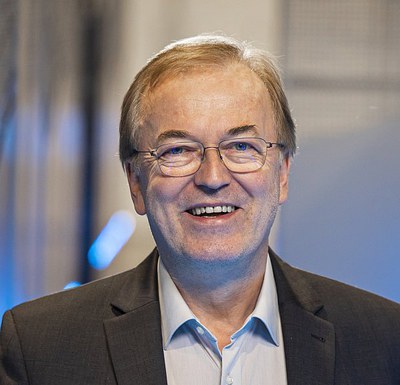
Director of Jülich Supercomputing Centre Speaker of Helmholtz Information Program 1 PI in Topics 1 and 2 & Joint Lab SMHB

Director of Jülich Supercomputing Centre Head of the division HPC for Quantum Systems Head of the Jülich UNified Infrastructure for Quantum computing (JUNIQ) Speaker of Helmholtz Information Program 1 – Topic 1 PI in Topics 1 and 2

Head of Division HPC, Cloud and Data Systems and Services PI in Helmholtz Information Program 1, Topic 2

Public Relations & Science Communication Officer