Rising carbon dioxide concentrations not only alter wheat’s growth and yield but also the composition of its proteins. A field study conducted in collaboration with researchers from Forschungszentrum Jülich shows that under elevated CO₂ levels, the amount of key gluten proteins decreased - as did baking quality. At the same time, the content of certain amylase trypsin inhibitors (ATI), these are proteins which may play a role in wheat-related diseases, increased. However, the extent to which the wheat changes depends largely on the variety.
The concentration of CO₂ in the atmosphere is rising. The consequences for wheat extend beyond growth and yield: the composition of the grain may also change. A field study conducted with the participation of Forschungszentrum Jülich shows exactly how.Copyright: Lukas Tennie/Unsplash
Climate Change Affects Bread
Whether bread rises well, whether dough is elastic, or how certain wheat proteins affect the human body is determined right at the grain level. But the grain’s composition is not fixed: the atmosphere in which the plant grows also influences which proteins the wheat produces.
A research team therefore cultivated ten winter wheat varieties under realistic field conditions at different CO₂ concentrations. With the help of BreedFace, a facility that allows growing plants under elevated CO₂ levels, the plants were cultivated either at an average of 450 ppm CO₂ or at an elevated level of 546 ppm — a value on the order of future atmospheric concentrations. Unlike in a greenhouse, the wheat grows under normal field conditions.
Fewer Gluten Proteins, Smaller Loaves
The results show a significant shift in protein composition. The total protein content of the grains decreased by an average of 4.7 % under elevated CO₂ levels. The effect was even more pronounced for the gluten proteins studied: their total amount was, on average, 18.7 % lower.
This is not merely a molecular finding. Gluten proteins play a key role in determining the properties of dough. In fact, during baking trials, bread volume also decreased by an average of 4.1 %; the so-called sedimentation volume - another indicator of wheat’s baking quality - decreased by 11.7 %. Many of the analyzed gluten proteins correlated directly with these quality characteristics.
The study thus establishes a link between climate changes in the field, changes in individual proteins within the grain, and a characteristic that directly affects consumers: the quality of flour and bread.
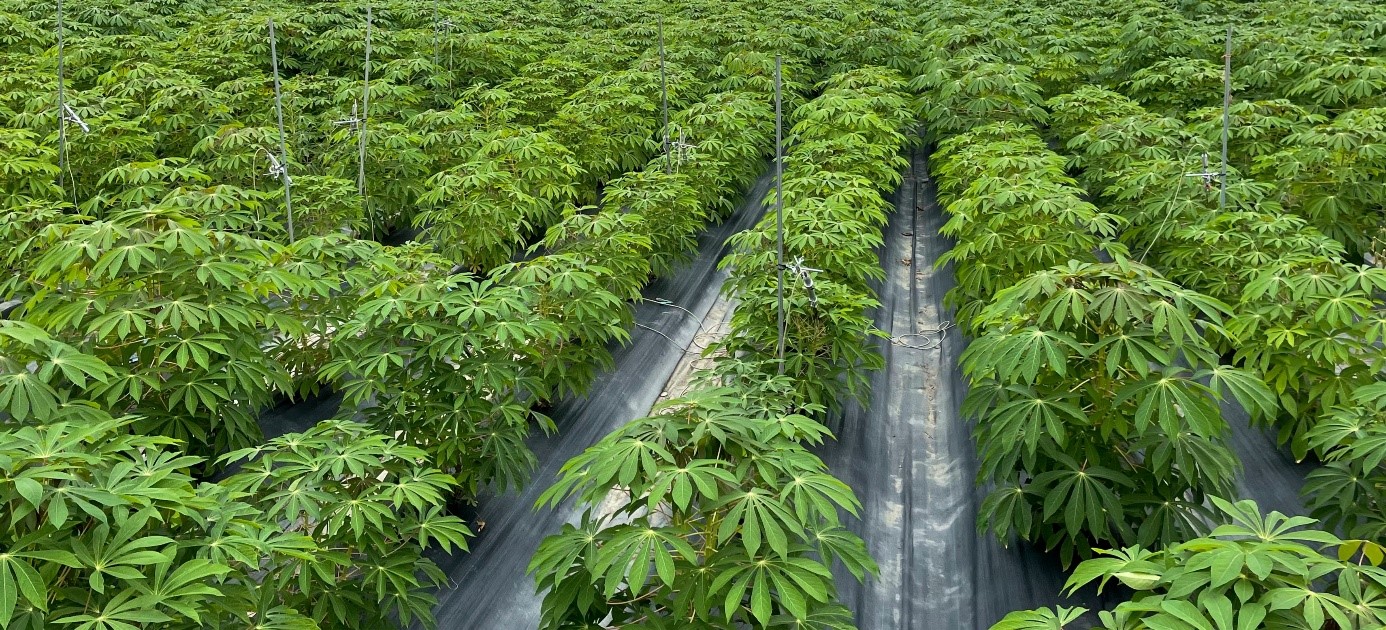
Harvest on a single plot at BreedFACE. This facility enables the cultivation of crops under elevated CO2 levels in the field using Free Air CO2 Enrichment (FACE) technology. BreedFACE is currently located on the Klein-Altendorf campus, the agricultural research station of the University of Bonn.Copyright: Campus Klein-Altendorf / University Bonn
Health-Related Proteins React Differently
It is particularly interesting that not all protein groups followed the same trend. While gluten proteins decreased, the total amount of the amylase and trypsin inhibitors (ATI) examined increased by an average of 5.7 %. ATIs are natural wheat proteins that are studied, among other things, in connection with wheat allergies and non-celiac wheat sensitivity. The researchers examined only a subset of the potentially immunologically active peptides and did not conduct any immunological tests.
The variety could become the key to climate-adapted wheat
One particularly relevant finding concerns the differences among the ten varieties studied. For most proteins, the genotype—that is, the wheat variety—had a greater influence than the CO₂ treatment itself. Some varieties exhibited comparatively stable protein profiles, while others reacted much more strongly to the increased CO₂ concentration.
This highlights an important implication of the study: Agriculture is not necessarily at the mercy of changes caused by rising CO₂ concentrations. The targeted selection and breeding of suitable varieties could help preserve or specifically influence the baking quality, protein content, and health-related properties of wheat even under future climate conditions.
No Prediction Yet for the Wheat of the Future
Nevertheless, the results should not be interpreted as a universally valid prediction. The experiment was conducted at a single location and during a single growing season. Furthermore, only one FACE ring with elevated CO₂ and one control ring were available for each . Further studies at different locations and over several years are therefore necessary.
However, the study makes it clear that the consequences of rising CO₂ concentrations can extend far beyond plant growth and yield. They may also alter the properties of our food—including how well wheat can be processed and which proteins we consume from it.
The infographic shows at a glance how rising CO₂ concentrations alter the protein composition of wheat, affect its baking quality, and why the differences between wheat varieties are socially relevant for breeding and research. >> Download the graphic
Q&A about the Study
How does higher CO₂ affect wheat?
A higher CO₂ concentration alters the protein composition of wheat and increases yield. Higher yields are accompanied by lower protein contents. In the study, the total grain protein content decreased by an average of 4.7 %. At the same time, certain types of proteins increased, while others decreased.
Does higher CO₂ affect the baking quality of wheat?
Yes. Under elevated CO₂ levels, the bread volume was on average 4.1 % lower, and the sedimentation volume decreased by 11.7 %. Both of these measures are important indicators of baking quality.
Does wheat contain less gluten at higher CO₂ levels?
The study shows that the total amount of the 21 gluten proteins examined decreased by an average of 18.7 % under elevated CO₂ levels. However, this does not imply that the total gluten content of wheat generally decreases by this amount.
Does wheat become less healthy as CO₂ levels rise?
This cannot be concluded from the study. The content of amylase and trypsin inhibitors (ATI) increased by an average of 5.7 %. However, the health implications of this increase remain unclear and would need to be investigated in functional and immunological studies.
What do these findings mean for people with celiac disease?
Several gluten peptides known to trigger celiac disease were present in lower quantities under elevated CO₂ levels. However, it cannot be concluded from this that the wheat is better tolerated by people with celiac disease, since only selected peptides were examined and no immunological tests were conducted.
What do the study’s findings mean for future wheat breeding?
The results suggest a need to specifically identify varieties that maintain good baking quality under higher CO₂ concentrations while also having low levels of ATI and celiac-active peptides.
How reliable are the results?
The study was conducted under realistic field conditions, but only at a single location and during a single growing season. Therefore, the authors emphasize that the results should be confirmed at additional locations, over several years, and in independent FACE experiments.
About the Study
The paper “Elevated CO₂ induces cultivar-dependent changes in wheat proteins linked to wheat-related disorders and baking quality“ by Sabrina Geisslitz and colleagues was published in 2026 in the journal *Food Chemistry*. Researchers from the Leibniz Institute for Food Systems Biology at the Technical University of Munich, the Karlsruhe Institute of Technology, the Technical University of Munich, Forschungszentrum Jülich, and the Bavarian State Institute for Agriculture were involved.