
Brilliant concept to combat neutron shortage
An innovative neutron source, designed by Jülich scientists, has been shortlisted for the German federal funding programme for large-scale research infrastructures.
After completing your studies in chemical and bioengineering, you mainly used X-rays in your research. Why are you involved as chairperson of the Research with Neutrons Committee?
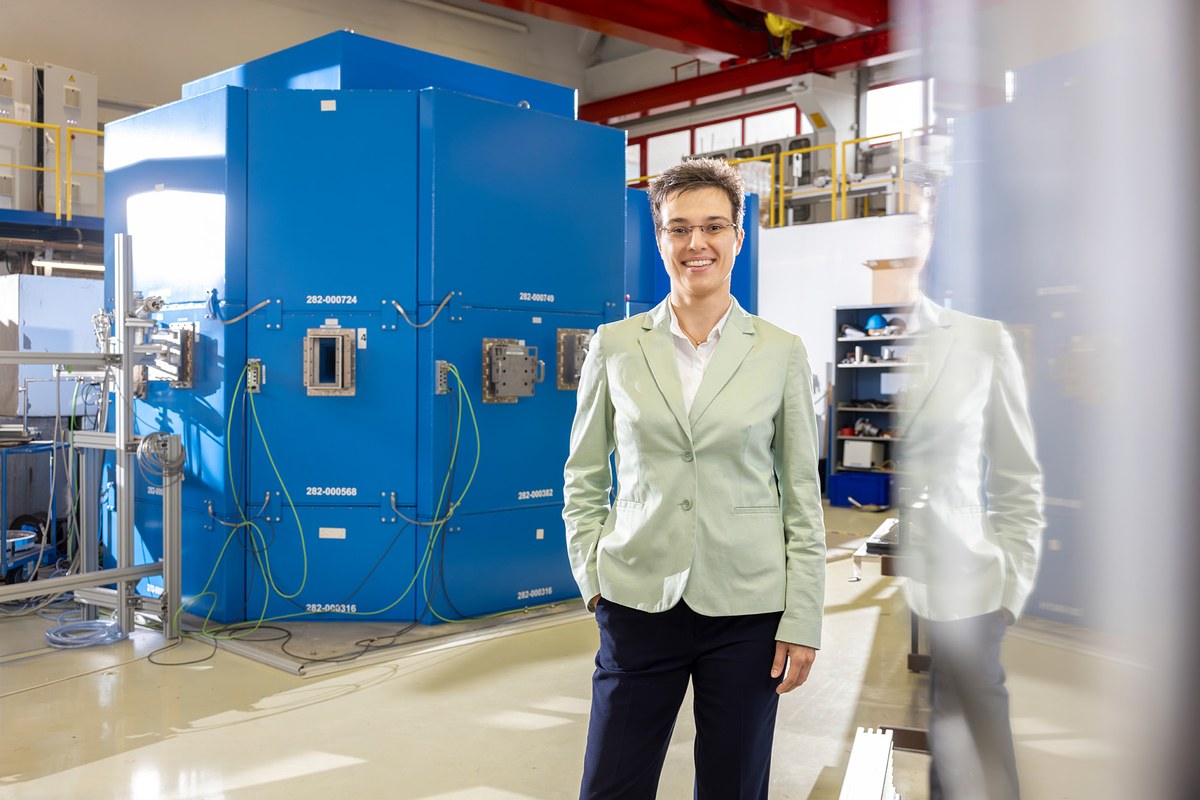
Mirijam Zobel: After completing my doctoral degree, I realized that neutrons offer insights into materials and processes that neither X-rays nor spectroscopic methods can provide. Neutrons are indispensable in many fields – including my research. At RWTH Aachen University, we are investigating how water molecules move on the surfaces of nanoparticles. These movements influence the properties and behaviour of the nanomaterials. We cannot investigate this without neutrons. However, the measurement options are very limited because there are not enough neutron sources. I therefore decided to get actively involved in research policy so that I could do something about this unsatisfactory situation.
At Jülich, you head an institute that uses neutrons for energy research. What special properties of neutrons does your team exploit?
Neutrons are particularly good at revealing light elements such as lithium and hydrogen, as well as their movements. We need them to observe lithium in batteries or hydrogen in fuel cells, for example. With the prospect of a future hydrogen economy, there are many materials that we need neutrons to investigate.
The European Spallation Source (ESS), the world’s most powerful neutron source, is currently being built in Sweden. Can it remedy the neutron shortage?
No. The ESS is a cutting-edge facility for research that cannot be conducted at any other neutron source. Researchers from Germany will have very few opportunities to perform measurements there because they will be competing with scientists from Europe and around the world for the limited measurement time. We need additional national neutron sources to be able to answer the diverse scientific questions raised by science and industry.
You’re not trying to address the neutron shortage by building conventional sources, but instead are focusing on the innovative High Brilliance neutron Source I (HBS-I). Why is this?
At HBS-I, a particularly large proportion of the neutrons generated can be used for experiments. This enables a compact design and comparatively low investment and operating costs. Unlike research reactors, HBS-I does not require nuclear fuel, which also makes access to the measuring instruments easier – an important advantage for industry in particular. Due to the modular design of HBS-I, individual parts can be replaced during maintenance and repair work without long interruptions. In addition, its particularly narrow neutron beam allows even very small sample quantities to be examined.
This text is taken from the 2/25 issue of effzett. Interview: Frank Frick