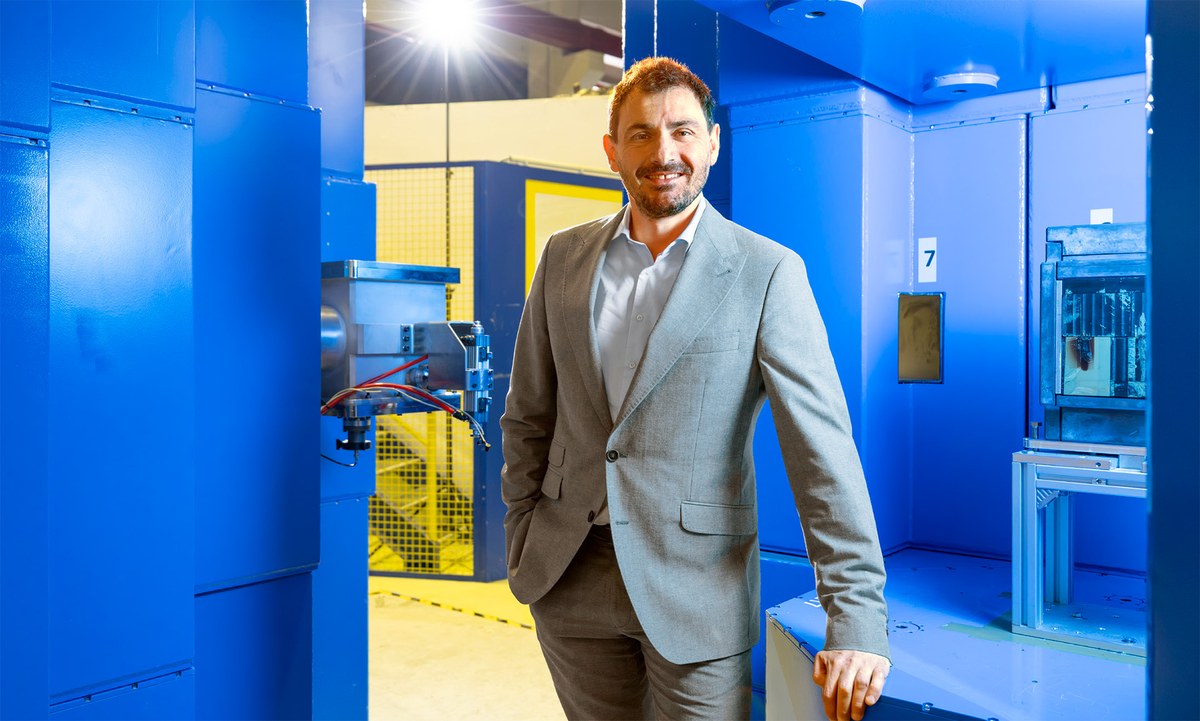
Why Prof. Mirijam Zobel is campaigning for a new type of neutron source
Mirijam Zobel heads the Jülich Centre for Neutron Science (JCNS-3), which uses neutrons for energy research. She is focusing on the innovative High Brilliance Neutron Source.
An innovative neutron source, designed by Jülich scientists, has been shortlisted for the German federal funding programme for large-scale research infrastructures.
They reveal where atoms, molecules, and internal magnetic fields are located and how they move. We’re talking, of course, about neutrons – tiny particles that originate from atomic nuclei and penetrate deep into the micro- and nanoworld of matter. As tiny probes, they provide important information for adapting material properties to a wide range of requirements and developing new substances. For example, they help to develop batteries and hydrogen storage systems for the transition to a climate-neutral economy, or drugs for the treatment of cancer or Alzheimer’s disease.
To release neutrons, the strong force that holds neutrons and protons together in atomic nuclei must be overcome. Until now, this has mainly been done using two methods: fission of atomic nuclei in research reactors or spallation in huge facilities. In spallation, a proton beam travelling at almost the speed of light strikes a block of heavy metal – the target – and knocks out neutrons.
However, the existing large sources are not sufficient to meet the demand for neutron research. “Sometimes researchers from Germany, including those from Jülich, have to fly with their samples to Australia to carry out measurements there because they cannot get measurement time anywhere else,” says Dr. Paul Zakalek from the Jülich Centre for Neutron Science.

Sometimes researchers from Germany have to fly to Australia with their samples to carry out measurements there.
Two dozen smaller facilities worldwide do little to alleviate the neutron shortage. This is because these compact facilities only generate a very weak neutron beam that is insufficient for many research questions. In addition, they are only available to a few researchers from the operating institution.
Jülich scientists are therefore proposing the construction of a novel source of their own design – the High Brilliance neutron Source (HBS). It will be open to universities, research institutions, and industry and will offer five different neutron instruments for measurements in its first expansion stage (HBS-I). Compared to conventional compact facilities, HBS-I allows 10 to 100 times more accelerated protons to strike the target simultaneously. Its beam is particularly bright, earning it the description “brilliant”.
Crucially, Jülich researchers have developed new, more stable targets that can withstand the enormous heat generated when the protons strike. In addition, the new targets only crack slowly when bombarded and do not become brittle as quickly.
“All of the new HBS-I components have already been created and tested as prototypes,” says Zakalek, who is coordinator of the HBS-I project, in which the Helmholtz-Zentrum Hereon is involved alongside Jülich. The inclusion of the HBS-I project on the shortlist for the federal funding programme for large-scale research infrastructures is evidence of the national interest and paves the way for its realization.
This text is taken from the 2/25 issue of effzett. Text Frank Frick